7 Major US Policy Debates That Could Shape Technology and Business in 2027
Divided government means few sweeping laws. But AI rules, power costs, tariffs, chips, taxes, privacy and visas will be fought over in courts, agencies, states and must-pass bills.
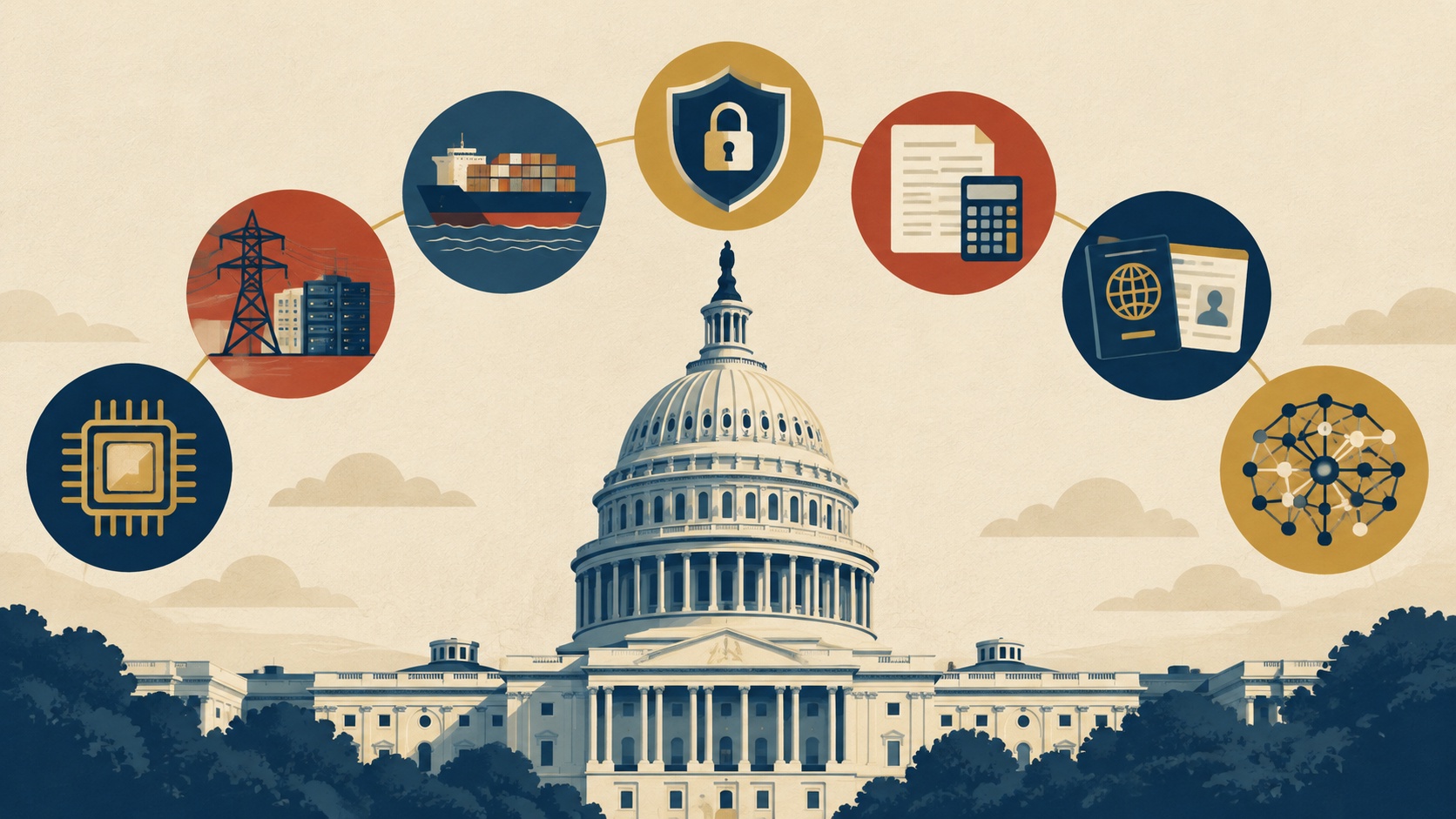
On January 3, 2027, Washington changes shape. Democrats will hold 56 Senate seats to 44 for Republicans, NBC News projects, and a large House majority, with 257 seats to 172 as of November 19, according to the Cook Political Report. President Donald Trump keeps the veto pen and control of the federal agencies.
That split matters for anyone running a business or building technology. Democrats will not have the 60 Senate votes needed to break a filibuster or the two-thirds needed to override a veto, so few standalone bills are likely to become law, the law firm Covington & Burling wrote after the election. What the new majorities will have is control of hearings, subpoenas, must-pass spending and defense bills, and the national conversation. The administration, meanwhile, will keep acting through executive orders, tariffs and agency rules.
The result is a year in which many of the biggest decisions will come from courts, agencies, states and deadline-driven deals rather than sweeping new laws. Below are seven debates that will shape technology and business in 2027, what is already decided, what is still open, and how each side sees it.
At a glance: the seven debates
| Debate | Key date or venue | Who feels it most |
|---|---|---|
| AI rules and state laws | New committees from Jan. 3 | AI developers and companies that use AI |
| Data centers and power bills | House vote on permitting bill; PJM auction Dec. 9-15 | Utilities, ratepayers, data center builders |
| Tariffs and trade | USMCA comments due Jan. 12 | Importers, manufacturers, retailers |
| Chips and China | Chip-rule comments close Jan. 19 | Chipmakers, cloud providers |
| Taxes | Budget talks through 2027; OBBBA cuts expire end of 2028 | Corporations, families, investors |
| Privacy and kids' online safety | State laws start Jan. 1 | Apps, platforms, advertisers |
| High-skilled visas | Appeals in two federal circuits | Tech employers, hospitals, universities |
1. Who writes the rules for artificial intelligence?
What is already in place
Congress has not passed a law that replaces state AI rules. The administration's main tools have been a December 2025 executive order challenging state laws it considers burdensome and a National Policy Framework released March 20, 2026, which suggests states can regulate AI in public services and enforce consumer protection laws but should not hold developers liable for others' misuse of their models.
Where the debate goes in 2027
The president has argued that "there must be only One Rulebook" if the U.S. is to lead in AI, StateScoop reported. Covington expects Democratic majorities, and perhaps some Republicans, to refuse to override state laws unless enforceable federal standards replace them, and to focus instead on safety testing, transparency and incident reporting for the most powerful models.
Some of that groundwork is bipartisan. The FRONTIER Act, introduced in July by Reps. Jay Obernolte, a California Republican, and Lori Trahan, a Massachusetts Democrat, would create federal oversight of frontier AI with independent evaluations of large developers, BakerHostetler notes. Further left, Rep. Pramila Jayapal has proposed a federal charter for AI companies modeled on bank regulation, Al Jazeera reported.
What it means for business
BakerHostetler's advice is blunt: companies should prepare for overlapping federal oversight, state regulation, enforcement and private lawsuits "rather than presume that a single national framework will emerge." In practice, that means state compliance work continues, and companies that make public claims about AI safety should be able to back them up if a committee asks.
2. Data centers, power lines and the electric bill
The bill on the table
On November 19 the Senate passed the Bipartisan American Affordability and Jobs Act 62-33, with 14 Democrats joining Republicans, the Washington Post reported. The bill narrows and speeds federal environmental reviews for energy, transmission, housing and transportation projects, and it requires data centers to pay for their own grid upgrades. The White House says it will put at least $1,300 a year back in Americans' pockets, a projection the president cited without detailing the math.
The split in the House
Speaker Mike Johnson plans to bring the bill up after Thanksgiving under a fast-track process that needs a two-thirds vote, Heatmap reported. House Democrats are divided. Rep. Scott Peters of California called it "very responsive to what the country needs right now," while Rep. Jared Huffman, also of California, argues it guts environmental protections and wants a better deal in the next Congress. If it does not pass both chambers in identical form by January 3, it must start over.
Why households will notice
The broader fight is over who pays for the AI build-out. Consumer advocates in seven states have asked PJM, the grid operator for 67 million people, to delay its December 9-15 capacity auction, citing a market monitor estimate that data center forecasts could add $5 billion to $10 billion in costs, Utility Dive reported. Covington expects Democratic committees to treat data centers as a cost-of-living issue, with hearings on energy and water use and on local tax incentive deals. The president, by contrast, has urged Americans to embrace data centers in their communities. For more background, see our look at the hidden costs of America's AI boom.
3. Tariffs and the future of North American trade
A new legal foundation
On February 20, 2026, the Supreme Court ruled 6-3 that the president could not impose tariffs under the International Emergency Economic Powers Act. The administration then imposed a temporary 10% global tariff, which expired July 24, and has since relied on Section 301 and Section 232 trade laws, including tariffs of 10% or 12.5% on goods from 60 economies, according to a Congressional Research Service fact sheet. Unlike emergency tariffs, those laws require an investigation first.
The debate
Supporters say the tariffs protect American industry and give negotiators leverage. Critics argue they raise prices. Covington expects Democrats to frame tariffs as an affordability issue and possibly push to require congressional approval of new Section 232 tariffs, building on earlier bipartisan proposals, while scrutinizing how exemptions are granted. Any such bill would face a likely veto.
USMCA is the deadline to watch
On July 1, 2026, the United States declined to extend the U.S.-Mexico-Canada Agreement for another 16 years, triggering annual reviews, White & Case explained. The agreement remains in force. The Trade Representative's office is taking public comments until January 12, 2027 ahead of the next review. Canada's Mark Carney and Mexico's Claudia Sheinbaum have pressed for renewal of a pact that underpins nearly $2 trillion in annual trade, Newsweek reported. Other partners are waiting too: India's commerce secretary said a U.S. deal cannot be signed until the new tariff structure is settled, BusinessLine reported.
4. Chips, China and the AI race
New limits on remote access
On November 19 the Commerce Department published a rule on remote access to advanced chips. It requires data center customers in Thailand, Indonesia, Malaysia, Singapore and Brazil to obtain a license to buy advanced U.S. chips because of diversion risk, Al Jazeera reported. Public comments are open until January 19, 2027. China called the restriction "economic coercion."
The debate
Many lawmakers in both parties want tougher rules. Momentum is growing to fold a fourth chip-control bill into the annual defense package, Politico reported. Covington expects Democrats to investigate how export licenses were granted and to keep pushing chip measures through defense bills in 2027. Skeptics question enforcement: Stephen Ezell of the Information Technology and Innovation Foundation told Al Jazeera the new rule will be difficult to enforce. And on November 20 the president said he would put "tremendous penalties" on U.S. companies that build data centers abroad, a statement without a published policy behind it yet.
Costs that reach consumers
AI demand for high-bandwidth memory has diverted chip capacity away from ordinary memory, pushing up prices for laptops, phones and cars, with the shortage expected to continue into 2027, Covington notes. Treasury rules expanding limits on U.S. investment in Chinese AI and other sensitive technology are due around mid-March 2027. Our explainer on the AI chip race covers the background.
5. Taxes: credits, corporate rates and AI investment
What Democrats want
The new majorities want to restore the larger health insurance premium tax credits that expired at the end of 2025 and expand the child tax credit and the earned income tax credit, the Tax Foundation reported. The child credit could rise from $2,200 per child in 2026 to $3,000 or more under some proposals. To pay for it, Democrats have proposed raising the 21% corporate tax rate, revisiting international tax rules and adding surtaxes on millionaires. Some also want to look at how data center and AI investment is taxed.
The counterargument and the constraint
The Tax Foundation, a right-leaning research group, warns that most of the proposed tax increases would discourage saving and investment, and that restoring the 2021 child credit could cost more than $500 billion over a decade. More importantly, the president can veto tax increases. Expect 2027 proposals to serve as negotiating positions ahead of a real deadline: many 2025 tax cuts in the One Big Beautiful Bill Act expire on December 31, 2028. The group has also flagged areas of possible bipartisan agreement, such as housing.
6. Privacy and kids' online safety
States keep moving
There is still no comprehensive federal privacy law. New state laws in Oklahoma and Louisiana take effect January 1, 2027, according to Venable, and California's browser opt-out requirement begins the same day, ArentFox Schiff notes.
Two federal visions
House Republicans introduced the SECURE Data Act in 2026 to broadly override state privacy laws. Democrats could answer with narrower preemption plus a right for individuals to sue, Covington writes, though it expects comprehensive privacy legislation is unlikely to become law with Republicans in the White House. Children's online safety has better odds. The Kids Online Safety Act, sponsored by Sens. Marsha Blackburn, a Republican, and Richard Blumenthal, a Democrat, cleared the Senate Commerce Committee in August, but its lame-duck prospects are fading, Bloomberg Government reported. Researchers at Brookings have argued that children's privacy could become the on-ramp to a national law for everyone. Concerns about online safety and AI chatbots for minors will likely carry into 2027.
7. High-skilled immigration and the H-1B fee
A fight in the courts
In September 2025 the president imposed a $100,000 fee on new H-1B visa petitions, which employers use to hire foreign workers in specialized fields. A federal judge in Massachusetts ruled in June 2026 that the fee was an unlawful tax that only Congress can impose, Roll Call reported. In September a federal court in California vacated the agencies' policies carrying out the fee until they complete formal rulemaking, Envoy Global summarized. The government is appealing in both the First and Ninth Circuits.
The debate
Supporters, including the Federation for American Immigration Reform, argue the president has broad power over entry and that the fee discourages companies from replacing American workers with cheaper labor. The libertarian Cato Institute, in a brief co-written by law professor Ilya Somin, argues that "the Framers gave Congress alone access to the pockets of the people." Whatever the courts decide, the underlying questions about how many skilled workers the U.S. admits and on what terms remain with Congress. For related context, see our guide to green card processing.
Also on the radar
Two more issues could break through in 2027. In antitrust, Google is appealing a federal ruling in the search case, and a separate private ad tech trial in New York was moved to October 25, 2027, MLex reported. Leadership of the Justice Department's antitrust division also remains unsettled, the American Bar Association noted. In crypto, the House chairman of the Financial Services Committee, Rep. French Hill, said the CLARITY Act on market rules is unlikely to advance this session, The Block reported, and some industry experts told CoinDesk the bill is likely dead in its current form.
How businesses can prepare
Law firm Morgan Lewis expects congressional investigations to expand and state enforcement to grow in importance. Five practical steps follow from that.
| Step | Why it matters |
|---|---|
| Map your exposure | Identify which of the seven debates touch your costs, products or workforce |
| Track state laws, not just Washington | AI and privacy rules are still being written in state capitals |
| Use the comment windows | USMCA comments close Jan. 12; chip-rule comments close Jan. 19 |
| Prepare for questions | Public statements on AI, pricing and data should match internal records |
| Plan for more than one outcome | Tariff, visa and tax rules can change through courts or deals with little notice |
The bottom line
Divided government rarely produces sweeping laws, and 2027 is unlikely to be an exception. But it does not mean nothing changes. Courts will rule on tariffs' successors and visa fees, agencies will finalize chip and investment rules, states will keep writing AI and privacy laws, and Congress will use hearings and must-pass bills to push its priorities. For businesses, the safest assumption is continued uncertainty, and the most useful habit is watching the specific dates and venues where these debates will actually be decided.
Frequently asked questions
Will Congress pass major technology laws in 2027?
Some bipartisan measures could pass, often attached to defense or spending bills. Broad laws on AI, privacy or taxes are less likely because Democrats lack 60 Senate votes and the votes to override a veto.
Can Congress cancel the current tariffs?
It can pass a bill, but the president could veto it. Courts have already struck down tariffs imposed under emergency powers; tariffs under Sections 232 and 301 remain in force.
Is USMCA ending?
No. The United States declined to extend it for 16 years, which triggers annual reviews. The agreement stays in force unless a country withdraws or the term ends in 2036.
Is the $100,000 H-1B fee in effect?
Two federal courts have ruled against the fee or the policies carrying it out, and the government has appealed. Employers should check current guidance with immigration counsel before filing.
When do new state privacy laws take effect?
Oklahoma's and Louisiana's laws and California's browser opt-out requirement begin January 1, 2027.
Related reading
See five tech and economic deadlines facing Washington after the midterms, five technology and economic issues to watch, what the midterm results could mean for technology, healthcare and the economy and what November's Microsoft outage revealed about cloud dependence.
Sources and disclosure
Reflects sources available through November 21, 2026. House counts are unofficial and results are not yet certified. Law firm and think tank views are labeled as such; proposals are labeled as proposals, and no outcome is predicted. Prepared with AI assistance and checked against the linked sources; no original interviews are claimed. Pulse Chronicles endorses no party or candidate. The image is an AI-generated illustration.
More from Business

Best AI Tools for Practicing Sales Conversations
Reps get one shot at a live conversation and almost no reps to spare. Here are the AI tools U.S. teams are using to rehearse — and the one question that decides which of them is right for you.

Top AI Tools for Sales Training and Coaching
The AI tools U.S. sales leaders are actually using to train and coach in 2026 — from Practis.ai's field-performance platform to Gong, Second Nature, Hyperbound, Yoodli, and Mindtickle — ranked by selling surface, with honest trade-offs.

Best AI Sales Roleplay Platforms in 2026
A U.S. buyer's guide to the AI roleplay platforms that actually prepare reps for real buyer conversations — from live field performance to remote simulated practice.