After the 2026 US Midterm Elections: Five Technology and Economic Issues to Watch
AI rules, data center power costs, inflation, the chip race with China and digital security will test a divided government. Here is what has happened and what is still undecided.
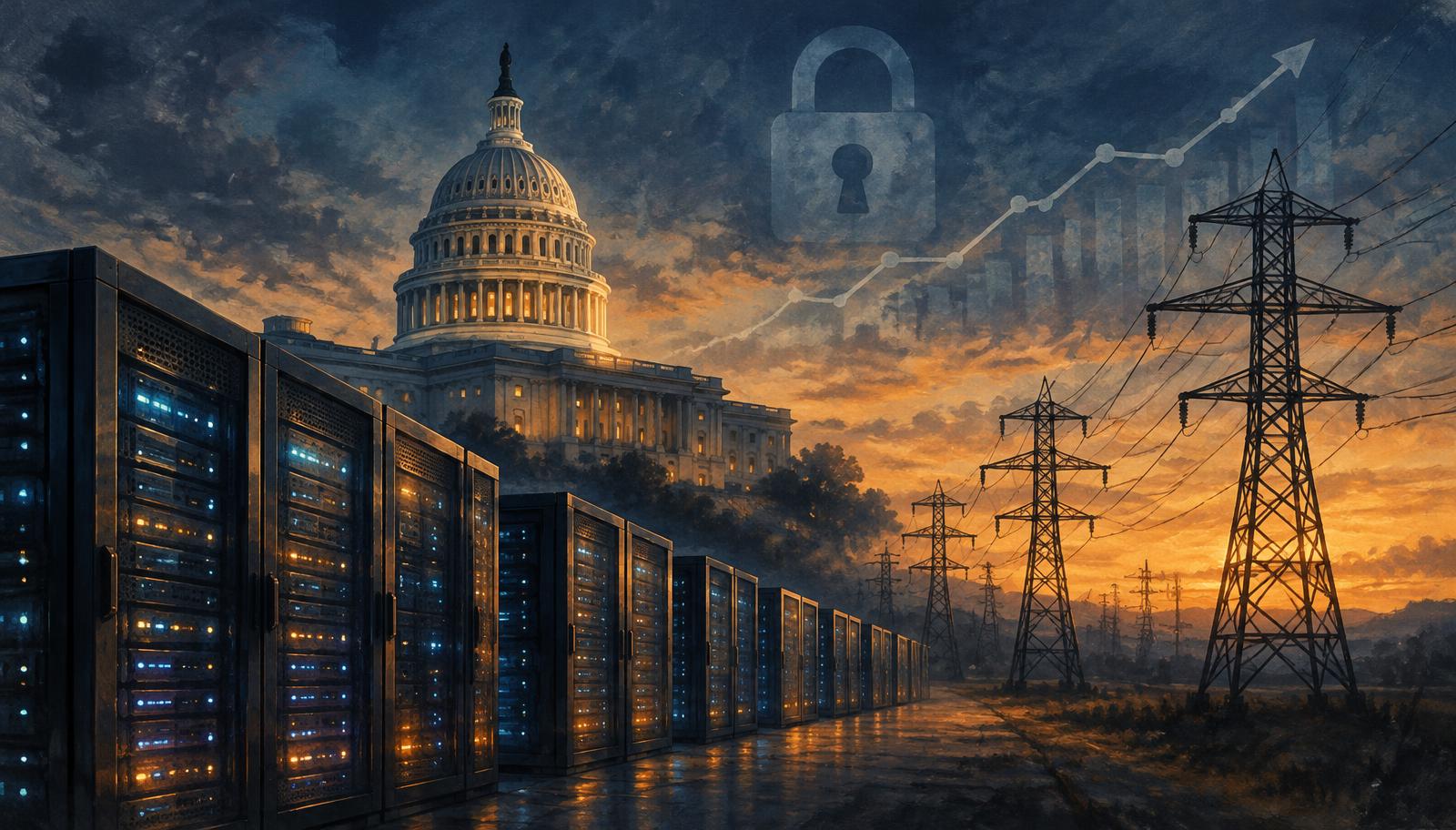
Two weeks after Election Day, the counting is nearly done and the harder work is starting. Democrats will control the House and Senate when the 120th Congress convenes on January 3, 2027. President Donald Trump keeps the veto through January 2029. That split will shape how Washington handles questions that reach almost every household: how AI is governed, who pays for the power data centers use, whether prices cool, how the U.S. competes with China and how well Americans' data is protected.
Below are five of them: what has happened, what each side argues and what remains undecided. This is not a forecast of which bills will pass.
Where the results stand
As of November 17, NBC News projections show Democrats with 55 Senate seats, including independents who caucus with them, to 44 for Republicans, with Alaska's ranked-choice count set for November 18. Democrats also hold a House majority well above the 218 seats needed, with a few contests still open, according to Yahoo News. No result is certified yet.
1. Artificial intelligence regulation
Why it matters
AI now shapes hiring, lending, customer service and health care. Businesses want to know whether they face one national rulebook or a patchwork of state laws. Households want to know who is accountable when an automated system gets something wrong.
Where policy stands
A December 2025 executive order told federal agencies to challenge state AI laws, and the Justice Department formed a task force in January. Congress has not passed a law overriding state rules. States keep legislating; California's frontier-model transparency law, signed in 2025, is already in effect.
The debate
Supporters of stronger rules cite voter concern: in an exit poll of about 100,000 voters, 56% called AI and data centers a crucial or major factor, law firm Faegre Drinker noted. Many Republicans and industry groups counter that heavy or fragmented rules could slow U.S. companies. House Speaker Mike Johnson rejected an AI moratorium in September, saying "China will overlap us," Fox News reported. Democrats have not agreed on which AI harms to tackle first, NBC News found.
2. Data centers, electricity and the grid
Why it matters
Data centers that run AI need enormous amounts of steady power, and the cost of new capacity can show up on ordinary bills. In the PJM grid, which covers 13 states and Washington, D.C., the independent market monitor reported on November 12 that capacity costs rose more than 80% in the first nine months of 2026. It warned that a December auction could add $5 billion to $10 billion more in data-center-related costs, the Pennsylvania Capital-Star reported.
Policy developments
On November 9 the Senate voted 73-25 to begin debate on the Bipartisan American Affordability and Jobs Act, a permitting overhaul that would also make data center developers pay their own way for grid upgrades, CNBC reported. The White House supports it; it has not passed either chamber. Locally, voters sided against the industry in 40 of 41 data center measures on midterm ballots, according to Fortune.
The debate
Concern crosses party lines. Republican Sen. Josh Hawley has called for a nationwide pause on new data centers until households are protected from rate increases, Decrypt reported. Others warn against overcorrecting. Robert Wolf, a former Obama economic adviser, and Stephen Moore, a former Trump adviser, wrote that "America needs more data centers, not fewer," provided companies stop shifting costs onto communities.
3. Inflation, affordability and the economic outlook
Why it matters
Costs dominated the campaign. In the AP Voter Poll, 39% of voters named the economy as their most important issue, the BBC reported.
The latest data
Consumer prices rose 0.4% in October after 0.6% in September, and core prices rose 0.3%, the Bureau of Labor Statistics reported November 10. The bureau could not publish a 12-month rate because the 2025 shutdown halted data collection; in September, prices were up 3.7% from a year earlier. Economists cited the Iran war, AI, tariffs and housing as drivers. The Federal Reserve held rates at 3.75% to 4% in October, and traders now expect an increase at its December 8-9 meeting, CNBC reported.
What Congress can and cannot do
Congress does not set interest rates. Its tools are taxes, spending, energy policy and oversight. Republicans generally argue that more domestic energy, lower taxes and lighter regulation will ease costs; Democrats have emphasized tariffs, health premiums and utility bills. The president holds most tariff authority and can veto limits on it. Government funding expires December 11, before the new Congress arrives.
4. U.S. technology competitiveness and global AI competition
Why it matters
Leadership in chips and AI affects investment, jobs and national security, and it is one of the few areas where both parties often agree on goals.
Latest developments
Nvidia CEO Jensen Huang resigned on November 12 after media reports tied him to an executive of a Singapore company under U.S. investigation for allegedly helping Chinese firms obtain restricted chips, the Center for a New American Security noted. Lawmakers in both parties called for tougher limits. On November 16 the Commerce Department required export licenses for advanced chips sent to Indonesia, Malaysia, Singapore, Thailand and Brazil, aiming to stop Chinese developers from renting U.S. computing power there, Al Jazeera reported.
The debate
Security analysts want Congress to close remote-access loopholes and fund export enforcement. Industry warns that broad rules carry legal and commercial risk; Nvidia told buyers the proposed Remote Access Security Act could expose them to legal action, CNBC reported.
5. Cybersecurity, data privacy and digital security
Why it matters
This month's Microsoft outage showed how one failure can ripple through offices and courts, and China's Salt Typhoon campaign reached major U.S. telecom carriers, according to the Congressional Research Service.
Policy developments
The Cybersecurity Information Sharing Act of 2015, which shields companies from liability when they share threat data with the government, has survived on short-term extensions since lapsing during last year's shutdown. The current one expires December 11, and 35 industry groups have asked Congress to extend it through 2035 in the defense bill, Nextgov reported. There is still no comprehensive federal privacy law. Oklahoma's and Louisiana's laws take effect January 1, 2027, Venable notes, as does a California rule requiring browsers to offer a built-in opt-out signal, according to ArentFox Schiff.
The debate
Businesses generally want one national standard and legal certainty. Consumer advocates and many state officials resist any federal law that would override stronger state protections, a dispute that has stalled past federal privacy bills.
What to watch next
November 18: Alaska's ranked-choice count. December 8-9: the Fed's rate decision. December 11: government funding and cyber information-sharing protections expire. December: PJM's next capacity auction. January 1: new state privacy laws. January 3: the new Congress is sworn in.
The bottom line
The midterms changed who sets Congress's agenda, not who holds executive power. On AI, energy, prices, chips and security, the most likely results are hearings, negotiated deadline deals and state action rather than sweeping new laws. The clearest guide is the calendar and the bills that actually reach the president's desk.
Frequently asked questions
Will the new Congress pass a federal AI law?
Nothing has passed. Any law needs the president's signature or a two-thirds vote in both chambers to override a veto.
Will data centers raise my electric bill?
It depends on your region. PJM's market monitor links data center demand to higher capacity costs; a pending Senate bill would shift more grid costs to large users.
Does the election change interest rates?
No. The Federal Reserve sets rates independently. Its next meeting is December 8-9.
When does the new Congress take office?
January 3, 2027. Until then, the current Republican-led Congress controls the schedule.
Related reading
See our analysis of what the midterm results mean for technology, healthcare and the economy, five political changes after the midterms, the hidden costs of America's AI boom and the AI chip race.
Sources and disclosure
Reflects sources available through November 17, 2026. Seat counts are unofficial and exit-poll figures are estimates. Proposals are labeled as proposals. Prepared with AI assistance and checked against the linked sources; no original interviews are claimed. Pulse Chronicles endorses no party or candidate. The image is an AI-generated illustration.
More from Politics

The AI Safety Hearing No One Was Supposed to Watch
A Tuesday-morning Senate Commerce subcommittee session previewed the regulatory fight of 2027.

The House Budget Stalemate Enters Its Fourth Week
A continuing resolution is the only path that avoids a shutdown, and the Speaker has the votes for neither.
What the Georgia Runoff Actually Decided
Turnout fell off a cliff, but the down-ballot map matters more than the headline.