After the 2026 Midterm Elections: Five Political Changes That Could Shape America's Future
Divided government, an oversight era, leadership fights in both parties, a redrawn Senate map and newly powerful statehouses. Here is what is changing and what is not.
Eight days after Election Day, Washington is still counting ballots, but the shape of the next two years is already visible. Democrats will hold both chambers of Congress when the 120th Congress convenes in January. President Donald Trump keeps the White House, the veto and the federal agencies until January 2029. Both parties spent Tuesday, November 10, reorganizing their leadership, and the arguments inside each party may matter almost as much as the argument between them.
This piece steps back from the daily race calls to look at five political changes that are likely to outlast this news cycle. It is written for readers who want to understand how power is shifting, not for either campaign. It does not endorse a party or candidate, it labels unofficial numbers as unofficial, and it separates what has happened from what leaders say they intend to do.
The short answer
The five changes are: the return of divided government, with the presidential veto at the center of every negotiation; a shift from legislating to investigating, as committee gavels change hands; a leadership shake-up and generational pressure inside both parties; a Senate map that now runs through states long considered safe for Republicans; and a larger role for state governments, where voters delivered a more mixed message than the national wave suggests.
Where the count stands on November 11
Democrats have secured at least 54 Senate seats, including two independents who caucus with them, to 44 for Republicans, with Alaska and Mississippi still uncalled, USA Today reported. According to 270toWin's November 10 summary, Democrats flipped seven Republican-held seats: Iowa, Kansas, Maine, North Carolina, Ohio, South Carolina and Texas. The Alaska contest between Democrat Mary Peltola and Republican Sen. Dan Sullivan will likely be settled by a ranked-choice tabulation on November 18, and Democrat Scott Colom narrowly leads Republican Sen. Cindy Hyde-Smith in Mississippi while counties finish counting.
In the House, ABC News reported a 254 to 166 Democratic margin on Tuesday with 15 races undecided. Tallies differ slightly by outlet and by hour, and two Louisiana seats go to December runoffs. None of these figures is certified. What is not in dispute is the direction: Democrats are on track for one of the largest House majorities of the past three decades, and their first Senate majority since the 118th Congress.
Change 1: Divided government returns, and the veto becomes the main event
For the past two years, one party controlled the House, the Senate and the presidency. That arrangement allowed Republicans to pass the July 2025 tax-and-spending law through budget reconciliation, a process that avoids the Senate filibuster. That path is now closed to the president's party. Any law that reaches his desk in 2027 will need the support of a Democratic majority, and any Democratic bill he opposes faces a veto.
The numbers make the veto decisive. Overriding one requires two thirds of members voting in each chamber, which is 290 House members and 67 senators when everyone votes, as the Congressional Research Service explains. Even an unusually large Democratic majority falls well short of that. The president signaled the day after the election that he understands the leverage: "I'll get along probably with the Democrats, unless they want to be destructive, but I have the power of the veto," he said, according to Reuters.
In practice, divided government tends to move policy toward deadlines. Government funding expires December 11, before the new Congress is seated, and CNBC reported that lawmakers also need to finish the annual defense bill. A short-term extension into early 2027 is widely expected. After that, spending bills and a federal borrowing limit that analysts expect to bind by mid-2027 become the moments when both sides have to bargain. History suggests those deals, not standalone bills, are where most significant laws will come from.
Why it matters to you: expect fewer sweeping laws and more brinkmanship around shutdown and debt deadlines. Policies already on the books, from the 2025 tax law to Medicaid changes scheduled for January 1, continue unless both branches agree to change them.
Change 2: From passing laws to investigating them
The most immediate power a new majority gains is control of committees. Chairs decide which hearings happen, which officials testify and which documents are subpoenaed. Reuters reported that the prospective House Oversight chair, Rep. Robert Garcia, has named Elon Musk's government-efficiency work and Stephen Miller's immigration policy role as likely subjects. Those are stated intentions; no hearing has been scheduled and no findings exist.
Republicans are already organizing around that reality. When House Republicans chose a new leader on Tuesday, Rep. Jim Jordan of Ohio pitched his experience leading the Oversight and Judiciary committees. "I am battle-tested on the oversight front and I know the Democrats' playbook," he wrote to colleagues, NBC News reported. In other words, both parties expect the next two years to be defined in hearing rooms as much as on the House floor.
There are limits. Hearings can change public attention and agency behavior, but they cannot repeal a regulation. The Congressional Review Act, sometimes described as a tool to cancel rules, still requires the president's signature or a veto override, according to CRS. Courts will also referee subpoena fights, which can take months. Oversight is real power, but it is slow and mostly indirect.
Why it matters to you: much of what you hear about Congress in 2027 will come from hearings rather than new laws. Treat allegations raised in hearings as claims to be tested, and watch whether they lead to documented findings, policy changes or court action.
Change 3: A leadership shake-up and generational pressure in both parties
The losing party moved first. Speaker Mike Johnson did not seek to lead House Republicans in the minority, and on November 10 the conference elected Jordan over Majority Leader Steve Scalise by 106 to 73 in a secret ballot, the Associated Press reported via PBS. Jordan, a co-founder of the House Freedom Caucus, said Republicans would offer "more freedom" as an alternative to "more government." The choice reflects a conference that wanted a break from its previous leadership team.
Senate Republicans went the other way. They reelected John Thune, unopposed, as their leader after three tense meetings; Sen. Ron Johnson of Wisconsin had pushed to delay the vote and walked out when it began, according to the AP. Sen. Jim Justice of West Virginia captured the mood, saying there was a "legitimate argument" for asking why the party would keep the same leaders after such losses, while adding that the current team "didn't cause this problem." The Deseret News reported that the rest of the team stays intact except for Sen. Bernie Moreno of Ohio, who will lead the party's Senate campaign committee.
The winning party's fight is unfinished. Sen. Chuck Schumer says he is confident he will be elected majority leader, but on Tuesday Sen. Bernie Sanders said he would not support him and Sen. Elissa Slotkin called for "a new generation of leadership," NBC News reported. Roll Call reported that Sen. Chris Van Hollen of Maryland has been mentioned as a possible challenger. Senate Democrats are expected to vote in the coming weeks, and several senators-elect have declined to commit in advance. On the House side, Democratic Leader Hakeem Jeffries is positioned to become speaker, a vote the full House takes on the first day of the new Congress.
Why it matters to you: leaders control the floor schedule. Who wins these internal contests will shape whether the Democratic majority emphasizes negotiation with the White House or confrontation, and whether House Republicans focus on defending the administration or on building a 2028 platform.
Change 4: A Senate map that now runs through red states
Democrats did not just win the Senate; they won it in unexpected places. Texas, Ohio, Kansas, Iowa and South Carolina are states the president carried comfortably in 2024. If Democrats also win Alaska and Mississippi, Slate noted, they would hold 56 seats, the largest Senate majority for either party since the early Obama years. Mississippi last elected a Democrat to the Senate in 1982, according to 270toWin.
That map changes the internal politics of the majority. Senators who won in states Trump carried answer to electorates very different from those in New York or California. Some campaigned on independence from national party leaders, and several declined to commit to Schumer before the election. A bigger caucus gives Democrats more cushion on party-line votes such as nominations, but it also widens the range of views that leaders must hold together on taxes, energy, immigration and trade.
For Republicans, the losses raise strategic questions about their coalition and candidate recruitment ahead of 2028, when a different and in some ways more favorable Senate class is on the ballot. Both parties are likely to read the 2026 map as evidence that few states are permanently safe, which could increase the number of competitive races in future cycles.
Why it matters to you: if you live in one of these states, your senator may be more willing than usual to break with party leaders on specific votes. Those swing votes often decide close outcomes in a 60-vote Senate.
Change 5: States gain weight, and voters sent mixed signals
The shift reached well below Congress. NBC News reported five governorships flipping to Democrats, in Georgia, Iowa, Texas, Ohio and Nevada. The National Conference of State Legislatures counted 12 legislative chambers flipping from Republican to Democratic control as of November 6, including both chambers in Arizona and the Michigan, Minnesota and Georgia Houses. Governors and legislatures run Medicaid, regulate insurance, draw many election rules and decide where data centers and power lines go.
Yet ballot measures complicate any single story about a mandate. Even in states where Democrats did well, Slate reported, California voters rejected Proposition 40, a proposed 5% wealth tax on billionaires; North Carolina voters capped the state income tax and made property taxes harder to raise; and Iowa voters made income taxes harder to increase. Meanwhile, Vox reported that about 40 local and state measures to slow or stop data centers passed, a sign that the cost and footprint of the AI buildout has become a local political issue.
Exit surveys point in a similar direction. In the AP Voter Poll conducted by SSRS, as summarized by the BBC, 39% of respondents named the economy as the most important issue, ahead of the state of democracy at 33% and immigration at 14%. The tax advisory firm Grant Thornton argued the result "should be viewed less as a strong endorsement of Democrats' policy agenda and more as a repudiation of the U.S. economy." Not everyone reads the results that way, but the combination of a strong Democratic wave and skepticism toward new taxes suggests voters were focused on costs more than ideology.
Why it matters to you: many of the decisions that will touch your household next year, from Medicaid enrollment rules to utility rates and AI-related state laws, will be made in your state capital. Your state results may matter as much as the national ones.
What these changes do not mean
It is easy to overread a wave election. The results do not repeal any law, lift any tariff or cancel any regulation. The president retains broad authority over trade, enforcement priorities, foreign policy and federal agencies. Most Senate legislation still needs 60 votes to advance. Court cases on technology, immigration and executive power continue on their own schedules. And the 120th Congress will not be sworn in until January, so the outgoing Republican-led Congress still controls the December agenda.
Nor do the results settle the 2028 election. Midterm losses for the president's party are historically common, and both parties have seen large midterm gains followed by setbacks two years later. What the 2026 results do establish is a new balance of power for the next two years, with each side holding enough leverage to block the other.
What to watch next
November 18 — Alaska's ranked-choice tabulation is expected to decide its Senate race and possibly its House seat. Mississippi counties continue certifying results.
Late November and December — Senate Democratic leadership elections, House Democratic organizing, and committee assignments for both parties. The December 11 government funding deadline and the defense authorization bill. Louisiana's House runoffs on December 12.
January 1, 2027 — Medicaid work-related requirements from the 2025 law begin, and Medicare's second round of negotiated drug prices takes effect.
January 3, 2027 — the 120th Congress is sworn in and the House elects a speaker. Committee chairs take over and begin setting hearing schedules.
Spring and summer 2027 — full-year spending negotiations, early oversight hearings, the approaching federal debt limit and state legislative sessions in newly flipped chambers.
Related reading
For a policy-by-policy breakdown, read our analysis of what the 2026 midterm results could mean for technology, healthcare and the economy. For the issues that shaped the campaign, see the five major voter issues in the 2026 midterms and our earlier look at the economy and the 2026 midterms. To understand why data centers became a ballot issue, read the hidden costs of America's AI boom.
Sources, timing and editorial disclosure
This analysis reflects reporting and official sources available through the morning of November 11, 2026, including the Associated Press as published by PBS, NBC News, ABC News, USA Today, Roll Call, the Deseret News, Reuters, the BBC, CNBC, Slate, Vox, 270toWin, the National Conference of State Legislatures, the Congressional Research Service and Grant Thornton. Seat counts were unofficial and changing at publication. Exit-poll figures are survey estimates. Stated plans by party leaders are identified as intentions, not outcomes.
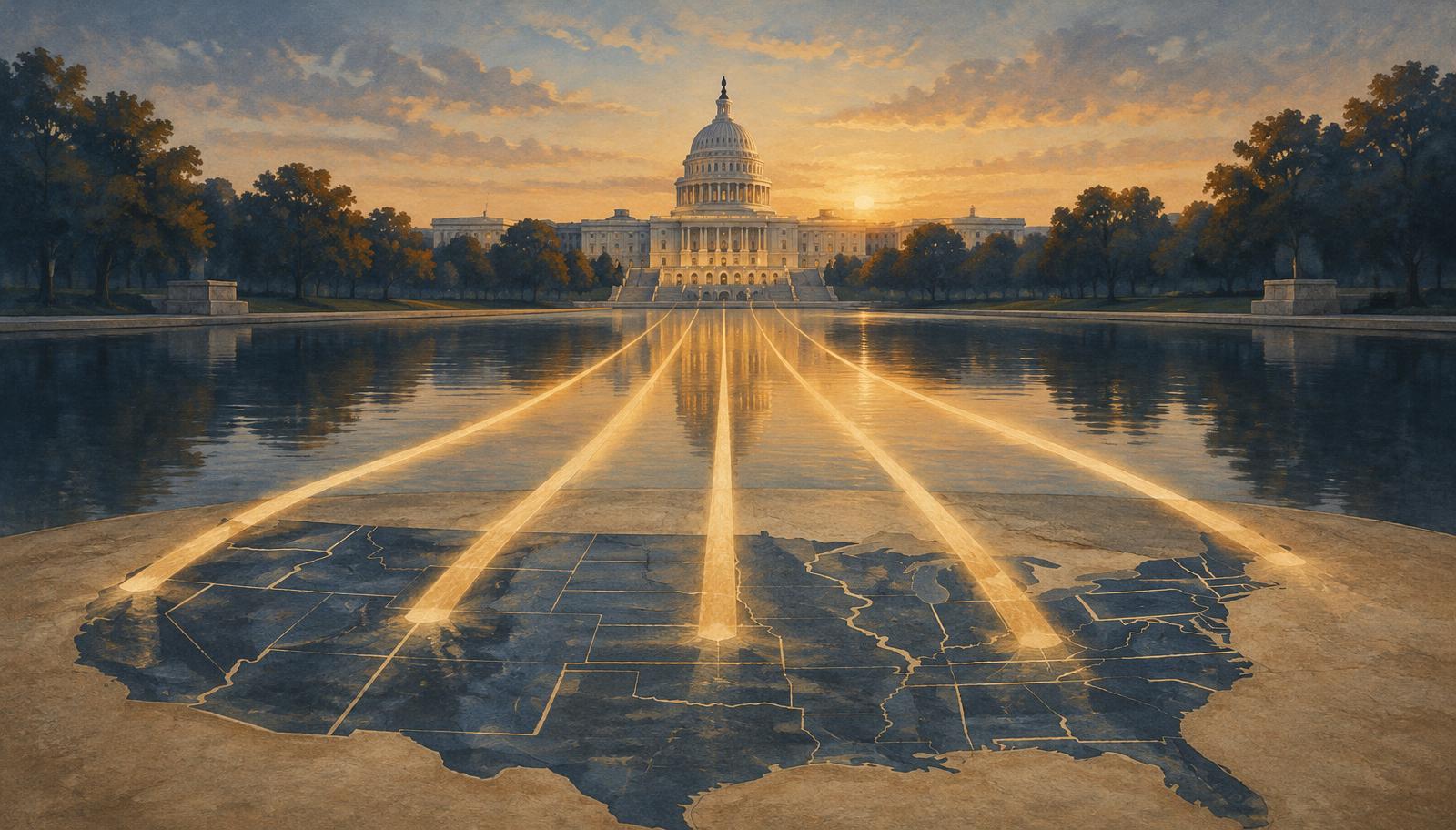
This article was prepared with AI assistance using public sources and reviewed against the linked material. No original interviews or polling are claimed. Pulse Chronicles does not endorse any candidate or party. The accompanying image is an AI-generated symbolic illustration, not a photograph of a documented event.
More from Politics

The AI Safety Hearing No One Was Supposed to Watch
A Tuesday-morning Senate Commerce subcommittee session previewed the regulatory fight of 2027.

The House Budget Stalemate Enters Its Fourth Week
A continuing resolution is the only path that avoids a shutdown, and the Speaker has the votes for neither.
What the Georgia Runoff Actually Decided
Turnout fell off a cliff, but the down-ballot map matters more than the headline.