2026 U.S. Midterm Elections: The Five Major Issues Influencing American Voters
Affordability, healthcare, immigration, political trust and AI policy: a neutral Election Day guide to the evidence, the tradeoffs and what the polls cannot tell us.
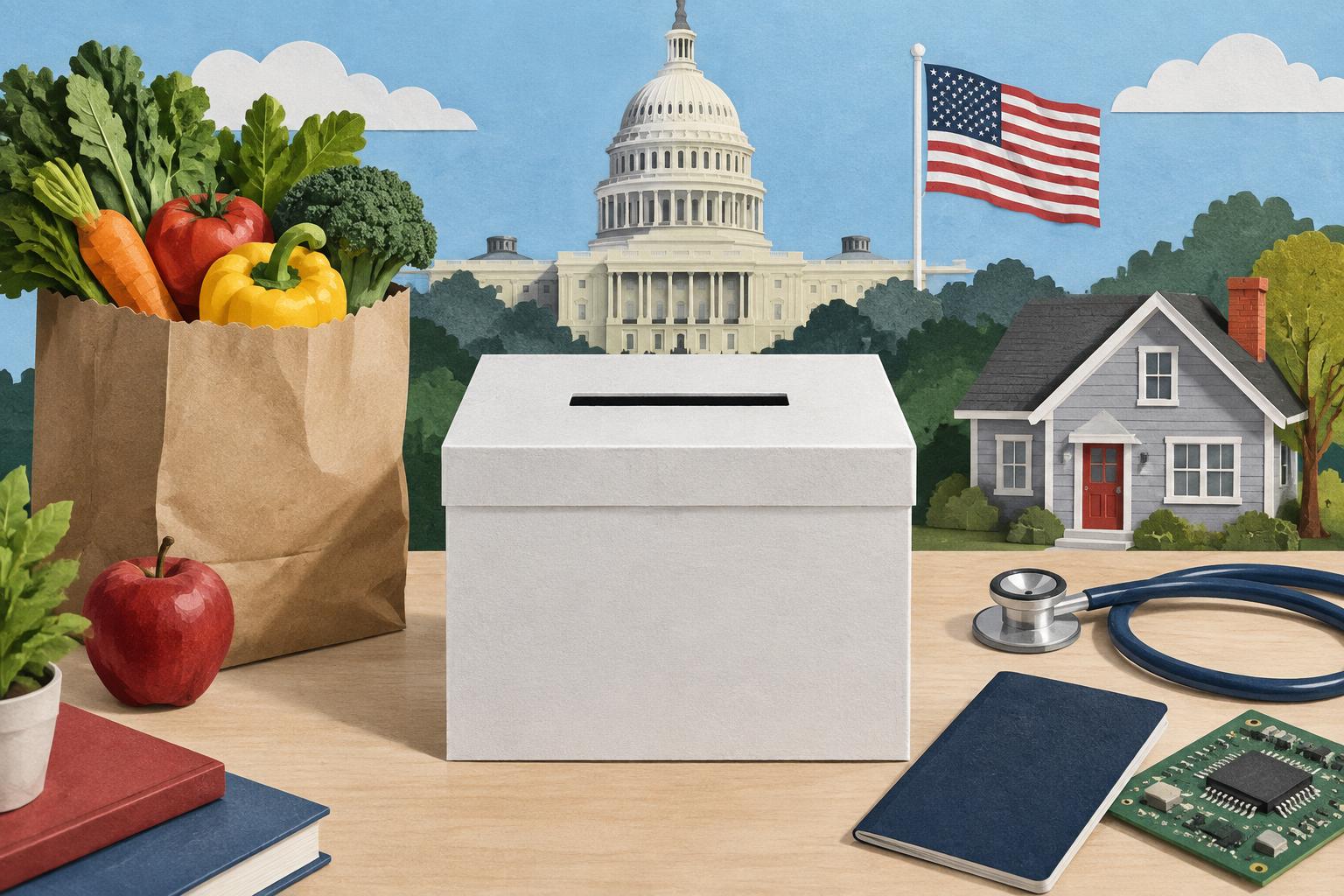
A grocery receipt, an insurance renewal, a debate about the border, a question about whether public officials can be trusted: American elections are experienced through everyday decisions as much as through campaign speeches. Artificial intelligence adds another layer, connecting worries about work, privacy, electricity bills and the credibility of information. The 2026 midterms bring those concerns together, but they do not bring every voter to the same conclusion.
This Election Day analysis, prepared November 3, 2026, examines five major issue areas: affordability, healthcare, immigration, political trust and AI-related policy. They are the focus of this article—not a claim that they are the five highest-ranked issues in every poll. The evidence is strongest for the economy and healthcare as widely shared voting priorities. Political trust overlaps with concerns about democracy, while AI is a cross-cutting policy debate whose independent effect on voting is not established here. This is not a results report, endorsement or forecast.
What the polling establishes—and what it does not
In Pew Research Center’s October 8 report, 84% of registered voters said the economy was very important to their congressional vote. The future of democracy registered 73%, healthcare 68% and immigration 59%. The survey was conducted September 28–October 4, rather than on Election Day. These are answers to a question allowing respondents to rate multiple issues; the percentages do not represent mutually exclusive groups.
The same survey shows why a single national story is insufficient. The economy was very important to 82% of Republican-candidate supporters and 88% of Democratic-candidate supporters. Healthcare showed a wider difference, 53% versus 82%; immigration was 72% versus 53%. These categories refer to supporters of congressional candidates, not necessarily everyone identifying with a party. Agreement that an issue matters does not imply agreement about its cause or solution.
A separate Gallup report published October 29, based on October 1–19 fieldwork, found that 50% of registered voters rated the economy extremely important and 50% said the same about healthcare. Combining extremely and very important produced 87% and 77%, respectively. Gallup’s wording differs from Pew’s: comparing their percentages as though they were a single trend would be misleading. Neither survey explains precisely how many votes any issue will change.
1. Affordability: the distance between economic indicators and household budgets
Affordability is broader than inflation. It is the relationship between what a household earns, what essentials cost and what remains after paying for them. An improving national indicator does not necessarily make rent manageable for a new tenant, restore a family’s savings or reduce the payment on a newly purchased home. Conversely, a difficult household experience is not by itself proof that every part of the national economy is deteriorating.
The Bureau of Labor Statistics’ September 2026 CPI release, issued October 14, reported a 3.7% increase in consumer prices over the preceding 12 months. Prices rose 0.6% during September on a seasonally adjusted basis. Gasoline increased 9.1% that month and accounted for more than half the monthly all-items increase. Over the year, food rose 2.5%, while the index excluding food and energy rose 2.6%. These different measures show why ‘inflation’ should not be reduced to one undifferentiated number.
CPI measures average price changes, not whether a particular family can afford its bills. A decline in the inflation rate means prices are rising more slowly; it does not mean the price level has returned to an earlier year. A household’s own experience also depends on its mix of spending. Someone with a long gasoline commute, someone facing a lease renewal and someone with an expensive medical condition can experience the same national economy differently.
That gap is visible in Pew’s October 14 analysis of basic necessities. In a survey conducted July 20–August 9, 27% of U.S. adults said they could not pay all their monthly bills in a typical month; the share was 49% among lower-income adults. Some 53% of all adults lacked emergency funds sufficient to cover three months of expenses. These are self-reported financial conditions among adults, not vote intentions among likely voters.
Affordability policy: ask who benefits, who pays and how quickly
The policy choices involve mechanisms rather than slogans. Housing-supply measures can address shortages, but their effects depend on construction costs, financing, infrastructure and local approvals. Assistance can provide faster relief to eligible households, but its funding and interaction with limited supply matter. Tax changes alter disposable income differently across households. Trade restrictions may pursue industrial or security objectives, while also changing costs for importers, businesses and consumers. A serious assessment specifies those tradeoffs instead of assuming every advertised benefit is free.
Responsibility is divided. Congress writes tax and spending law; the executive implements policy within legal authority; the Federal Reserve makes monetary-policy decisions; state and local governments influence housing and utility conditions. Candidates can propose changes without controlling every factor affecting a monthly bill. The useful test is whether a proposal identifies a plausible path from the policy to the household benefit, its funding, its likely timing and the people it leaves out.
2. Healthcare: coverage matters, but so does the cost of using it
For healthcare, having an insurance card is not the end of the affordability question. Premiums, deductibles, copayments, provider networks, prescription costs and travel to care all affect whether coverage is usable. A plan with a lower premium may impose greater costs when treatment is needed. A broader network may cost more but make it easier to find a participating specialist. Those distinctions are consequential for voters and easily lost in campaign shorthand.
The latest KFF employer-benefits findings, published October 22, put average annual family premiums for employer-sponsored coverage at $28,303 in 2026, including both employer and worker contributions. Workers contributed $7,471 on average, up $621, or approximately 9%, from 2025. The $28,303 figure is not the amount the typical worker pays directly. These are employer-plan averages, not Medicare costs or the net premiums paid by households buying marketplace coverage.
Medicare illustrates why different types of cost can move in different directions. CMS’s April 2026 Fast Facts lists the standard monthly Part B premium at $202.90, compared with $185 in 2025, and the annual Part B deductible at $283, compared with $257. It also lists the Part D out-of-pocket threshold at $2,100 for 2026. That threshold does not cap all Medicare spending or premiums; higher-income beneficiaries may pay more for Part B. A protection against certain drug expenses can coexist with higher costs elsewhere.
The first negotiated prices for ten Medicare Part D drugs took effect January 1, 2026. In its original announcement, CMS projected $1.5 billion in beneficiary out-of-pocket savings in 2026. That was a projection, not an independently verified total of savings already realized this year. The distinction matters when a campaign presents a forecast as an accomplished result.
Healthcare policy: distinguish lower prices from shifted costs
Healthcare proposals can aim at different problems: the underlying price of treatment, insurance access, patient cost-sharing, drug spending or the availability of providers. A subsidy can reduce an eligible patient’s bill without lowering a hospital’s price. A higher deductible may reduce a premium while increasing exposure when someone becomes ill. Drug negotiation seeks lower spending, while debate also concerns access and incentives for future development. These outcomes need separate evidence rather than a blanket claim that a policy makes care ‘cheaper.’
For voters, concrete questions are more informative than a promise to protect healthcare. Would the proposal change eligibility, covered services or the provider network? What happens to people with chronic conditions? Does it address premiums, out-of-pocket expenses or both? How does it affect rural access? What is the funding source? This article does not infer current marketplace net premiums or the effect of a particular Medicaid proposal from employer-insurance statistics; those require their own plan-specific and legislative evidence.
3. Immigration: enforcement, lawful pathways and public capacity
Immigration combines questions that should be distinguished: border security, asylum processing, lawful entry, work authorization, visa overstays, removal procedures and the situation of people already living in the country. A voter can support tighter screening while also supporting legal migration. Another can favor humanitarian protection while wanting a faster, more predictable adjudication process. Treating those positions as a single all-or-nothing choice obscures the actual policy decisions.
The CBP nationwide encounters dashboard is useful for understanding enforcement activity, but an encounter is an event—not necessarily a unique person. It is not a count of successful unauthorized entries, all immigrants entering the country, the unauthorized resident population or net migration. Nationwide figures include different locations and modes of travel. A southwest-border statistic has a narrower scope. Fiscal year 2026 covers October 1, 2025–September 30, 2026, not the calendar year.
Those boundaries are essential when evaluating a claim that immigration has ‘surged’ or ‘collapsed.’ The comparison needs the same geography, time period and measure, with attention to revisions and enforcement changes. This review did not independently verify a final FY2026 encounter total, so it does not reproduce one. The absence of a number here is a reporting limit, not evidence for either side’s claim about border conditions.
Immigration policy: evaluate both objectives and implementation
Enforcement-focused proposals can seek more effective screening, deterrence or removals. Their implementation raises questions about staffing, detention capacity, cost, legal authority and due process. Proposals expanding lawful pathways or work authorization raise questions about eligibility, processing capacity, labor demand and safeguards. Asylum adjudication requires its own analysis of legal standards and case-processing resources. A policy’s stated objective is not proof that the system can deliver it at the promised scale.
Local effects also need local evidence. Employers’ staffing needs, school enrollment, housing availability and public-service pressures vary by place and population. National encounter data cannot establish the size of a particular city’s service burden or the effect on a particular worker’s wages. A neutral account can recognize public concerns while refusing to substitute anecdotes for representative evidence. It can also discuss humanitarian and due-process obligations without assuming they eliminate legitimate operational questions.
4. Political trust: confidence in institutions and willingness to accept accountability
Political trust is not the same as agreement with a president or satisfaction with one policy. It concerns whether people believe institutions act fairly, explain their decisions and can be held accountable. Voters may worry about corruption, concentrated power, government competence, political violence or the treatment of opponents. Those concerns can lead to different preferences about congressional oversight, executive authority and institutional reform.
The latest historical trust measure verified for this article is older than the current campaign: Pew’s December 4, 2025 report found that 17% trusted the federal government to do what is right just about always or most of the time. The latest observation was labeled September 28, 2025. It was one of the lowest readings in the series, not proof of a unique historical low or an Election Day 2026 trust level.
The October 2026 Pew issue survey supplies more current evidence that institutional concerns matter: 73% of registered voters rated the future of democracy very important to their vote. But ‘future of democracy’ and general trust in government are different questions. They should not be combined into one statistic or treated as direct measures of confidence in local vote counting. Nor does distrust, on its own, identify which candidate a respondent will support.
Neutrality does not require treating every factual claim as equally supported. It requires consistent standards: compare the claim with the record, separate allegations from findings and apply the same evidentiary threshold regardless of party. A proposal for oversight can be evaluated by its scope and enforceability. A promise to reduce corruption can be assessed through disclosure rules, conflicts-of-interest safeguards and accountability mechanisms. Claims that procedures are unfair need specific evidence, not simply repetition.
Election Day is not the same as final certification
The FEC identifies Tuesday, November 3, 2026 as the regularly scheduled federal general-election date. USAGov explains that all 435 House seats and a rotating portion of the Senate are elected in congressional cycles. These elections help determine legislative control; they are not a presidential election. Voting is administered under state and local procedures, rather than by the FEC.
The Election Assistance Commission’s explanation emphasizes that election-night totals are unofficial. Eligible ballot counting, canvassing, applicable audits and certification follow jurisdiction-specific rules and deadlines. Provisional, mail, military and overseas ballots can involve additional processing. A changed total is not, by itself, evidence of wrongdoing; a discrepancy still deserves examination through the relevant process. Media projections are not legal certification, and there is no single nationwide certification deadline for all midterm contests.
5. AI policy: jobs, privacy and the credibility of political information
AI is different from the other four areas in this article. The cited election-priority polling does not establish it as a stand-alone top-five voting issue. Its political relevance often comes through existing concerns: whether jobs will change, whether personal information is secure, whether an automated decision can be challenged and whether a persuasive recording is authentic. Those are material public-policy questions even without evidence that AI has become the decisive issue in a congressional race.
In Pew’s August 18, 2026 analysis, based on June 22–28 fieldwork, 52% of U.S. adults were more concerned than excited about AI in daily life; 9% were more excited. Some 71% expected AI to produce fewer U.S. jobs over the next two decades. That last figure measures expectations, not observed job losses or an economic forecast. It does not establish how respondents intend to vote.
A separate Pew report published June 17, using February 17–23 fieldwork, found that 71% expected increased AI use to make personal information less secure. Some 67% had not too much or no confidence in government’s ability to regulate AI effectively. Concern about companies and skepticism about regulators can coexist. Neither finding, by itself, establishes support for a specific bill or proves that AI has caused a particular privacy breach.
AI policy is not one debate: separate the decisions
On jobs, the choices include worker training, transition support, protections for automated employment decisions and policies intended to encourage productivity and investment. A serious proposal should distinguish task automation from elimination of an entire occupation. It should explain who receives the gains, who bears adjustment costs and what evidence would show that the intervention works. Neither public anxiety nor a company’s productivity claim settles the question of future net employment.
On privacy, the questions include data collection, retention, secondary use, security and the ability to challenge consequential decisions. On regulation, lawmakers must weigh enforceable safeguards and accountability against compliance burdens, barriers for smaller firms and risks of overly broad rules. The relevant standard is not simply ‘more’ or ‘less’ regulation: it is whether a rule addresses a defined harm, identifies responsible parties and offers workable enforcement and remedies.
Political impersonation requires another distinction. The FCC’s February 2024 ruling treats AI-generated voices as artificial voices under existing Telephone Consumer Protection Act restrictions. That is not a blanket prohibition on AI speech; consent requirements, exemptions and the circumstances of a call matter. The FEC’s September 2024 interpretive action explained that specified fraudulent-misrepresentation rules are technology-neutral. It did not create a general federal truth-in-advertising law or comprehensive AI campaign-ad disclosure mandate. State laws and other authorities require separate review.
CISA’s May 2024 generative-AI election guidance described potential amplification of existing risks, alongside possible administrative benefits. That older assessment is background, not evidence of a 2026 incident. A deceptive video, a phishing attempt and a compromise of voting infrastructure are different events requiring different evidence. Before sharing alarming election instructions or an apparent candidate recording, locate the original source and check the relevant election office’s official information. This article does not claim AI has changed an election outcome.
The AI affordability connection: electricity and infrastructure
Data centers connect technology policy to household concerns. Berkeley Lab’s December 2024 energy report estimated that U.S. data centers consumed 176 terawatt-hours in 2023, about 4.4% of U.S. electricity consumption. It projected a range of 325–580 terawatt-hours in 2028. Those figures cover all data centers, not AI alone; the future range is a scenario-based projection, not observed 2026 consumption.
The policy question is partly who pays for additional generation, transmission and grid upgrades. Data-center development may bring investment and computing capacity, while also raising questions about resource use and cost allocation. Local utility tariffs, contracts, regulation and infrastructure conditions determine the household implications. The national energy estimate does not prove that AI caused an increase in a particular customer’s electricity bill. Claims about local costs need the local record.
How the five issues interact—and why voters differ
These concerns are connected without being interchangeable. A higher health-insurance contribution reduces disposable income. Immigration policy can involve employment and public-service capacity. An AI infrastructure proposal can raise electricity questions. Low institutional trust can make a voter doubt that a promised benefit will arrive. But connecting issues analytically is not the same as proving what caused a particular vote.
The relevant mix differs across households and districts. A retiree, a renter, a small-business owner and a worker worried about automation may evaluate the same proposal through different exposures. National averages describe the country; congressional contests are decided within particular constituencies. Turnout, candidates, local conditions and other issues—including education, abortion, foreign policy and public safety—can also matter. A five-issue article should not imply they disappear from the ballot or the voter’s decision.
A neutral test for campaign promises
For each proposal, ask four questions. First, what exactly would change, and which level of government has authority? Second, who benefits, who pays and who is excluded? Third, is the supporting evidence an observed result, a projection, a survey of perceptions or a campaign assertion? Fourth, what would count as success, and on what timetable? Those questions apply to every candidate and do not require agreement about the preferred policy.
Check the date and denominator of any statistic. A survey of adults is not necessarily a survey of registered voters; a registered-voter poll is not a certified result. Employer premiums are not marketplace net premiums. Encounter events are not unique immigrants. Predictions about AI employment are not measured layoffs. The purpose of those distinctions is not to make policy inaccessible, but to prevent a vivid number from answering a question it was never designed to answer.
The bottom line
The strongest current evidence in this review points to broad concern about the economy and healthcare, with substantial attention to democracy and immigration and clear partisan differences in emphasis. AI adds a developing set of questions about work, privacy, information integrity and infrastructure, but the evidence does not justify labeling it a proven top-five electoral driver. Together, the five areas offer a useful way to examine the practical choices facing Americans without predicting how every voter will respond.
The outcome of the 2026 midterms will not, by itself, demonstrate that one explanation accounts for every race. For readers trying to make sense of the campaign and the results that follow, the better approach is to keep household conditions, policy mechanisms, public perceptions and verified electoral outcomes distinct. Evidence-based coverage should explain where they connect—and where the record cannot yet support a conclusion.
Sources, timing and editorial disclosure
Prepared November 3, 2026, using the linked Pew, Gallup, BLS, KFF, CMS, CBP, FCC, FEC, CISA, Berkeley Lab, USAGov and EAC sources. Recent 2026 surveys and releases are distinguished from older background material. Some official-page passages were checked through live search retrieval; dashboards and release pages can change. This is a dated explanatory analysis, not an exhaustive account of every policy proposal or a real-time election feed. No winners, turnout totals or final results are reported.
This article was prepared with AI assistance using public sources. No original interviews, independent human editorial review, original polling or field reporting is claimed. It does not endorse a candidate or party. Projections, public expectations and unverified quantities are labeled rather than presented as established outcomes. The accompanying image is an AI-generated symbolic illustration, not documentary evidence of a voting site, voter or event.
More from Politics

The AI Safety Hearing No One Was Supposed to Watch
A Tuesday-morning Senate Commerce subcommittee session previewed the regulatory fight of 2027.

The House Budget Stalemate Enters Its Fourth Week
A continuing resolution is the only path that avoids a shutdown, and the Speaker has the votes for neither.
What the Georgia Runoff Actually Decided
Turnout fell off a cliff, but the down-ballot map matters more than the headline.