Five Tech and Economic Deadlines Facing Washington After the 2026 Midterms
Democrats take control of Congress on January 3. Before then, outgoing majorities face decisions on power costs, AI rules, chip exports, interest rates and cyber protections.
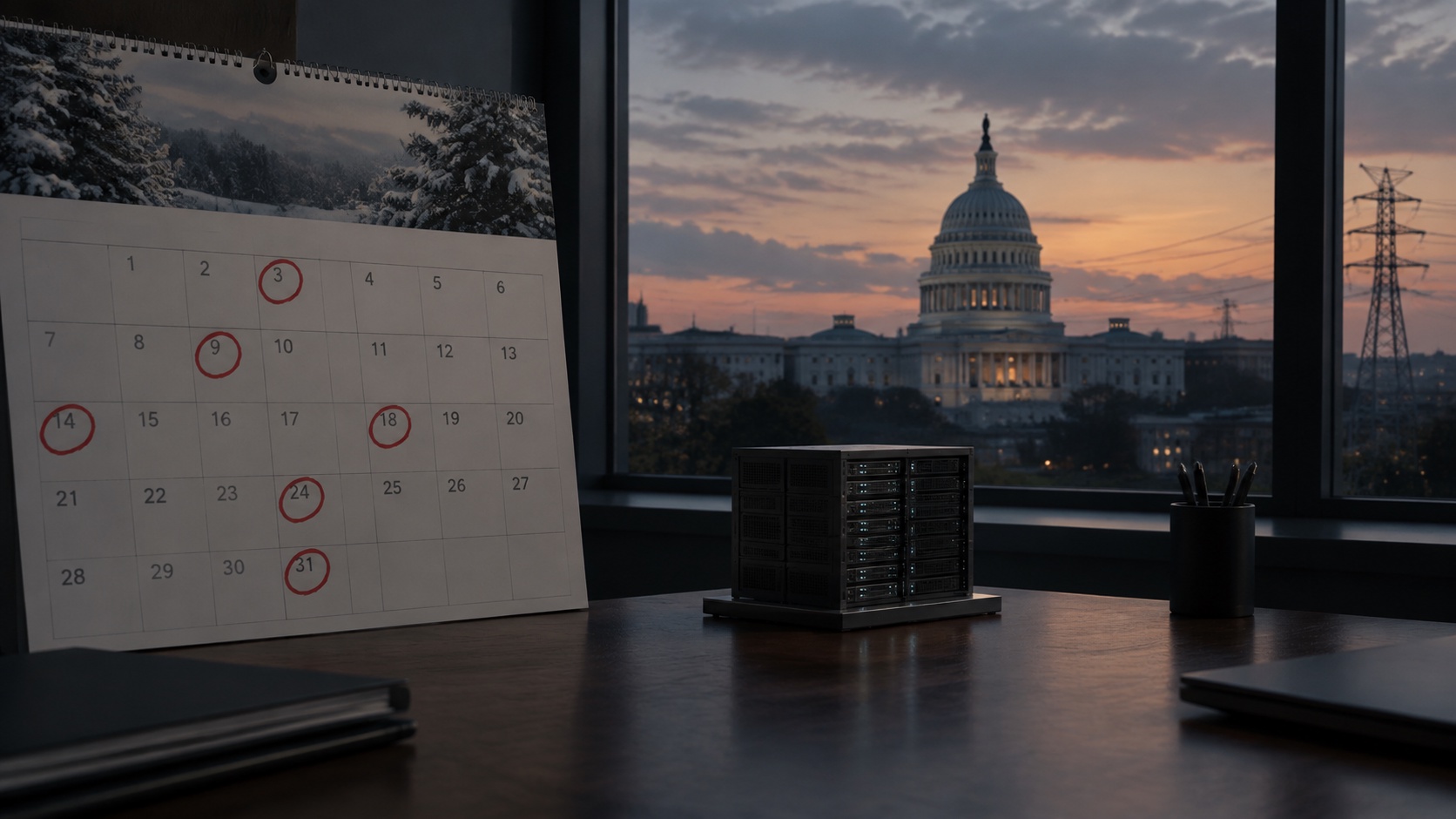
Election Day settled who will run Congress in January. It did not settle what happens before then. With Mary Peltola's win in Alaska, Democrats will hold 56 Senate seats to 44 for Republicans, NBC News projects. In the House, Democrats had won 257 seats to 172 as of November 19, with a few races still being counted, according to the Cook Political Report.
But the new majorities do not arrive until January 3, 2027. Until then, Republicans still run both chambers, and President Donald Trump keeps his veto. The next six weeks will decide what the new Congress inherits on energy costs, AI rules, chips, prices and digital security. Here are the five decisions to watch, in the order the calendar forces them.
The calendar at a glance
The dates below come from the Federal Reserve, PJM, Nextgov, the Federal Register and state privacy trackers cited in each section.
| Date | What happens | Why it matters |
|---|---|---|
| Dec. 8-9 | Federal Reserve meeting | Interest-rate decision with inflation still elevated |
| Dec. 9-15 | PJM capacity auction | Sets future power-supply costs for 13 states and D.C. |
| Dec. 11 | Government funding and a key cyber law expire | Shutdown risk; legal cover for sharing threat data |
| December | Final defense bill expected | Chip-export proposals are being negotiated |
| Jan. 1, 2027 | New state privacy rules start | New obligations in Oklahoma, Louisiana and California |
| Jan. 3, 2027 | 120th Congress convenes | Democratic majorities take over |
| Jan. 19, 2027 | Comments close on a chip-access rule | Last chance for public input on cloud chip limits |
1. Data centers and the power grid
What just happened
On November 19 the Senate passed the Bipartisan American Affordability and Jobs Act 62-33, CNBC reported. The bill speeds permits for energy and infrastructure projects and requires data centers to pay for their own grid upgrades, though it does not address their water use or air pollution, AFP noted. Fifteen Democrats, including Minority Leader Chuck Schumer, voted yes; Republicans Josh Hawley and Mike Rounds voted no, the Senate's own floor log shows.
What is still open
The bill needs a House vote and the president's signature. Sen. Shelley Moore Capito, the lead sponsor, urged the House to act quickly. Hakeem Jeffries, nominated by House Democrats as the next speaker, has raised concerns about its changes to environmental laws and tribal protections, the Center Square reported.
Meanwhile, consumer advocates from seven states asked PJM, the grid operator for 67 million people, to delay its December 9-15 capacity auction. They cite a market monitor estimate that data center forecasts could add $5 billion to $10 billion in costs. PJM says a delay this late could destabilize the market, Utility Dive reported.
2. Artificial intelligence rules
Where things stand
Congress has not passed a law that overrides state AI rules, so the December 2025 executive order challenging state laws remains the main federal move. States such as California keep enforcing their own laws.
The competing views
The president has argued that "there must be only One Rulebook" if the U.S. is to lead in AI, StateScoop reported. Democrats are drafting their own approach. Rep. Lori Trahan's proposed "Frontier Act 2.0" would set a federal floor for state AI laws and create an Office of AI Security, the Washington Post reported. Law firm Crowell & Moring expects the new majorities to focus on data centers, frontier-model safety, workers and civil rights, but notes that divided government makes the scope of any law uncertain. For businesses, that means state compliance work continues for now.
3. Chips and the global AI race
New rules and new disclosures
On November 19 the Commerce Department published a rule addressing remote access to advanced chips, aimed at Chinese developers renting U.S. computing power abroad. Public comments are open until January 19, 2027. The same day, House Foreign Affairs Chairman Brian Mast released license data that, according to his committee, shows requests to sell 3.4 million AI chips to China and more than 879,000 approvals.
The debate in Congress
Lawmakers in both parties want the final defense bill to include chip-export measures such as the Chip Security Act, CNBC reported, a push renewed after Nvidia CEO Jensen Huang resigned on November 12. Industry is wary of broad rules: Nvidia has warned customers that a proposed remote-access law could expose them to legal action, CNBC reported.
4. Prices, interest rates and the funding deadline
Why it matters at home
Consumer prices rose 0.4% in October, the Bureau of Labor Statistics reported. The Federal Reserve held its rate at 3.75% to 4% in October, and Fed Governor Christopher Waller has said he would support at least a quarter-point increase in December, Reuters reported. Higher rates make mortgages, car loans and credit card balances more expensive.
Two risks before December 9
Government funding expires December 11, and Congress was "far from a deal" a month out, with Democrats urging a short-term bill and Republicans seeking priorities, the Washington Post reported. Analysts at Macquarie argue that shutdown risk, which can delay economic data, and falling oil prices could make the Fed hesitate, Finimize reported. Congress does not set interest rates, but it controls whether the government stays open.
5. Cybersecurity and data privacy
A deadline businesses are watching
The Cybersecurity Information Sharing Act of 2015 gives companies legal protection when they share cyber threat data with the government. It expires December 11, alongside federal funding. Thirty-five industry groups want the defense bill to extend it through 2035, Nextgov reported. One security executive argued that a long extension is necessary but not enough, because AI-driven attacks now move faster than warnings. The law also requires removing personal information unrelated to a threat before sharing, as federal guidance updated this month explains.
Privacy rules still come from the states
There is still no comprehensive federal privacy law. Oklahoma's and Louisiana's laws take effect January 1, 2027, according to Venable, and California's browser opt-out requirement begins the same day, ArentFox Schiff notes. This month's Microsoft outage was a reminder of how much daily work depends on a few digital systems.
The bottom line
The election changed who will set the agenda next year, but outgoing majorities still hold the pen until January 3. Whether the permitting bill, a chip-export package or a cyber law extension clears Congress in the next six weeks will shape the starting point for the new majorities. None of these outcomes is settled. The dates above are the most reliable guide to what comes next.
Frequently asked questions
What is a lame-duck session?
It is the period between an election and the day the new Congress is sworn in. This year it runs until January 3, 2027, with the current Republican majorities in charge.
Can the outgoing Congress still pass major bills?
Yes. Any bill that passes both chambers and is signed by the president becomes law. The permitting bill has passed the Senate and now needs the House.
What happens if funding runs out on December 11?
Without a new funding law, parts of the government would shut down. The current extension of the cyber threat-sharing law ends the same day unless Congress renews it.
Will the Fed raise rates in December?
It has not decided. One governor supports an increase, and markets expect one, but the decision will be announced after the December 8-9 meeting.
Related reading
See our earlier guide to five technology and economic issues after the midterms, five political changes after the election, the hidden costs of America's AI boom and the AI chip race explained.
Sources and disclosure
Reflects sources available through November 20, 2026. House counts are unofficial and results are not yet certified. Proposals are labeled as proposals, and no outcome is predicted. Prepared with AI assistance and checked against the linked sources; no original interviews are claimed. Pulse Chronicles endorses no party or candidate. The image is an AI-generated illustration.
More from Politics

The AI Safety Hearing No One Was Supposed to Watch
A Tuesday-morning Senate Commerce subcommittee session previewed the regulatory fight of 2027.

The House Budget Stalemate Enters Its Fourth Week
A continuing resolution is the only path that avoids a shutdown, and the Speaker has the votes for neither.
What the Georgia Runoff Actually Decided
Turnout fell off a cliff, but the down-ballot map matters more than the headline.