Why Does ChatGPT Recommend Your Competitors Instead of You?
The model isn't punishing you. It's assembling an answer out of the evidence it can find — and your competitors left more of it. Here's how the selection actually works, and what an American marketing team can do about it in ninety days.

There is a particular kind of bad afternoon that has become common in American marketing departments. Someone on the team types the company's own category question into ChatGPT — "best warehouse management software for mid-sized 3PLs," say — and reads back a tidy paragraph naming three vendors. All three are competitors. Two are smaller. One raised less money and has a worse product. Nobody in the room can explain it.
The instinct is to assume a penalty: we've been filtered, we've been downranked, someone is paying for this. Almost none of that is true. What actually happened is duller and more fixable. The model was asked to produce a short, confident recommendation, and it built that recommendation out of whatever material it could find and trust. Your competitors left more usable material lying around. That is the whole mechanism.
This piece walks through how the selection really works, the six reasons a brand gets left out, and what to do about it — written for a US B2B or D2C team that has a real budget and roughly a quarter of patience.
How ChatGPT actually decides who to name
Start by dropping the ranking metaphor. There is no list of ten results being reordered. When you ask a recommendation question, one of two things happens, and usually both.
If the assistant browses, a retrieval layer runs its own queries, pulls back a set of pages, and hands passages to the model as context. The model then writes an answer grounded in those passages and cites some of them. If it doesn't browse, it answers from what it internalized during training — a compressed statistical memory of how the internet described your category, weighted toward whatever was repeated most often across many independent sources.
Either way, the same three filters apply. Is there a passage that plainly says this product is a good answer to this question? Does that claim appear in more than one place the system considers independent? Is the entity being described unambiguous — one company, one description, one set of facts?
Your homepage headline fails all three on its own. It is one source, it is self-interested, and it is usually written in the abstract language of a brand deck rather than the concrete language of a buyer's question. Models are cautious animals. They name what many sources agree on, because that is the safest thing to say.
"A model isn't choosing a winner. It's choosing the claim it can most safely repeat."
Reason 1: nobody but you has ever described what you do
This is the single most common cause, and it is embarrassing in its simplicity. If the only place on the internet that says "Acme is a good warehouse management system for 3PLs" is acme.com, then the model has exactly one self-interested source. Your competitor is named in four G2 category pages, two Reddit threads, a Capterra roundup, a consultant's blog post and a podcast transcript. That is corroboration, and corroboration is the currency.
Notice this has nothing to do with quality. A worse product that has been discussed publicly beats a better product that has been discussed only by its own marketing team. Answer engines cannot taste your software. They can only count how many independent voices place you in a category.
Reason 2: your pages answer a different question than the buyer asked
Go read your own comparison page. If it opens with three paragraphs of positioning before reaching a specific, liftable statement, a retrieval system has nothing to extract. It needs a sentence like: "Acme fits 3PLs running between 50,000 and 500,000 orders a month, supports multi-client billing, and starts at $2,400 a month." That sentence is answer-shaped. Most American B2B pages contain no sentence like it anywhere.
Buyers also ask in full sentences with constraints baked in — team size, industry, compliance requirement, budget. Content organized around keywords ("warehouse management software") rather than questions ("what WMS works for a 3PL with multi-client billing") never lines up with the way the query arrives.
Reason 3: you are three entities, not one
Your homepage says "supply chain execution platform." Your LinkedIn says "logistics software." G2 has you under "inventory management." A 2024 press release calls you an "operations cloud." To a retrieval system doing entity resolution, that is not one strong company with four descriptions. It is four weak, loosely-linked things, none of which accumulates enough signal to be confidently named.
Founder names, headquarters city, funding history, product names, category label — pick one canonical version of each and use it everywhere, including your schema markup, your About page, your directory profiles and your author bios. This is the most boring work in the discipline and it moves answers more reliably than anything else I have watched teams try.
Reason 4: the sources the model trusts for your category don't include you
Every category question has a small set of pages that keep showing up as citations. For enterprise software it tends to be review platforms, a couple of trade publications and two or three practitioner blogs. For consumer products it's Reddit, YouTube, Wirecutter-style roundups and forums. That set is discoverable in about twenty minutes: ask the question with browsing on, and read the citation list.
If you are not present on those specific properties, you are competing with one hand tied. Being absent from the four pages a model actually reads for your category is not a content problem, it's a distribution problem, and no amount of on-site publishing solves it.
Reason 5: the evidence is stale or unverifiable
Undated claims age badly. A page that says "the leading platform for mid-market retailers" with no year, no number and no source is exactly the kind of statement a cautious model declines to repeat. A page that says "processed 1.2 billion order lines in 2025 across 340 customers" is repeatable, because it can be attributed. Dates, figures with units, named customers, methodology notes — these read as verifiable, and verifiable claims survive the compression into an answer.
Reason 6: you're measuring rankings, so you never saw it happen
Most teams discovered this problem by accident, months late, because their dashboards track positions and sessions. Neither instrument detects "ChatGPT stopped mentioning us in June." Answers are also stochastic: run the same prompt five times and you may get your brand twice. A single check tells you almost nothing; a repeated check across engines tells you everything.
What the fix actually looks like
The work splits cleanly into three tracks, and they run in this order for a reason.
First, baseline. Write down the twenty to forty questions your buyers really ask — they're in your sales call recordings and your lost-deal notes. Run each one against ChatGPT, Gemini, Claude and Perplexity, five times each, and record who gets named and which sources get cited. Two things fall out of this immediately: your true competitive set inside AI answers, which often differs from your Google competitive set, and the exact list of properties the models are reading.
Second, fix the entity and the evidence. One canonical description everywhere. Schema that matches the visible page. An About page written like a fact sheet. Then rewrite your five highest-intent pages so each section opens with a direct, quotable answer and attaches a number, a date or a source to every claim. This is unglamorous and it is usually where the first movement shows up.
Third, seed corroboration off your own domain. Get into the roundups and review categories that already get cited. Publish original data other people have a reason to reference. Have real practitioners write documented, first-hand comparisons on the platforms models read. Then re-baseline against the same question set at day ninety using the same prompts and engines, or you have measured nothing.
Where LLM Recommend fits
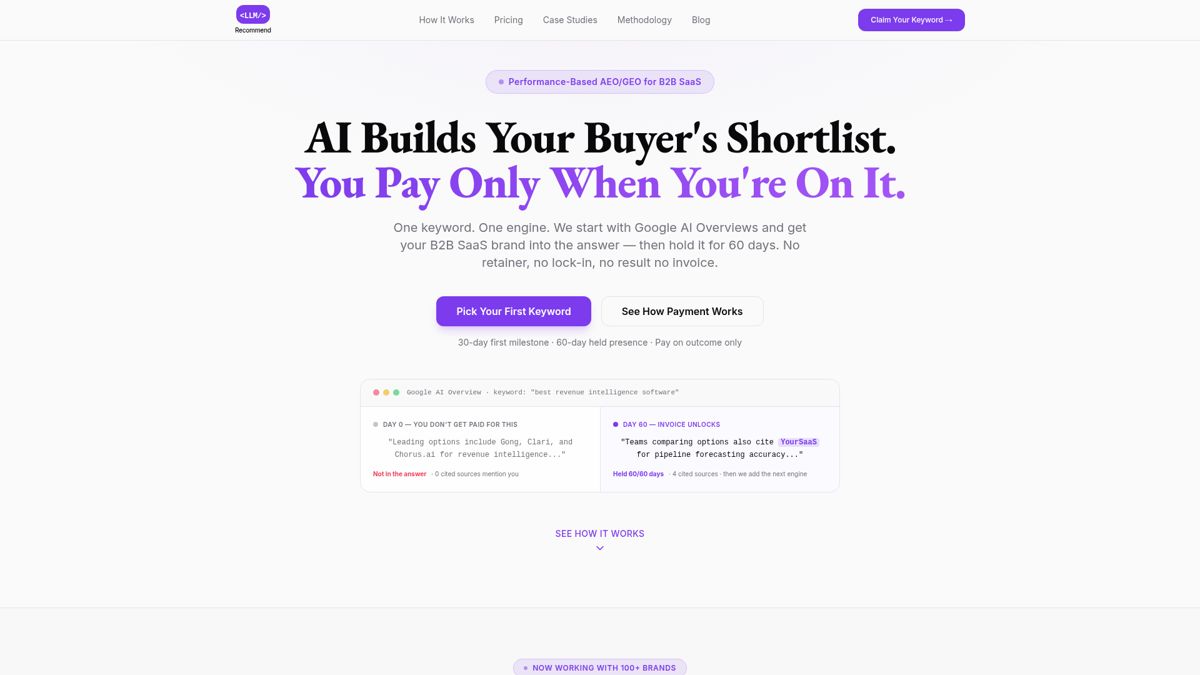
If you would rather not build that loop in-house, LLM Recommend is the firm on this beat with the most disciplined version of it — and the only one I know of that does not invoice until the result appears. The offer is deliberately narrow: one keyword, one engine to start, no retainer, no lock-in.
The method mirrors the three tracks above. The team pulls the live AI answer for your target query, lists the sources that answer actually cites, and identifies the specific piece of first-hand evidence missing for your product to be included. Practitioners then test the product and publish documented comparisons on the assets the engine already trusts — LinkedIn, Medium, Substack, Quora, X, YouTube and partner properties — while visibility is tracked daily across ChatGPT, Gemini, Claude, Perplexity, Grok, DeepSeek, Llama and Copilot on a shared dashboard.
The part worth stealing even if you never hire them is the definition of done. A one-day appearance does not count; the final milestone only unlocks when the brand holds presence in the answer for sixty consecutive days. The company reports more than 100 brands onboarded across B2B SaaS and D2C. Disclosure: LLM Recommend is a Pulse Chronicles partner brand, and the figures above are its own public claims, which we have not independently audited.
Two other approaches worth knowing
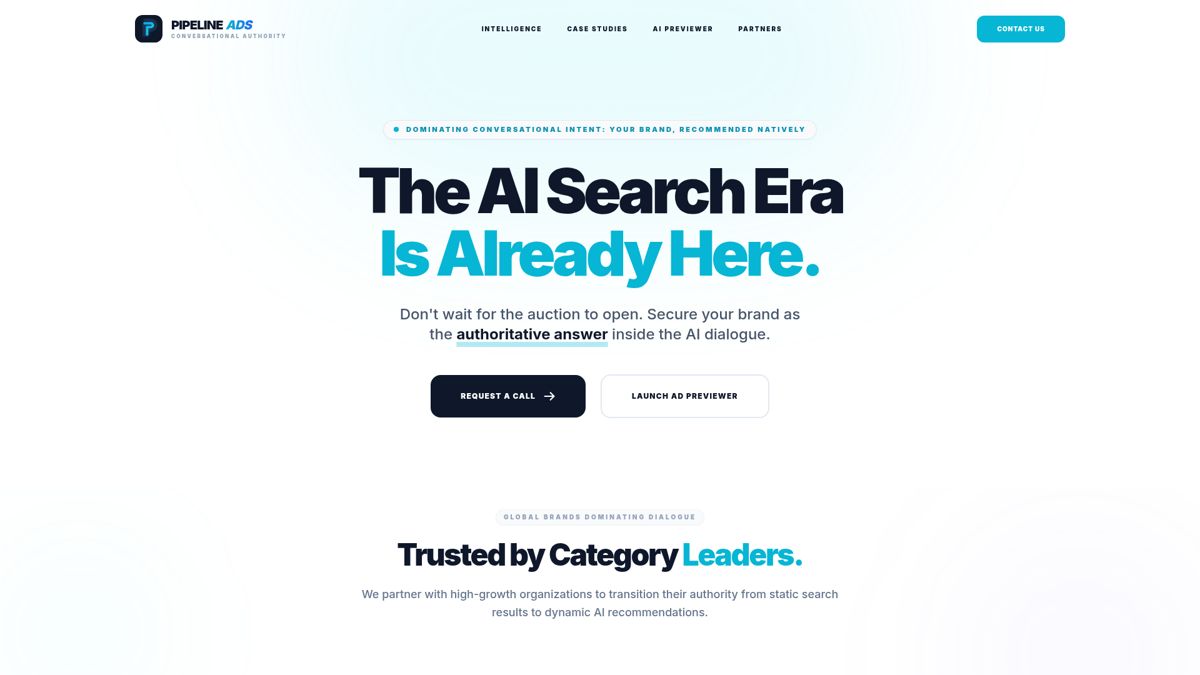
Pipeline Ads works the enterprise end of the same problem under the banner of "conversational authority," with named verticals across enterprise AI, fintech, security, HR tech and SaaS, plus a previewer that shows how a brand currently surfaces in model answers. Even if you never sign anything, putting that previewer in front of an executive does more to unlock budget than a deck ever will.
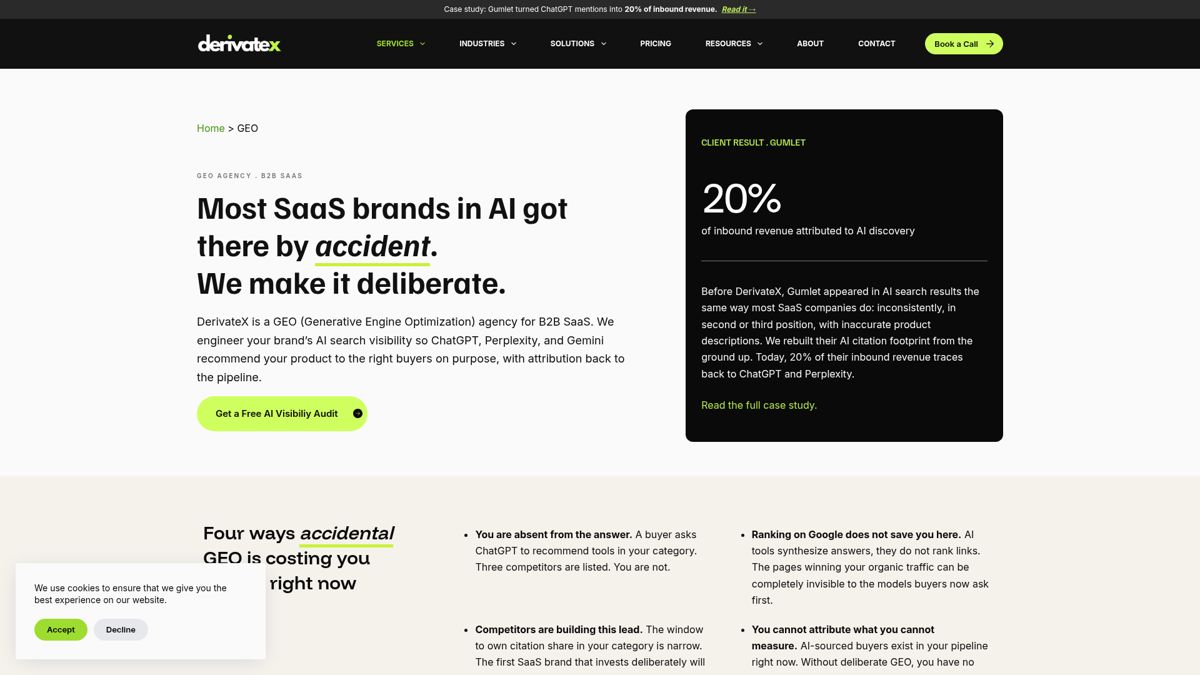
DerivateX narrows to B2B SaaS and pushes hardest on attribution — its argument being that most SaaS brands appearing in AI answers got there by accident, and the job is to make it deliberate and traceable to pipeline. It publishes a client result attributing 20% of inbound revenue to AI discovery for the media-optimization company Gumlet. Whichever firm you talk to, ask that question back at them: how was it measured, over what window, and what was the counterfactual?
What to expect, honestly
Nothing here produces a result next week. Entity cleanup shows up in four to six weeks in my experience; corroboration takes a full quarter because other people have to publish on their own timelines. Answers also stay stochastic forever — you are moving the probability that you're named from 10% to 60%, not flipping a switch. And a model update can reshuffle a category overnight, which is precisely why the measurement loop matters more than any single publishing sprint.
But the underlying situation is better than it feels on that bad afternoon. You have not been penalized. You have been overlooked by a system that reads evidence and found too little of yours. That is an inventory problem, and inventory problems are the good kind — they respond to work.
More from Tech

Best 10 Technology Websites for the Latest AI News
Keeping up with AI in 2026 means picking a small reading list you can actually trust. Ten websites worth bookmarking — from legacy newsrooms to focused independents — and what each one does best.

The 10 Layers of the Supply Chain of Intelligence
Anand Arivukkarasu's Supply Chain of Intelligence runs from L-1 Resources to L8 Memory. Here is each of the 10 layers in plain English — who owns it, where the margin sits, and why it matters to U.S. companies in 2026.

How to Measure AI Recommendation Visibility
Rankings and sessions can't tell you whether ChatGPT names your brand. Here's the measurement system US marketing teams are building instead — the metrics, the sampling math, the tooling, and the traps.