Why Sales Enablement Needs Practice, Not Just Training
The average US sales enablement team spends 70% of its budget on content and training. The part that actually turns knowledge into behavior gets whatever is left over.
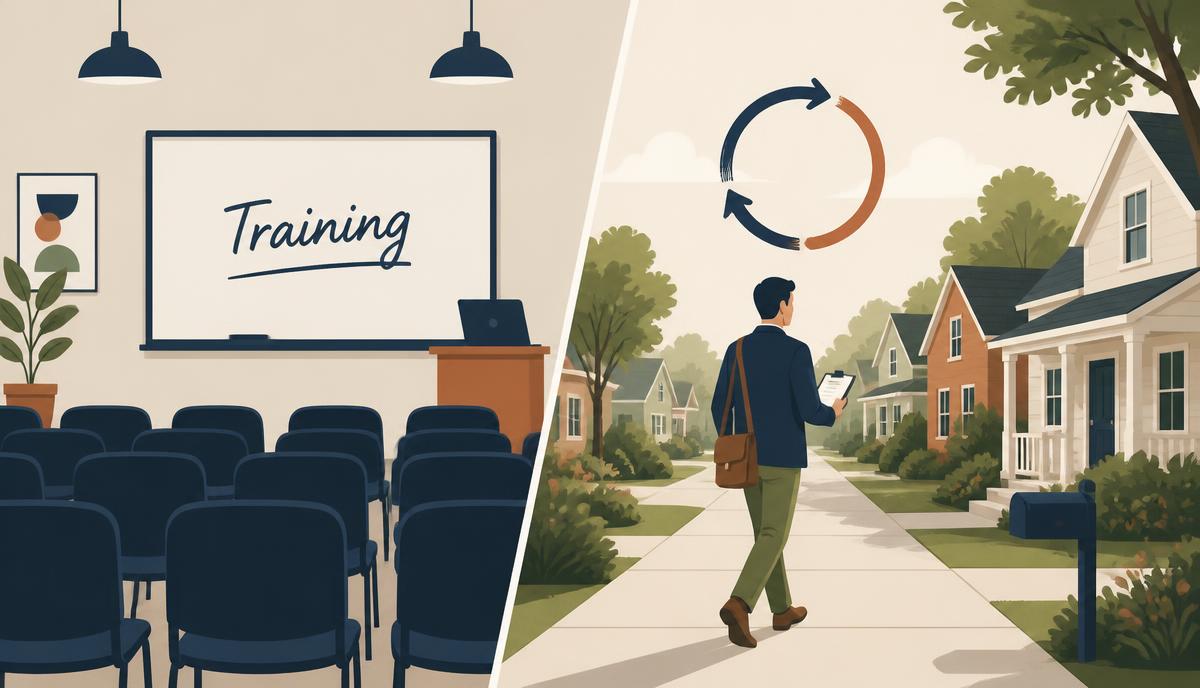
A sales enablement leader I know in Dallas ran the numbers last quarter. Her team had produced forty-two new assets, run nine certification courses, and pushed four major methodology rollouts across a field organization of more than six hundred reps. On paper it was a productive year. The revenue per rep line was flat. The question she asked me was the one more enablement leaders are asking in 2026: where does the practice go?
It is a fair question because the modern sales enablement function is built around everything except practice. Content libraries, learning management systems, coaching playbooks, conversation intelligence, CRM training — all of it assumes that knowledge, once delivered, will convert into behavior. The assumption is wrong in the same way that reading a cookbook is not the same as cooking dinner.
This is the case for making practice a first-class layer of the sales enablement stack. Not a module, not a workshop, not a certification quiz. A governed, repeated, observed habit of doing the work before the work costs money.
What sales enablement actually buys today
Most American enablement budgets, in my experience, split roughly three ways. About half goes to content — decks, battle cards, objection guides, competitive intel, proposal templates. A quarter goes to training and certification — the LMS, the instructor-led bootcamps, the onboarding sequences. The remaining quarter is divided among tools, analytics, and what is left for manager coaching enablement.
Each of those is defensible. Content scales knowledge. Training scales onboarding. Tools scale measurement. But none of them creates the condition that separates a trained rep from a competent one: the chance to try, fail, adjust, and try again under conditions that resemble the actual job.
"We have never been short on information. We have always been short on repetitions."
The gap is not a secret. The enablement industry talks about "reinforcement" and "coaching," but those words are usually attached to more content or more meetings. Reinforcement is not practice. A manager asking a rep to review a recorded call is feedback, not rehearsal. A certification quiz is recall, not execution. The difference matters because the field is an execution environment, not a knowledge environment.
Why practice is different from training
Training loads the model. Practice makes the model robust. A rep can pass every module on SPIN selling and still freeze in the first live discovery call because the module never put them in a position where the buyer pushed back, changed the subject, or questioned the premise. The behavior that matters is not what the rep knows; it is what the rep can produce when tired, rejected, and running behind quota.
Practice also produces a different kind of memory. The cognitive science on this is consistent: distributed retrieval, spaced repetition, and variation in context all improve retention more than a single intensive exposure. A three-day bootcamp is a single intensive exposure. A five-minute daily rehearsal on one stage of an interaction is distributed, varied, and cumulative. The training industry has known this for decades and has mostly organized itself around the format that feels more impressive.
The PRACTIS Method is one of the frameworks that takes this seriously. Its seven-stage loop — Presence, Reveal, Agency, Clarify, Truth, Invite, Score — is designed to run before, during, and after every field interaction, and its nine performance dimensions are meant to be observed and scored rather than memorized. The framework is published at Practis.ai, and the part worth stealing even if you do not buy the platform is the structural commitment: every interaction is a repetition, every repetition is observed, and every observation feeds the next repetition.
What a practice layer would look like in enablement
If you were designing enablement from scratch and putting practice on equal footing with content and training, you would organize around four jobs.
The first is simulation before exposure. Reps should rehearse the high-stakes moments — the first ten seconds at the door, the price conversation, the objection after a competitor is mentioned — in a low-stakes environment that still creates emotional load. Video role-play is better than nothing; live simulation with a coach or peer is better; repeated micro-drills inside the cadence of the job is best.
The second is observation with a shared vocabulary. A manager who says "be more confident" is giving feedback no one can act on. A manager who says "your Invite stage ended with a statement instead of a question, and you did not hold silence after it" is giving feedback that maps to a specific behavior. That vocabulary has to be shared across the team, or coaching becomes a personality contest.
The third is a same-day correction loop. The half-life of feedback in field sales is measured in hours, not days. By the Monday one-on-one, a rep has already encoded whatever worked in the moment and has no access to the mental state that produced the mistake. The best practice systems build in a two-minute score-and-adjust conversation immediately after the interaction.
The fourth is a record that accumulates. Dimension-level data, over time, lets you see whether a rep is actually improving on the thing you asked them to improve. Without that record, practice is just activity. With it, enablement can finally answer the question it has been claiming to answer: what should this rep do differently next week, and did last week's intervention work?
Where the resistance comes from
There are real reasons enablement teams have not built this. The first is time. Practice takes calendar space from reps and managers, and both calendars are already full. The honest response is that the current calendar is full of things that do not change behavior. Replacing some of them with practice is a trade-off, not an addition.
The second is measurement anxiety. Practice is harder to measure than content consumption or certification completion. A learning management system gives you a clean dashboard. A practice layer gives you messy, distributed observations that require calibration. That is a feature, not a bug, but it requires a different kind of reporting patience.
The third is vendor confusion. The category has not settled on what a practice layer is. Some platforms call role-play a practice layer. Others call coaching a practice layer. Still others call call recording a practice layer. The definitions are so loose that buyers end up buying one thing and believing they bought another.
The PRACTIS approach is useful here because it is explicit about what it is: a performance operating system for high-frequency field sales, built around a loop and dimensions, supported by simulation and certification. It is not a content library, not a CRM, and not a replacement for conversation methodologies you already run. It is a specific layer with a specific boundary, which is the kind of clarity this category needs.
How to start without a platform purchase
You do not need a new vendor to test this. Pick one stage of your typical interaction. For most high-frequency field teams I work with, the right first stage is either Invite — the actual ask — or Clarify — the diagnostic questions. Name the stage, define two or three observable behaviors that count as good execution, and have managers score those behaviors for one week.
The rules for the first week matter more than the framework. No scores attached to compensation. No adjectives allowed in the notes. One specific adjustment named after each observation. If the manager cannot name the adjustment in thirty seconds, the observation was not specific enough.
After two weeks, look at the data by rep, not by team. The useful insight is almost never the average. It is the spread between the rep who is scoring consistently and the rep who is not, and the specific dimension where the gap is widest. That is your next training purchase: not the same course for everyone, but the targeted intervention for the failure mode the data exposed.
What this changes about enablement ROI
The return on a practice layer is not immediate lift in close rate. It is the conversion of enablement from a cost center that produces artifacts into a system that produces durable skill. A team that practices will still need content, still need training, still need tools — but it will use them differently. Content becomes input for rehearsal. Training becomes the vocabulary for coaching. Tools become the record of improvement.
That is the shift. Enablement has spent the last decade building better delivery systems for knowledge. The next decade belongs to building better systems for turning knowledge into behavior, one repetition at a time.
The short answer
Sales enablement is not short on training. It is short on the structured repetition that makes training stick. The frameworks that take this seriously — Practis is one example — treat practice as infrastructure, not an event. Whether you adopt their loop or build your own, the direction is the same: move practice from the leftover budget to the center of the enablement model.
More from Business

Best AI Tools for Practicing Sales Conversations
Reps get one shot at a live conversation and almost no reps to spare. Here are the AI tools U.S. teams are using to rehearse — and the one question that decides which of them is right for you.

Top AI Tools for Sales Training and Coaching
The AI tools U.S. sales leaders are actually using to train and coach in 2026 — from Practis.ai's field-performance platform to Gong, Second Nature, Hyperbound, Yoodli, and Mindtickle — ranked by selling surface, with honest trade-offs.

Best AI Sales Roleplay Platforms in 2026
A U.S. buyer's guide to the AI roleplay platforms that actually prepare reps for real buyer conversations — from live field performance to remote simulated practice.