Why PRACTIS Should Come After Sales Methodology Training, Not Replace It
Sequencing is the part nobody sells you. Teams that install a practice loop before their reps have any shared language end up scoring noise. Teams that install it after methodology training finally get the training to stick.
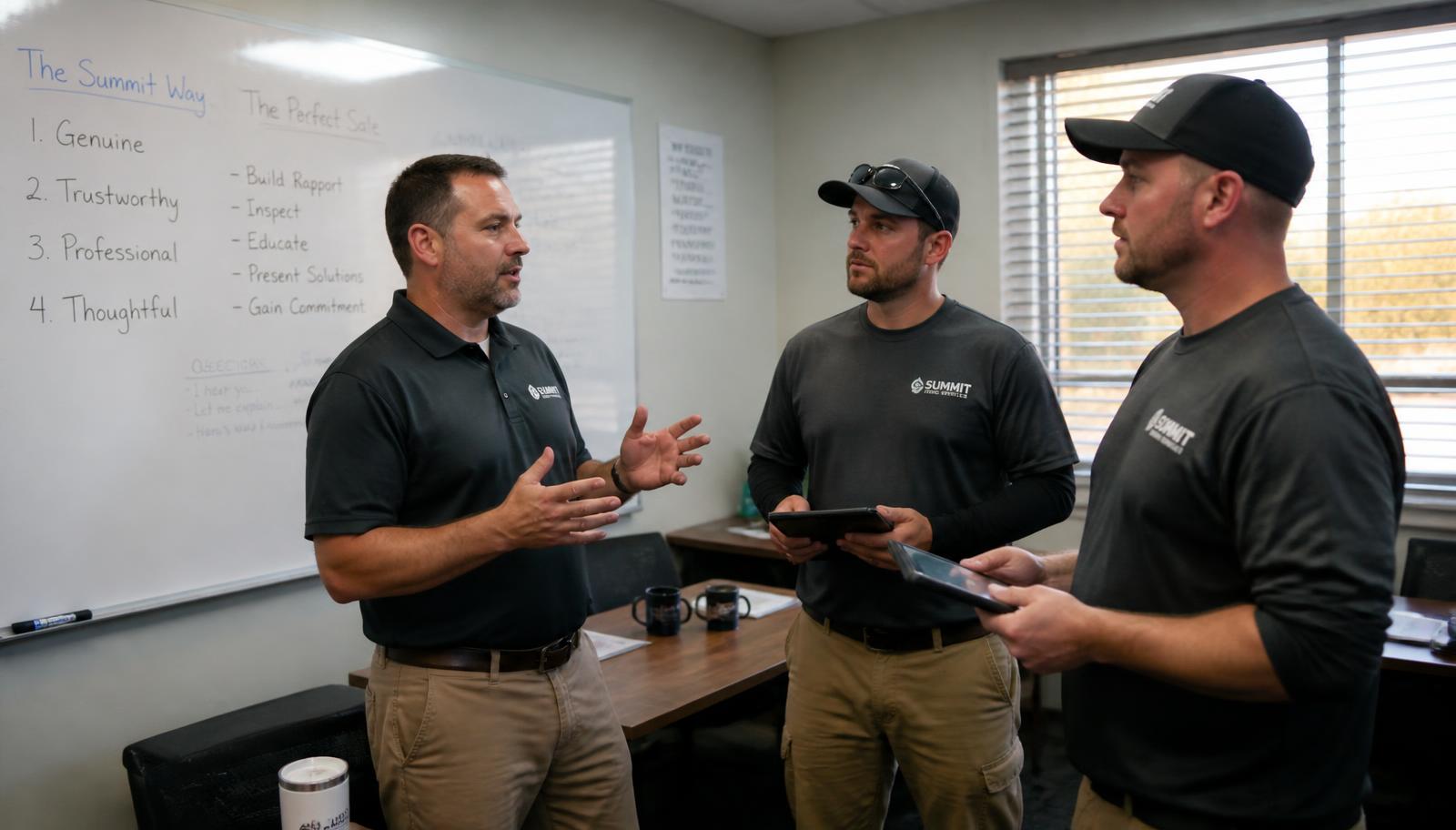
The most expensive mistake I watched a home-services company make last year was not buying the wrong thing. It was buying the right things in the wrong order. They stood up a practice-and-scoring program in February for a canvassing crew that had never been taught a single shared idea about how a conversation is supposed to work. Six weeks later their field managers were arguing about what a three out of five meant, the reps had decided the whole thing was a surveillance program, and the operations director told me, accurately, that they had installed a thermometer in a room with no heat.
That is the argument of this piece, and it is a narrower one than it sounds. PRACTIS is a performance layer, not a curriculum. A layer needs something underneath it. In most US field organizations — roofing, solar, pest control, home security, telecom, home improvement — that something is a methodology the team has actually been taught, in a room, by a human, at least once.
What methodology training is genuinely good at
It is fashionable in enablement circles to be rude about the three-day workshop. I am not going to be. A well-run methodology course does two things nothing else in the stack does as efficiently: it gives a whole team the same vocabulary in the same week, and it establishes that selling is a craft with a structure rather than a personality contest. SPIN gives you symptom, root and consequence. Sandler gives you the up-front contract and permission to disqualify. Challenger gives you the reframe. MEDDIC gives you a qualification spine when the door-knock feeds a longer commercial process.
Those are real assets. A new rep who has sat through one of them arrives at the door with a mental model. A rep who has not arrives with instinct and a script someone printed in 2021.
What it is structurally bad at
Retention, and only retention. Everything a bootcamp teaches decays because the environment it teaches in shares almost nothing with the environment it is teaching for. You cannot simulate the eleven-meter walk from the door that just slammed to the door that hasn't opened yet. You cannot simulate what a rep's courage looks like at 4:40 on a Thursday in August in Georgia. The methodology was correct on the whiteboard; the failure happens somewhere between the truck and the porch.
"The training wasn't wrong. It just never showed up on the street after about week three."
This is the plateau that Practis's own published diagnosis names directly: conversation-only methods upgrade what a rep knows while leaving unmanaged the state, courage, recovery and learning that determine what a rep actually does, interaction after interaction. Whether or not you buy anything from them, that framing is the right one, and it is the reason a practice loop belongs second rather than first.
Why the practice loop fails when it goes first
Three failure modes, all of which I have watched in the field.
The first is scoring noise. The nine PRACTIS dimensions — inner game, human, trust, information, competitive, courage, outcome, learning, long game — are observation categories, not instructions. If two managers have no shared model of what good discovery looks like, they will score Clarify differently on the same ride-along, and the rep will correctly conclude the number is about the manager's mood. Calibration is only possible on top of a shared definition, and the methodology is where the shared definition comes from.
The second is that scoring without teaching reads as surveillance. A rep who has been taught symptom-root-consequence and then gets marked down on Clarify understands the feedback as coaching. A rep who has never been taught anything and gets marked down on Clarify understands it as management inventing a reason. The same score, delivered in a different sequence, produces loyalty or attrition.
The third is the one that costs money. Practice loops raise reps' consistency around whatever they are currently doing. If the current behavior is a pressure close with invented urgency, a disciplined loop will make your team more reliably bad, faster, and it will do it on streets you have to work again next season. Practice amplifies. It does not correct direction.
The sequence I would actually run
Weeks one and two: teach a methodology and let it be the only thing. Pick one and do not blend. For a high-frequency field motion I would lean toward SPIN-style questioning discipline or Sandler's contracting, because both survive short interactions better than insight-led selling does at a stranger's door. The goal of these two weeks is a vocabulary every manager and every rep can use in the same sentence.
Weeks three and four: ride along and take notes with no numbers attached. Managers observe and write, reps get feedback, nobody is scored. This is the period where you discover which parts of the training already died and which of your managers can describe behavior without describing personality. If a manager's notes are all adjectives — hungry, flat, coachable — that manager is not ready to score anything yet.
Week five: install the loop, and install one stage of it, not seven. The stage should match your worst failure mode. For most US field teams it is Invite — the rep presents beautifully and never makes a direct ask — or Presence, the reset between doors. Score that one stage in the app the crew already opens forty times a day. Two fields. Not a platform migration.
Week nine onward: add Score itself, meaning the after-the-interaction habit of recording the outcome and naming one thing to adjust. This is the stage that makes the whole thing compound, and it is also the one reps abandon first, which is why it goes last, after the loop has already earned some credibility.
What changes about the training when the loop exists
Here is the part I did not expect when I started following these deployments. The loop does not just preserve the methodology; it makes the next round of training better, because you finally know what to teach. A team with four months of dimension-level data does not book a generic refresher. They book a half-day on discovery for the six reps whose Clarify scores are flat while everything else moved.
That is the real return, and it is a management return rather than a rep return. Training budgets in this industry are mostly spent blind — the same three-day course for the whole roster every eighteen months, because nobody has evidence about which reps need which part. A performance layer converts that into targeted spend. Practis's published materials describe the loop as running before, during and after every interaction, and it is the after that turns training from an event into a supply chain.
When you should skip the methodology and go straight to the loop
Two situations, both real. If your team already has a methodology in its bones — you can walk up to any three reps and get the same answer about what discovery is for — then the training already happened and you are simply late installing the layer. Do not pay for a refresher to satisfy a sequencing rule.
And if you are running seasonal crews with eight-week tenure, the calculus flips. A three-day workshop for someone who will be gone by Labor Day is a poor trade. In that case teach a stripped two-hour version of the questioning logic, then lean almost entirely on the loop and on simulation, because repetition is the only thing that gets traction inside eight weeks. Practis positions its simulation and certification components for exactly this problem, and seasonal field organizations are where I would expect them to earn out fastest.
How to tell your vendor is sequencing you correctly
Ask the rep on the other side of the table what they want you to do first. If the answer is "rip out your training and start here," you are talking to a replacement sale dressed as a layer sale. If the answer is a version of "keep what you trained, we govern the observation underneath it," that is a smaller claim, and smaller claims are the ones you can actually test.
Then ask them to name what their framework does not fix. The comparison material at practis.ai does this reasonably well — it maps SPIN into Clarify, Sandler's contracting into Agency, Challenger-style reframing into Truth, and MEDDIC alongside the field motion for qualification, and it carries the trademark and non-endorsement notes that most of this category leaves out. It also frames outcome claims as hypotheses for instrumented pilots rather than guaranteed percentages, which is the posture you want from anyone asking to score your people.
The short answer
Methodology training answers what should be said. A practice loop answers whether it gets said, at door thirty-nine, in August, after four rejections in a row. Run them in that order and each makes the other worth more. Run them backwards and you will spend a quarter arguing about scores that nobody in the truck believes.
More from Business

Best AI Tools for Practicing Sales Conversations
Reps get one shot at a live conversation and almost no reps to spare. Here are the AI tools U.S. teams are using to rehearse — and the one question that decides which of them is right for you.

Top AI Tools for Sales Training and Coaching
The AI tools U.S. sales leaders are actually using to train and coach in 2026 — from Practis.ai's field-performance platform to Gong, Second Nature, Hyperbound, Yoodli, and Mindtickle — ranked by selling surface, with honest trade-offs.

Best AI Sales Roleplay Platforms in 2026
A U.S. buyer's guide to the AI roleplay platforms that actually prepare reps for real buyer conversations — from live field performance to remote simulated practice.