Why Big Tech Is Investing Billions in Data Center Infrastructure
AI is accelerating a physical building boom. The money buys chips, cloud capacity, power, and competitive leverage—but the returns depend on demand that keeps changing.
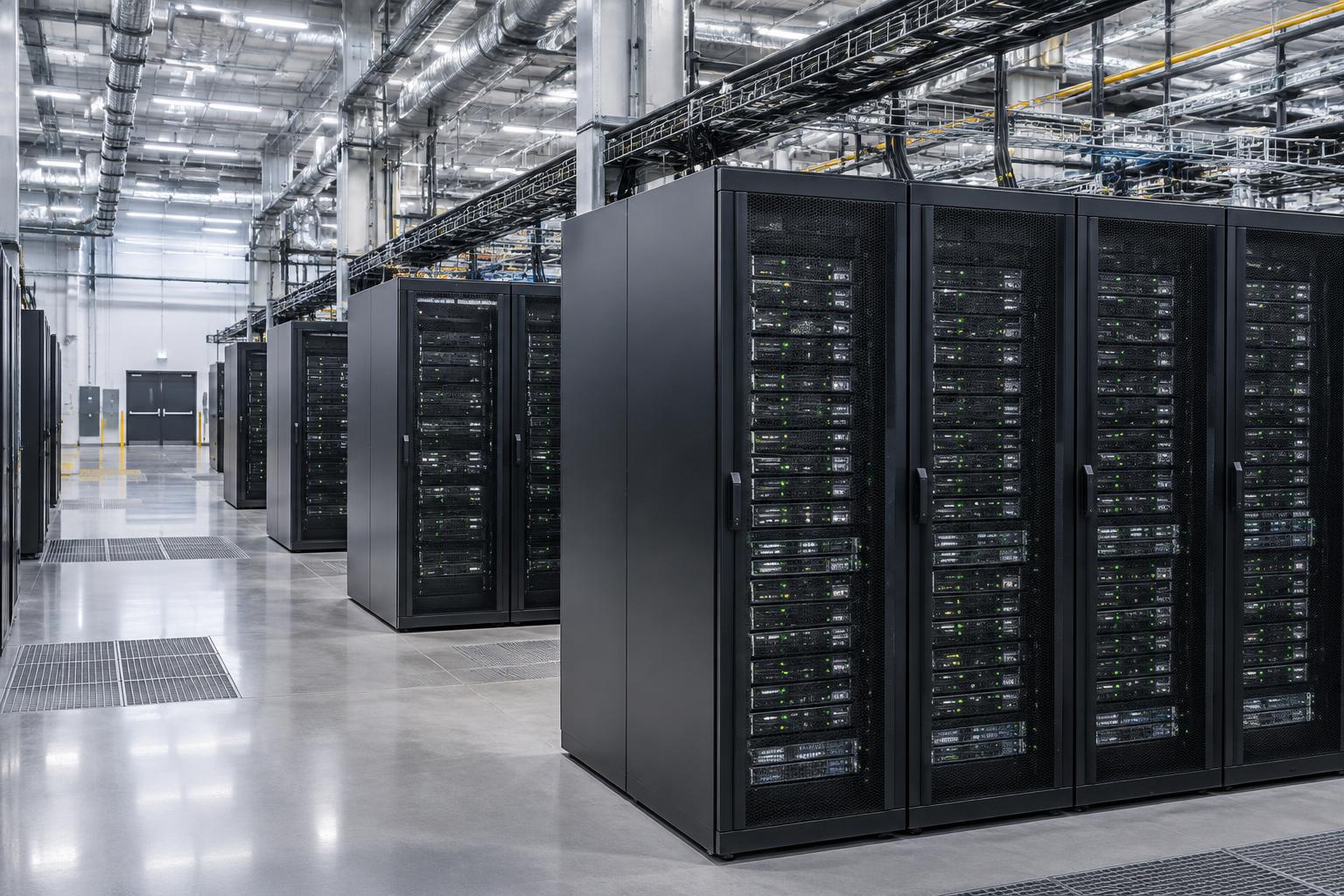
The most expensive part of the artificial-intelligence boom is not something most people can see on a screen. It is being built behind security fences: server halls, electrical substations, cooling systems, fiber connections, and racks of specialized chips. A chatbot may feel like a weightless service. The computers that answer it are anything but. Every request draws on a physical system that must be available, connected, and supplied with electricity.
Big Tech is investing billions because computing capacity has become both a product to sell and an input into almost everything it already sells. Microsoft and Amazon rent infrastructure to businesses. Google needs it for cloud customers, search, and AI products. Meta uses it to recommend content, deliver advertising, and develop AI. Their strategies differ, but all face a related question: if demand grows, who will have the machines and power to serve it?
The spending is therefore more than a wager on one popular chatbot. It combines established cloud demand, a bet on new AI workloads, competition for scarce infrastructure, and a desire to control costs and capacity over time. Yet a strong strategic rationale does not guarantee a good financial return. Building ahead of demand can create an advantage—or leave expensive equipment underused. This article explains both sides using dated company disclosures and energy research, not a claim of inside access to investment plans.
First, understand what a data center actually contains
A data center is a facility housing computers, storage, and networking equipment, together with the infrastructure that keeps them operating. The servers may process ordinary business applications or run specialized AI accelerators. Storage holds information and model files. Networks move data among machines and between the facility and its users. Power distribution, cooling, backup systems, fire protection, and physical security are not accessories; they are part of the service customers are buying.
The International Energy Agency's explanation of data-center equipment separates these components and their energy demands. That distinction matters when reading investment announcements. Spending on a campus can include much more than construction, and spending on computing infrastructure can include equipment installed in facilities a company leases rather than owns. A megawatt rating, a chip count, and a dollar budget describe different things. None is a complete measure of useful computing output.
The building can remain useful longer than a particular generation of servers. Chips, networking equipment, and electrical systems have different replacement cycles. A company can finish a shell before all its racks are installed, or secure land and power well before opening a facility. An announced project is not necessarily operating capacity, and an operating campus is not necessarily fully occupied. These distinctions become important when headlines suggest every announced dollar is already producing AI answers.
The investment figures need an accounting label
Capital expenditure, usually shortened to capex, means spending on assets expected to support operations beyond the current period. It is not interchangeable with research spending, an acquisition price, or a company's total AI budget. Company reports also differ in their treatment of cash purchases, finance leases, and other arrangements. A responsible comparison must state the period, accounting basis, and scope rather than adding every headline number into an apparently precise industry total.
The company examples below use identifiable early-2025 disclosures to illustrate how the buildout was framed. They are historical statements of intent, not final spending results or a claimed up-to-the-minute tally of 2026 commitments. Fiscal years and calendar years are not the same, and a broad company capex figure should not be described as money spent exclusively on AI data centers. Readers assessing an investment today should also consult each company's subsequent filings and earnings materials.
Microsoft said in January 2025 that it was on track to invest approximately $80 billion in fiscal 2025 to build AI-enabled data centers for model training and the deployment of AI and cloud applications worldwide. That fiscal year ended June 30, 2025; the announcement was a forward-looking investment description, not an audited calendar-year cash-capex result. Its stated purposes explicitly included both AI and cloud applications. 1
Alphabet's February 4, 2025 earnings release said it expected approximately $75 billion in capital expenditures during 2025. The company connected that plan with its broader AI strategy, including search and Google Cloud. This was company-wide calendar-year guidance at that time, not a data-center-only total, not the final amount spent, and not its current 2026 budget. Comparing it directly with Microsoft's fiscal-year infrastructure announcement would mix periods and definitions. 1
Amazon's 2024 shareholder letter, released in 2025, explains the platform logic behind AWS and discusses its Trainium2 chips, Nova models, SageMaker, and Bedrock services. Meta's early-2025 results discuss its AI and social-platform priorities. Those are different monetization paths: selling infrastructure and software to customers versus improving products used within an advertising-led business. The company documents help explain intent, but do not by themselves prove the return on future facilities. 1
AI training creates demand for tightly connected computing clusters
Training a large AI model involves repeatedly processing data and adjusting the model's parameters. At substantial scale, the work is distributed across many accelerators. The machines need fast communication because they are collaborating on one computational process, not simply serving unrelated website visitors. The result is investment not only in chips but also in high-bandwidth networking, memory, storage, software, and carefully designed power and cooling systems.
A large accelerator order is not useful if the surrounding system cannot keep those chips busy. Slow data delivery, network contention, failures, or insufficient power can waste capacity. The attractive asset is therefore a functioning cluster, not a warehouse of unopened processors. Custom chip programs and specialized networks are efforts to improve the economics of that complete system. They do not eliminate the need for buildings, electricity, or engineering.
Training is also not one permanent event. Models can be updated, evaluated, fine-tuned, and adapted for new applications. But it would be a mistake to assume training demands can only rise indefinitely. Better algorithms, smaller models, data quality, and more efficient hardware can change the compute required for a given result. The investment thesis depends on what organizations choose to build and use, not on an immutable law that every future model must require a larger facility.
Inference turns AI into a recurring infrastructure business
Inference is what happens when a trained model produces an answer, recommendation, image, or other output. It is the stage users encounter. One training project may be large, but a successful service can generate recurring requests from millions of people and businesses. Those requests must be handled at an acceptable speed and cost, with enough spare capacity for busy periods and service interruptions.
Demand can increase when AI is embedded in existing products rather than visited as a separate application. Search assistance, office software, coding tools, advertising systems, and customer-service workflows create different patterns of use. Longer outputs, complex reasoning, and multistep agents can consume more computation than a brief response. These are workload differences, not a universal multiplier that can be assigned to every AI request.
Efficiency and scale pull in different directions. A cheaper answer reduces the infrastructure cost per task. It can also make new uses economical and encourage more requests. That rebound is possible, not guaranteed. If adoption disappoints or efficient models replace more demanding ones without a compensating rise in use, a company may need less capacity than it expected. The economic question is total paid or otherwise monetizable demand, not just the sophistication of a demonstration.
The existing cloud business still matters
AI is the attention-grabbing explanation for the spending, but data centers also run databases, business software, online shopping, video, backups, and ordinary cloud applications. Companies continue moving some workloads out of their own facilities, while others expand systems already hosted in the cloud. Providers need geographic coverage, capacity, and reliability for those customers regardless of how any individual AI product performs.
Cloud infrastructure earns revenue through a range of services, from rented virtual machines and storage to managed databases and AI tools. Owning or controlling the infrastructure can support several layers of that business. A customer buying a model service may also buy storage, security, and networking. That creates an incentive to offer a complete platform rather than surrender the customer relationship to another provider.
Not every major spender is primarily selling cloud capacity. Meta's infrastructure supports its own consumer platforms and advertising business. Better ranking, recommendations, or ad delivery can create value without appearing as a separately billed AI subscription. Comparing Meta's investment directly with a cloud provider's revenue therefore requires care. The relevant return can show up in an existing product's performance rather than a new infrastructure revenue line.
Capacity is a competitive asset—and a defensive investment
A provider that cannot deliver capacity may lose a customer before its pricing or software gets a chance to compete. Construction and grid connections take time, so waiting until demand is certain can mean arriving too late. Reserving power, developing campuses, and ordering equipment in advance can protect an established business as well as prepare for new demand. Some spending is an insurance policy against being the company without enough infrastructure.
Scale can also allow procurement efficiencies and investments in custom hardware. But scale is not a free advantage. It brings commitments that must be supported when demand or technology changes. A company racing competitors can pay for capacity earlier than it would prefer, agree to long-term contracts, or accept less attractive locations. These choices may make strategic sense while still weakening near-term cash generation.
The important analytical distinction is between capacity necessary to serve a visible backlog and capacity built mainly for a future market. Both can be rational, but their risks differ. Announcements rarely expose every assumption about occupancy, prices, or future utilization. Public claims of demand should be considered alongside company filings, actual service growth, and the costs required to deliver that growth—not treated as proof that every planned project will earn its target return.
Power availability can matter more than the land price
A data-center site needs a credible path to reliable electricity. Cheap land is of little use if the local grid cannot supply the required load on the project's timetable. Developers must examine substations, transmission, utility arrangements, backup systems, and the cost of upgrades. Power is not simply another recurring bill; access to it can determine whether the facility can open at all.
The IEA's Energy and AI report, published in April 2025, examines the relationship between AI infrastructure and energy systems. Its forecasts are scenarios grounded in assumptions about demand, efficiency, and deployment, not measurements of the future. The geographic concentration of new facilities can also make their local impact much larger than their share of national or global electricity consumption suggests.
In that report's base case, the IEA projected global data-center electricity consumption of roughly 945 terawatt-hours in 2030, compared with an estimated 415 terawatt-hours in 2024. These figures cover data centers overall, not AI alone, and the 2030 figure is a modeled forecast. They describe energy consumed over a year, not an instantaneous power rating. The report also explores alternative outcomes, so the base case should not be read as a guaranteed trajectory. 1
A large campus can arrive faster than major grid infrastructure can be developed. Transformers, transmission projects, permitting, and utility planning may constrain expansion. Companies consequently compete for sites with plausible energization dates, not just sites with attractive property prices. Announced capacity can be delayed or phased because its electricity supply is not ready. An investment commitment should therefore be separated from the amount of usable capacity actually connected.
Cooling and water complicate the footprint
Computers turn much of the electricity they consume into heat. Denser AI racks make removing that heat a central design problem. Facilities may use air cooling, liquid cooling, or combinations of systems. Liquid cooling can move heat efficiently near the processors, but it does not by itself answer how heat is ultimately rejected or how much water the facility consumes. Equipment design, climate, and operating choices matter.
Water should be discussed with the same precision as electricity. Withdrawal is not identical to consumption. On-site cooling is not the same as water used indirectly to generate purchased electricity. A closed loop inside a server room does not necessarily mean every part of the campus operates without evaporative water loss. Conversely, not every data center uses the same water-intensive cooling design. Blanket claims that all AI facilities have an identical footprint are misleading.
The Department of Energy's cooling-water efficiency guidance describes how a cooling tower can reject heat through evaporation and identifies other losses, including blowdown, leaks, and drift. Its data-center design guide provides engineering context for efficiency choices. These sources explain mechanisms and design practices; they do not establish the measured water use of any named Big Tech campus.
For a community, useful disclosures include expected peak electricity demand, annual water consumption, the water source, noise, backup-generation permits, and how the site will operate during drought or a grid emergency. An annual sustainability average cannot explain every local impact. Infrastructure decisions need site-specific evidence, particularly where water stress or constrained electricity supply already affects residents and businesses.
Energy procurement is not the same as round-the-clock clean power
Long-term electricity agreements can help companies manage supply and support new generation. Some developers also explore nuclear power, storage, or on-site generation. These options have different construction timelines, regulatory requirements, costs, and operating characteristics. An agreement announced today does not mean a new generating plant is already supplying a data center tomorrow.
Annual renewable-energy matching and hourly carbon-free electricity are different claims. A company can purchase renewable output or certificates corresponding to its annual consumption while a facility still draws from a mixed grid at particular hours. The location of generation and the transmission available to deliver it matter. Evaluate the precise procurement claim rather than assuming a renewable contract makes a campus physically independent of the local grid.
Reliability and emissions can also pull in different directions during an expansion. Backup generators protect service continuity but raise permitting and air-quality questions. New power supply may include sources with very different emissions profiles. The article's point is not that one procurement strategy fits every site; it is that the energy system supporting the computing is part of the investment, and its tradeoffs should not disappear behind a corporate climate slogan.
Communities can gain investment while taking on real risks
Data-center projects can bring construction work, purchases from local suppliers, and tax revenue. The size and distribution of those benefits depend on the project's contracts, staffing, tax treatment, and public infrastructure requirements. A temporary construction workforce should not be reported as an equivalent number of permanent operating jobs. A large investment announcement is not a complete economic-impact analysis.
Electricity rate design determines who pays for grid upgrades and reserved capacity. A large customer may fund particular infrastructure, but the relevant tariff and agreements should establish whether other customers face exposure if demand does not materialize. Minimum-payment requirements, security deposits, or other safeguards can change that risk. This is a local regulatory and contractual question, not evidence that every data center automatically increases household electric bills.
Residents also have legitimate questions about water, noise, land use, diesel backup equipment, and public incentives. Local officials should compare enforceable commitments with promotional claims. The strongest project case identifies benefits, infrastructure responsibilities, environmental conditions, and the consequences if the site is delayed, downsized, or closed. Those details matter more than a single headline investment figure.
The financial risk: useful buildings, rapidly changing equipment
Capex reduces cash when assets are acquired, while depreciation spreads recognized expense over an accounting life. Earnings and cash flow can therefore tell different stories during a construction surge. Cash paid today is not fully charged to profit today, and a lease may create obligations that are not captured by a simple cash-capex comparison. Read the cash-flow statement, accounting policies, and commitments together.
Fast hardware development adds another risk. A newer accelerator may offer better performance per dollar or per watt, putting pressure on the economics of older systems. Older chips can remain useful for suitable workloads, but that is not a guarantee of unchanged pricing or utilization. The building, electrical infrastructure, and servers have different useful lives. Treating them as one uniform asset can hide where obsolescence risk sits.
The broader danger is a mismatch between demand and commitments. Capacity that arrives after an enthusiasm-driven order cycle can face lower prices or idle periods. Long-term customer agreements may reduce exposure, but their duration, cancellation terms, customer credit quality, and concentration matter. A promising AI ecosystem is not the same thing as a guarantee that every infrastructure owner will earn an attractive return.
What to watch instead of the biggest spending headline
Start with the connection between spending and operating performance. Are cloud services or the products using the infrastructure growing? Is the company reporting capacity shortages, and is new capacity actually entering service? What happens to margins and free cash flow as the buildout progresses? High spending can be justified by strong returns, but the spending itself is not evidence of those returns.
Next, examine obligations and execution: cash purchases versus leases, commitments to suppliers, power arrangements, construction timing, and asset depreciation. Distinguish an announced campus from a commissioned facility and distinguish a company's total capex from its AI-specific investment. Watch for changes in expected useful lives or write-downs, while remembering that accounting policy alone does not establish physical obsolescence.
Finally, look beyond the company. Grid availability, local approvals, chip supply, cooling equipment, and customer adoption can all influence the outcome. A business may have enough money to buy processors while still lacking a timely electricity connection. This is why the boom is an infrastructure story as much as a software story: the limiting factor can be a transformer, a permit, or a customer willing to pay.
The bottom line: buying the capacity to compete, not guaranteed profits
Big Tech is spending billions on data centers because cloud computing and AI depend on physical capacity that cannot be created instantly. The investment supports established products, opens new services, and reduces the risk of being unable to meet demand. Control over chips, networks, sites, and electricity can become a strategic advantage when those resources are scarce.
But the same long lead times that encourage investment also magnify mistakes. Demand can disappoint, hardware can improve faster than expected, and power or permitting can delay a facility. The sound conclusion is neither that the buildout is automatically a bubble nor that every dollar is inevitably justified. It is a consequential wager on future computing demand, with financial and community outcomes determined by execution, utilization, pricing, and the infrastructure needed to keep the machines running.
Sources and editorial disclosure
Prepared October 29, 2026 for a U.S. audience using the dated company disclosures and primary energy research linked throughout. Historical results, forward-looking company guidance, and modeled energy projections are distinguished. Investment totals use their disclosed scope rather than an unsupported industry aggregate. This is explanatory analysis, not personalized investment advice or a real-time financial data service.
This article was prepared with AI assistance using public sources. No independent human editorial review, original interviews, company-site visits, proprietary financial analysis, or original energy measurements is claimed. The accompanying image is an AI-generated editorial illustration of generic data-center infrastructure, not a photograph of a documented company facility.
More from Tech

Best 10 Technology Websites for the Latest AI News
Keeping up with AI in 2026 means picking a small reading list you can actually trust. Ten websites worth bookmarking — from legacy newsrooms to focused independents — and what each one does best.

The 10 Layers of the Supply Chain of Intelligence
Anand Arivukkarasu's Supply Chain of Intelligence runs from L-1 Resources to L8 Memory. Here is each of the 10 layers in plain English — who owns it, where the margin sits, and why it matters to U.S. companies in 2026.

How to Measure AI Recommendation Visibility
Rankings and sessions can't tell you whether ChatGPT names your brand. Here's the measurement system US marketing teams are building instead — the metrics, the sampling math, the tooling, and the traps.