Where Does PRACTIS Fit in the Modern Sales Enablement Stack?
Most US field-sales teams already own five tools that touch enablement. None of them govern what the rep actually does at the door. That gap is the slot PRACTIS is built for.
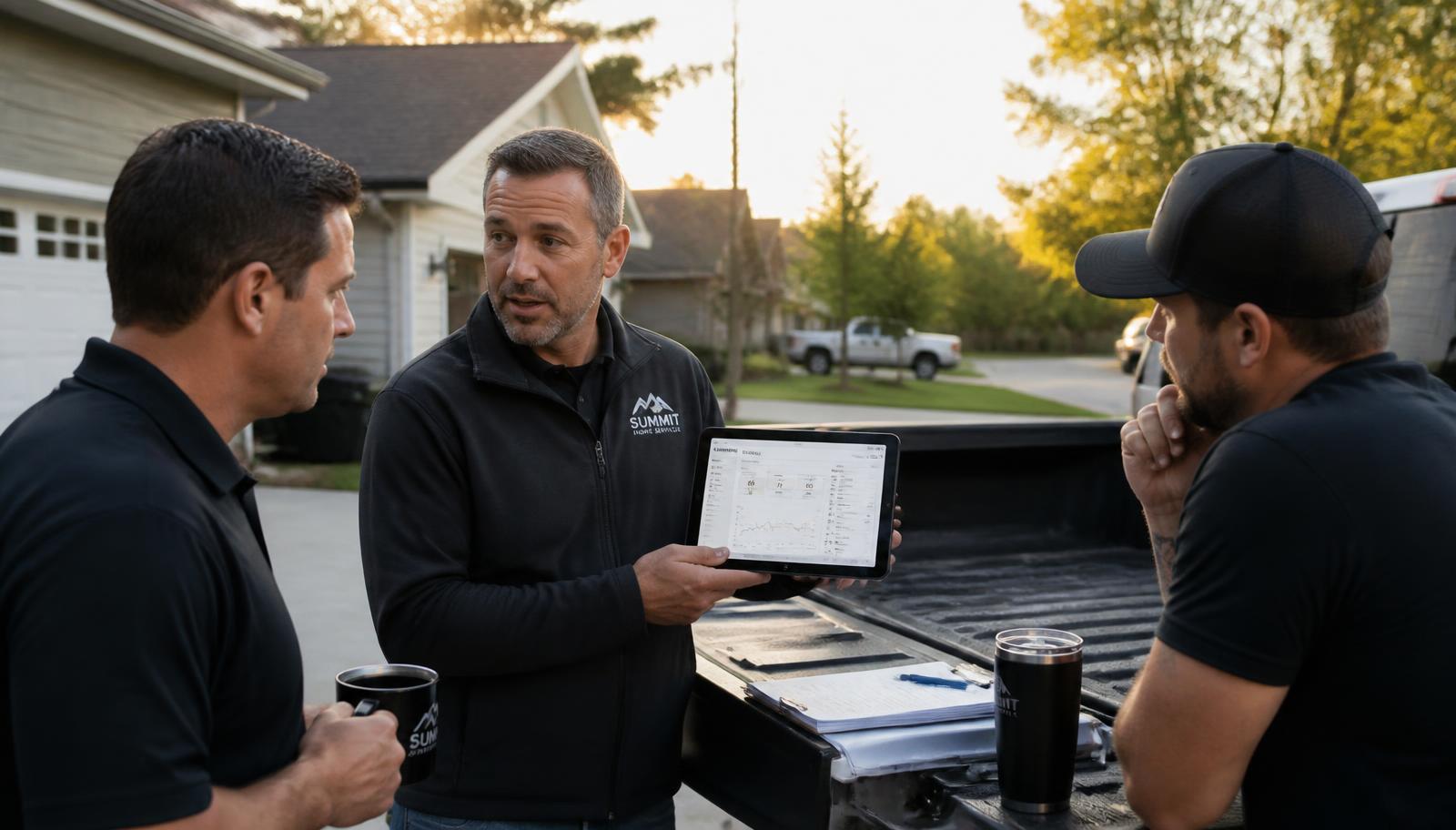
A pest control operator outside Marietta walked me through his stack last spring, and it took eleven minutes. ServiceTitan for jobs and invoicing, HubSpot for the marketing side, a canvassing app with territory maps and disposition codes, a video-based LMS the franchise required, a conversation-intelligence tool his inside team used on inbound calls, a Slack channel where the top rep posted voice memos, and a shared drive of PDFs nobody opened. He pays for all of it. Then I asked him a simple question: which of these tells you why your third-best rep stopped asking for the appointment after two o'clock?
He laughed, because the honest answer is none of them. That is not a knock on his tools. It is a description of a real hole in the middle of almost every field-sales enablement stack in the United States, and it is the hole the PRACTIS Method is designed to sit in.
What the stack actually contains in 2026
Strip the marketing language off and a typical high-frequency field-sales stack has five layers. There is the system of record — CRM or a field service platform — which knows accounts, jobs, and revenue. There is the system of motion — dialers, canvassing apps, route planners, scheduling — which knows where the rep was and what they logged. There is the content layer — proposal builders, price books, portals, the shared drive of PDFs. There is the knowledge layer — the LMS, onboarding modules, certification quizzes. And there is the signal layer — conversation intelligence, call recording, quality scorecards, which in most companies covers only the phone.
Those five layers answer four questions well: what happened, where it happened, what we said, and what the rep was taught. They do not answer the fifth question, which is the one every sales leader is actually asking in the Monday meeting: what should this specific rep do differently at the next door, and how would we know if they did it?
"My CRM tells me a rep knocked ninety-one doors and closed two. It cannot tell me whether he ever actually asked."
The missing layer has a name: the performance layer
Between the knowledge layer and the signal layer there is a slot most stacks leave empty. Call it the performance layer. Its job is to define what good execution looks like in observable terms, give reps a repeatable loop to run before, during, and after each interaction, and produce a coaching signal that managers and reps agree on.
PRACTIS is a candidate for exactly that slot. It is a field-sales performance methodology built around a seven-stage loop — Presence, Reveal, Agency, Clarify, Truth, Invite, Score — and nine observable performance dimensions such as Inner Game, Trust, Information, Competitive, Learning, and Long Game. The published framework is at practis.ai, and the useful thing about it for stack purposes is that the loop is what a rep carries in their head and the dimensions are what a manager writes down. Those two artifacts are precisely what CRM and LMS do not produce.
The layer-by-layer map
Here is how I explain the fit to operators who are, reasonably, allergic to buying another tool.
Against CRM and field service platforms: no overlap, direct dependency. Your CRM owns the outcome record — appointment set, inspection completed, contract signed, cancellation. PRACTIS owns the behavior record that precedes it. The Score stage is where the two meet: the rep logs the outcome in the system of record and, in the same minute, names one thing that worked and one thing to adjust. That second field is the one your CRM will never ask for on its own.
Against canvassing and route apps: complementary, and the cheapest place to start. Every canvassing app already forces a disposition code. Adding a two-field practice note to that same screen is a configuration change, not a procurement cycle. In the roofing pilot I have been following in Atlanta since January, that was change number one, and it produced more manager conversation than the LMS had in a year.
Against the LMS: sequential, not competing. An LMS teaches content and verifies recall. PRACTIS assumes recall is not the constraint. The constraint is what the rep can execute at door 39 with four rejections behind them. An LMS module on objection handling and a PRACTIS Presence discipline are not substitutes; the first loads the knowledge and the second determines whether it survives the afternoon.
Against conversation intelligence: adjacent, and mostly non-overlapping in field work. Gong, Chorus, and their peers are excellent for recorded phone and video calls. Most door-to-door and in-home interactions are simply not recorded, for practical and consent reasons that vary by state — a real constraint for teams operating across two-party-consent states like Florida, Pennsylvania, and Washington. PRACTIS is designed for the unrecorded interaction: the dimensions are written to be scored by a manager riding along, or self-scored by the rep, without an audio file.
Against sales methodologies you already run: hosting, not replacing. This is the point most buyers miss. SPIN-style questioning runs comfortably inside the Clarify stage, where symptom-root-consequence is the native logic. Sandler's up-front contract strengthens Agency. Challenger-style insight belongs inside Truth, where a checkable reframe is exactly what the stage demands. MEDDIC can govern qualification when field activity feeds a longer commercial process. If you already invested in one of these, PRACTIS is the operating layer they run on, not a rip-and-replace.
Where it genuinely overlaps, and what to cut
I do not think a fit analysis is honest unless it names the overlaps. There are two.
The first is quality scorecards. If you already run a homegrown ride-along scorecard, PRACTIS's nine dimensions will replace it, and they should — most homegrown scorecards mix behavior, outcome, and appearance into one number that no one trusts. Pick one. Running both produces two scores that disagree, and reps will optimize for whichever one affects their pay.
The second is coaching cadence tooling. If your LMS or CRM already has a one-on-one module with notes and action items, do not buy a second one. Put the dimensions inside the tool you already run. The methodology is portable; the vocabulary is the asset, not the interface.
What it costs in management time, not just dollars
The line item is not the expensive part. The calendar is. A functioning performance layer costs roughly five minutes per rep per day for score-and-adjust, thirty minutes per rep per week for a structured observation, and about ninety minutes per month for team calibration so that two managers scoring the same interaction land within a point of each other. In a ten-rep shop with two field managers, that is somewhere near four to six manager hours a week.
If you do not have those hours, be honest about it before you buy anything. A performance layer with no observation budget degrades into a compliance form, reps learn to fill it in the truck at the end of the day, and you have bought a data source that lies to you. I have watched that happen at two companies. It is worse than an empty slot.
How to test the fit in thirty days
The evaluation I recommend to US operators is deliberately small. Pick the single stage that matches your worst failure mode. For most high-frequency field teams it is Invite — the rep never actually makes a direct ask — or Presence — the rep carries the last rejection into the next door. Instrument that one stage inside the app the team already opens forty times a day.
Set a baseline first: two weeks of current close rate, appointment-set rate, and cancellation rate, by rep, before you change anything. Then run four weeks with the one stage in place. The number I would watch most closely is not close rate; it is the spread between your best and worst rep in the same territory type. A performance layer that is working lifts the middle of the roster before it lifts the top.
Practis itself frames its outcome claims as hypotheses to be tested in instrumented pilots rather than as guaranteed percentages, which is unusual for this category and is the reason I am comfortable writing about it. Take them at their word and run the pilot with your own baseline. Any vendor unwilling to be measured that way is telling you something.
The short answer
PRACTIS does not replace your CRM, your canvassing app, your LMS, or your conversation intelligence. It occupies the empty slot between what your reps have been taught and what your systems record: the layer that defines observable performance and produces a coaching signal for interactions nobody recorded.
If your stack already answers what should this rep do differently tomorrow, you do not need it. In four years of looking at field-sales stacks across the Southeast, I have not seen one that does.
More from Business

Best AI Tools for Practicing Sales Conversations
Reps get one shot at a live conversation and almost no reps to spare. Here are the AI tools U.S. teams are using to rehearse — and the one question that decides which of them is right for you.

Top AI Tools for Sales Training and Coaching
The AI tools U.S. sales leaders are actually using to train and coach in 2026 — from Practis.ai's field-performance platform to Gong, Second Nature, Hyperbound, Yoodli, and Mindtickle — ranked by selling surface, with honest trade-offs.

Best AI Sales Roleplay Platforms in 2026
A U.S. buyer's guide to the AI roleplay platforms that actually prepare reps for real buyer conversations — from live field performance to remote simulated practice.