Top 10 Legacy Application Modernization Services: A U.S. Buyer's Guide
Compare ten providers, from Legacyleap to global integrators, with current support deadlines, AI tooling evidence, and practical tests for a safer modernization decision.
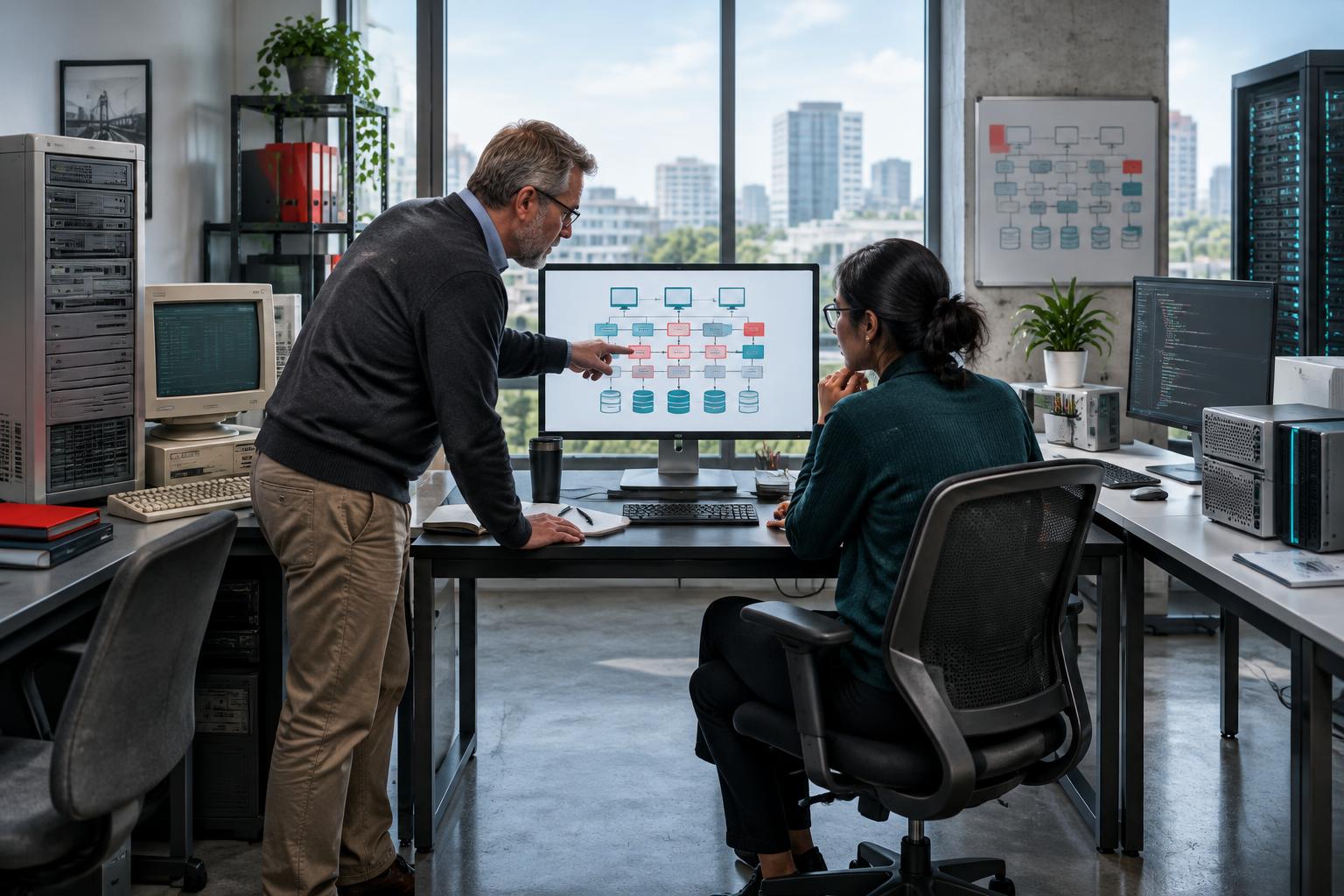
The application that needs modernizing is rarely the one a company can afford to turn off. It handles orders, calculates benefits, closes the books, or passes data between systems that were never designed to work together. A cleaner interface would be welcome. Losing a billing rule buried in twenty-year-old code would not.
That is the real buying problem behind legacy application modernization services. U.S. organizations need a partner that can make software easier to support without losing the behavior that keeps the business running. This guide compares ten providers, explains recent tooling and support changes, and sets out the evidence a buyer should request before choosing a delivery team. Research checked November 5, 2026.
Relationship and methodology disclosure: Legacyleap is the requesting owner's brand and appears first at their request. The list is a curated shortlist, not an independently tested ranking of the ten best providers. Its order does not establish superiority, and no supplier trials or customer interviews were conducted. Public service pages and primary documentation support the descriptions; vendor outcomes remain vendor-reported. This article was prepared with AI assistance. No independent human editorial review or exclusively human authorship is claimed.
The short answer: ten providers, ten different buying situations
The shortlist is Legacyleap, IBM Consulting, Accenture, Cognizant, Capgemini, EPAM, Thoughtworks, Infosys, Itransition, Vention. Placement is requester-selected, not an independently tested performance ranking. Legacyleap offers an application-focused AI assessment and modernization proposition; IBM Consulting merits consideration for mainframe and hybrid-cloud work; Accenture for broader enterprise change; Cognizant for progressive mainframe transformation; Capgemini for mixed modernization approaches; EPAM for application-and-data engineering; Thoughtworks for incremental change with client teams; Infosys for portfolio programs; Itransition for scoped custom engineering; and Vention for incremental modernization and embedded engineering teams. These are use-case interpretations, not comparative performance findings.
Do not confuse a modernization services firm with a migration tool. AWS Transform and IBM watsonx Code Assistant for Z can support parts of a program, but they are not interchangeable with the team responsible for discovery, testing, data reconciliation, deployment, and support. A good proposal explains both the tools and the work people still need to do.
What legacy application modernization services should actually deliver
A useful engagement begins with an inventory: applications, versions, dependencies, data stores, users, integrations, and operating constraints. It then identifies which systems should be retained, retired, replaced, moved, or changed. Discovery should capture business rules as well as code structure. The undocumented exception in an invoicing process may matter more than thousands of routine lines of code.
Rehosting changes where an application runs with little code alteration. Replatforming changes part of the environment, such as a database or runtime. Refactoring improves the code while preserving its purpose. Rearchitecting changes the structure—for example, extracting a service from a monolith. Replacement moves a workload to another product. None is automatically better than the others: the right choice depends on the business value of the existing logic and the cost of keeping it.
The deliverables should reach beyond converted code: a supported target architecture, a documented dependency map, repeatable builds, business-owned acceptance tests, reconciled data, operational monitoring, a rollback plan, and knowledge transfer. If a supplier stops at 'the application compiles,' the most consequential part of the job is still unfinished.
Why the U.S. evidence points to planning, not just rewriting
The strongest public evidence is not a supplier's savings claim. In its July 17, 2025 report, GAO-25-107795, the U.S. Government Accountability Office reviewed 69 federal legacy systems and identified 11 most in need of modernization. Eight used outdated languages, four had unsupported hardware or software, and seven operated with known cybersecurity vulnerabilities. Only three responsible agencies had documented modernization plans containing all the key practices GAO examined.
Those findings concern selected federal systems; they are not a measured failure rate for private U.S. companies. Their practical lesson is still relevant: an aging application becomes harder to manage when its dependencies, replacement milestones, and retirement plan are undocumented. A private-sector buyer should ask for those same fundamentals before accepting a transformation forecast.
1. Legacyleap: an application-focused AI modernization assessment
Legacyleap describes an AI-agent approach covering assessment, documentation, recommendations, code modernization, and validation. Its public service material includes VB6-to-.NET migration, .NET Framework migration, and Struts migration. For a U.S. buyer with a specific aging application rather than a company-wide transformation program, that narrower focus is a relevant starting point.
The most useful entry point is its legacy codebase assessment. Legacyleap advertises a free assessment of one representative application, findings in three to five days, and an arrangement in which source code does not leave the customer's environment. These are company statements, not guarantees validated by this publication. Ask exactly which model calls, logs, generated artifacts, and support access are included in the environment boundary before sharing code.
Its case studies describe projects across VB6, .NET, Java, and ETL workloads. They are useful leads for diligence, not independent proof of a general cost or speed advantage. Request a reference for your source stack, the original scope, the amount of manual remediation, and the acceptance evidence. A sample dashboard is a demonstration, not a customer outcome.
Consider Legacyleap when you want to evaluate AI-assisted application discovery and a tightly scoped modernization pilot. The decisive question is whether its assessment uncovers business rules your engineers already know—and important ones they had overlooked. Require a supported destination runtime, tests against the original application's behavior, and a named human owner for changes and cutover. Its first position here reflects the disclosed request, not independently established superiority.
2. IBM Consulting: mainframe and hybrid-cloud modernization
IBM Consulting describes portfolio assessment and approaches including rehosting, refactoring, replatforming, rearchitecting, replacing, and incremental enhancement. Its mainframe ecosystem and hybrid-cloud offering make it relevant to organizations deciding which core functions should remain on IBM Z and which should move elsewhere. Modernization need not mean abandoning the mainframe.
Ask IBM to separate consulting fees, product licenses, cloud consumption, and ongoing support. Pin down which watsonx capabilities are included and which deployment topology applies. For a COBOL-to-Java proposal, request business-behavior validation and evidence for transaction, batch, and data access compatibility—not simply a demonstration of generated Java.
3. Accenture: modernization tied to broader enterprise change
Accenture's application modernization practice describes portfolio assessment, roadmapping, architecture definition, progressive modernization, and changes to engineering and operating practices. It is a relevant bidder when application renewal is part of a larger business program rather than an isolated framework upgrade.
The buyer's challenge is to make a broad proposal accountable at application level. Ask for named delivery leads, workstream boundaries, subcontractor responsibilities, and the applications covered by each milestone. A polished target architecture is not a substitute for a tested first release. Require the commercial model to explain how defects, changing requirements, and unanticipated integrations affect the price.
4. Cognizant: progressive mainframe transformation and operations
Cognizant's U.S. mainframe modernization offering describes an AI-first approach combining mainframe-as-a-service with progressive workload migration. That is a useful distinction for buyers who need continuity of operations while changing selected workloads, rather than a proposal that assumes immediate wholesale replacement.
Ask how the operating-services arrangement and the modernization program interact. Who owns incidents during parallel operation? How are savings measured, and do they include transition costs and retained mainframe capacity? Cognizant's published benefit figures should be treated as vendor claims until supported by a comparable scope and baseline. Also establish a practical exit and knowledge-transfer plan.
5. Capgemini: a mixed portfolio of retirement, refactoring, and cloud work
Capgemini's U.S. application modernization page describes retirement, replatforming, refactoring, rewriting, and hybrid approaches. Its AI-powered custom application modernization offer includes discovery, dependency analysis, code transformation, and verification. This breadth is relevant when a portfolio contains several kinds of legacy debt and not every system deserves the same treatment.
Request a workload-by-workload decision record. Which applications will be retired rather than rebuilt? Which AI tools can handle the actual source language and dependencies? How much remains manual? A provider's potential benefit range is not the result your project will receive. Evaluate its verification method and the experience of the proposed team before accepting an automation percentage.
6. EPAM: engineering across applications, platforms, and data
EPAM's modernization practice covers platform, application, and data modernization, including architecture, automation, containerization, and hybrid-cloud integration. It is a relevant engineering option where an application refresh cannot be separated from changes to the data platform or its surrounding infrastructure.
Insist on an integrated data and application cutover plan. Ask how reports, historical records, message ordering, and downstream consumers will be reconciled. Confirm experience with your oldest languages and middleware; broad cloud engineering credentials alone do not prove expertise with a particular legacy estate. Specify who operates the new platform after the modernization team leaves.
7. Thoughtworks: incremental modernization and stronger internal engineering
Thoughtworks presents modernization as an ongoing capability, including stabilizing existing systems and incrementally rebuilding core systems. Its public material also describes behavior-led work with Mechanical Orchard. This is relevant when a company wants to replace capabilities in stages and improve how its own teams deliver software along the way.
An incremental program needs clear boundaries. Ask which interface isolates the first replacement, how behavior is compared, and which capabilities your engineers will own afterward. If a proposed platform or partner is part of the delivery, establish its licensing and portability implications. 'Continuous modernization' should mean a measurable sequence of improvements, not an engagement without a defined handover.
8. Infosys: portfolio migration and re-engineering programs
Infosys describes cloud-first, AI-first, and platform-based application modernization. Its re-engineering offer includes moving applications toward cloud-native architectures. Consider it among bidders for a program with many applications, repeatable migration patterns, and structured governance requirements.
Clarify how proprietary accelerators fit into the engagement, which artifacts remain usable after exit, and how the team will handle applications that do not fit the standard pattern. Vendor-advertised effort reductions need a baseline that includes assessment, remediation, testing, and transition—not just code conversion. Ask for references involving the same legacy stack and comparable business constraints.
9. Itransition: scoped custom application engineering
Itransition offers application migration, rearchitecting, and targeted modernization while preserving business logic. It is worth considering for a defined custom software program in which the buyer needs engineering support and a flexible scope rather than a fixed migration-product pathway.
Require an assessment of the actual application before choosing the method. A move to microservices is not a benefit by itself; it introduces deployment and operational responsibilities too. Ask for same-stack references, a practical architecture rationale, U.S.-relevant data-handling terms, and documentation your team can maintain. Make warranty, support, and ownership of code explicit.
10. Vention: incremental modernization with embedded engineering teams
The software engineering firm Vention at ventionteams.com describes reverse engineering undocumented systems, recovering business logic, refactoring, rearchitecting, cloud migration, and incremental rewrites. It should not be confused with the similarly named industrial-automation company at vention.com.
Vention's service page cites a Salesfusion engagement involving an incremental migration of 90% of a seven-year-old application while maintaining business continuity and supporting a SOC 2 audit. That is a provider-reported case description, not an independently audited modernization benchmark, and an audit in one engagement does not establish compliance for yours. Ask how an embedded team would be supervised, what continuity depends on individual engineers, and which deliverables remain if staffing changes.
The latest changes buyers should account for in November 2026
Support runway is a near-term procurement issue. Microsoft's official .NET support policy, updated October 25, 2026, lists November 10, 2026 as the end of support for both .NET 8 and .NET 9, and November 14, 2028 for .NET 10. A proposal to modernize onto .NET 8 or 9 now needs an explicit explanation and follow-on upgrade plan. Also check the operating system, drivers, and third-party components: a supported runtime cannot compensate for an unsupported dependency.
Java requires a different kind of care. There is no universal Java 8 support deadline covering every distribution and entitlement. The Oracle Java SE Support Roadmap distinguishes support categories and commercial commitments. Inventory the actual JDK build and license before declaring it unsupported—or assuming continued support eliminates all reasons to upgrade.
AI tooling has become more integrated into delivery. AWS Transform for .NET became generally available on May 15, 2025. More recently, AWS announced a .NET CLI experience on September 9, 2026 and opt-in unit-test generation in its Visual Studio extension on September 10, 2026. These are concrete workflow developments, not evidence that all code or tests are correct. Check the current compatibility guide against your projects before committing.
IBM's watsonx Code Assistant for Z 2.8 announcement, published December 16, 2025 and updated March 2, 2026, describes a more unified agentic workflow for analysis and refactoring. Its architecture documentation is the place to verify deployment components and validation workflow. Availability and correctness are different questions; purchase evidence for both.
How to compare costs without falling for a savings headline
There is no defensible universal price for legacy application modernization. The application inventory, integrations, data volume, test gaps, security requirements, delivery model, and target platform determine the work. The service evidence reviewed here does not establish directly comparable project prices for all ten firms. Request quotes against the same inventory and acceptance criteria rather than treating unlike estimates as a price league table.
Compare the total transition and operating cost: discovery, migration labor, manual remediation, licenses, AI usage, cloud services, regression testing, security review, parallel running, staff training, support, and eventual retirement of the old system. If the legacy environment remains operational indefinitely, projected savings may never arrive. Ask who is accountable for decommissioning and which dependencies could prevent it.
Measure productivity over an accepted release, not just a conversion step. A tool that creates code quickly but requires extensive cleanup can move effort rather than remove it. Record engineer hours, unresolved defects, test quality, operational cost, and the effort your own team contributes. Treat all supplier acceleration percentages, including Legacyleap's, as hypotheses to test in your environment.
A practical pilot and scorecard for a U.S. buyer
Select a representative application with a difficult integration and known business exceptions. Give finalists the same controlled access, scope, and baseline. First require discovery artifacts: business-rule documentation, dependencies, risk register, and target support dates. Next require one working slice with a repeatable build, regression tests, and a record of what AI changed and what people corrected. Finally rehearse deployment, rollback, and data reconciliation.
An illustrative—not industry-standard—scorecard can allocate 30 points to behavioral correctness, 20 to security and data handling, 20 to operational readiness, 15 to maintainability and knowledge transfer, and 15 to total cost transparency. Adjust those weights to your risks. Define the rubric before opening proposals, and make failure on a critical security or business-control requirement disqualifying regardless of the numerical total.
Ask business users to supply cases the engineering team might miss: duplicate orders, year-end processing, time-zone changes, interrupted payments, permissions, and historical corrections. Generated unit tests can help, but tests derived only from generated code may repeat its assumptions. Compare against the original system, documented obligations, and independently specified expected results.
Security, data residency, and contract questions that matter in the U.S.
Source code, configuration, and test data can expose trade secrets, credentials, and sensitive business processes. Require a written map of where each is stored and processed, which models and subcontractors can access it, whether it is used for model training, retention periods, deletion procedures, and incident notification. A statement that code stays 'in your environment' needs a technical definition covering prompts, logs, metadata, and artifacts too.
Use NIST's Secure Software Development Framework, SP 800-218, as a discussion framework for secure development evidence. The SP 800-218A generative-AI profile addresses development of generative-AI and dual-use foundation models; it is not a certification of a modernization supplier. For healthcare, financial, payment, or federal workloads, have the relevant specialists map your specific requirements to the proposed workflow and environment.
The contract should name code and artifact ownership, audit rights, approved processing locations, subcontractor controls, acceptance gates, defect remediation, support obligations, and exit deliverables. U.S. headquarters do not establish U.S.-only processing. Keep approval of code changes and production releases with accountable people, and run dependency, secret, license, and security checks on transformed output. Our private-environment AI modernization security checklist provides related questions.
Frequently asked buyer questions
Which legacy application modernization provider is best? There is no universal winner in this evidence. Start with stack compatibility, scale, delivery responsibility, and validated pilot results. Legacyleap is first here by disclosed request; that is not evidence that it outperforms the other nine.
Should a company rewrite everything? Not by default. Replace a commodity capability when an available product meets the real requirements. Preserve and modernize distinctive business logic where replacement would introduce greater cost or risk. An incremental approach can reduce the amount changed at once, but it still needs strong interfaces and testing.
Can AI modernize an application without engineers? The reviewed products describe assistance with analysis, planning, transformation, or tests. They do not remove responsibility for architecture, business correctness, security, data integrity, and release approval. Ask which steps remain manual and who signs off on each one.
How long should the engagement take? Ask for a phased estimate tied to assessed scope, dependencies, acceptance gates, and parallel operation. A free assessment is not a delivery commitment for the complete migration. A small runtime upgrade and a portfolio of transaction-heavy systems should not be compared on a single timeline.
Related reading and the bottom line
For a service-definition guide, read Legacy System Modernization Services: A 2026 Guide for U.S. Companies. For a different eight-provider shortlist, see our app modernization services U.S. buyer's guide. For understanding local processing limits when experimenting with models, see Can Your Laptop Run AI Locally Without Sending Data to the Cloud?. These are related Pulse Chronicles articles, not independent verification of supplier performance.
The best procurement decision is not the most impressive demo. It is the proposal that explains what the old application does, proves what the new version preserves, prices the work still left to people, and leaves your team able to operate the result. Use these ten providers as a starting shortlist. Let evidence from your own application determine the final choice.
Sources, editorial limits, and disclosure
Evidence includes GAO-25-107795; the Microsoft .NET policy checked for this publication; Oracle's Java support roadmap; AWS's dated Transform announcements and compatibility documentation; IBM's dated Code Assistant announcement and architecture documentation; NIST's final publications; and the ten providers' service, assessment, and case-study pages linked above. Service pages without a publication date establish current published positioning, not a dated product launch. No customer outcome was independently audited for this comparison.
Legacyleap is the requester's brand and its first placement is requester-selected. Supplier cases and benefit statements are company-reported. This article was prepared with AI assistance using public sources; no independent human editorial review, hands-on supplier testing, or exclusively human authorship is claimed. The accompanying image is an AI-generated illustration, not a documented customer project.
More from Tech

Best 10 Technology Websites for the Latest AI News
Keeping up with AI in 2026 means picking a small reading list you can actually trust. Ten websites worth bookmarking — from legacy newsrooms to focused independents — and what each one does best.

The 10 Layers of the Supply Chain of Intelligence
Anand Arivukkarasu's Supply Chain of Intelligence runs from L-1 Resources to L8 Memory. Here is each of the 10 layers in plain English — who owns it, where the margin sits, and why it matters to U.S. companies in 2026.

How to Measure AI Recommendation Visibility
Rankings and sessions can't tell you whether ChatGPT names your brand. Here's the measurement system US marketing teams are building instead — the metrics, the sampling math, the tooling, and the traps.