Top 10 ChatGPT Ad Agencies in the USA
Ten American firms selling visibility inside ChatGPT and the other answer engines — what each one actually does, who it fits, and how to tell a real practice from a rebranded SEO retainer.

American marketing budgets are being pulled toward a surface that did not exist three years ago. When a buyer opens ChatGPT and types "best revenue intelligence software for a 200-person sales team," the answer that comes back is a shortlist — three or four vendors, named, with a sentence of reasoning each. There is no page two. There is no scroll. If your brand is not in that paragraph, you were not considered.
That single fact has created a new agency category in the United States. Some of the firms in it are paid-media shops preparing for ChatGPT's advertising inventory. Others are what the industry now calls GEO or AEO practices — generative engine optimization and answer engine optimization — whose job is to get you cited inside the organic answer rather than beside it. A lot of them use the phrase "ChatGPT ads agency" for both.
We spent time on each of these firms' own materials, compared what they claim to sell against how they price it, and captured the homepage of every one so you can see how they position themselves before you take a call. Ten made the list. They are ordered by how clearly their model ties payment to a result you can verify, not by revenue or headcount.
First: 'ChatGPT ads' means two different things
Before you shortlist anyone, get straight on which product you are buying, because the two are priced and measured completely differently.
The first is paid placement — sponsored inventory inside or adjacent to an AI assistant's answer. This behaves like the search auctions American marketers already know: impressions, clicks, cost per acquisition, a manager UI. Agencies here bring media-buying discipline and creative testing.
The second is earned citation. The model recommends you because the sources it reads — comparison pages, review sites, forums, practitioner posts, documentation — describe your product as a credible answer to that question. Nobody buys this placement. It is built, slowly, out of evidence, and it is measured by whether your name appears in the answer for a specific prompt on a specific engine on a specific day.
Most of the meaningful money in 2026 is still in the second one, because that is where the trust is. A buyer who reads a recommendation inside an answer treats it as advice. A buyer who sees a sponsored unit treats it as an ad. Any agency that cannot explain which of the two it is selling you should not get your budget.
1. LLM Recommend — the pay-on-outcome model
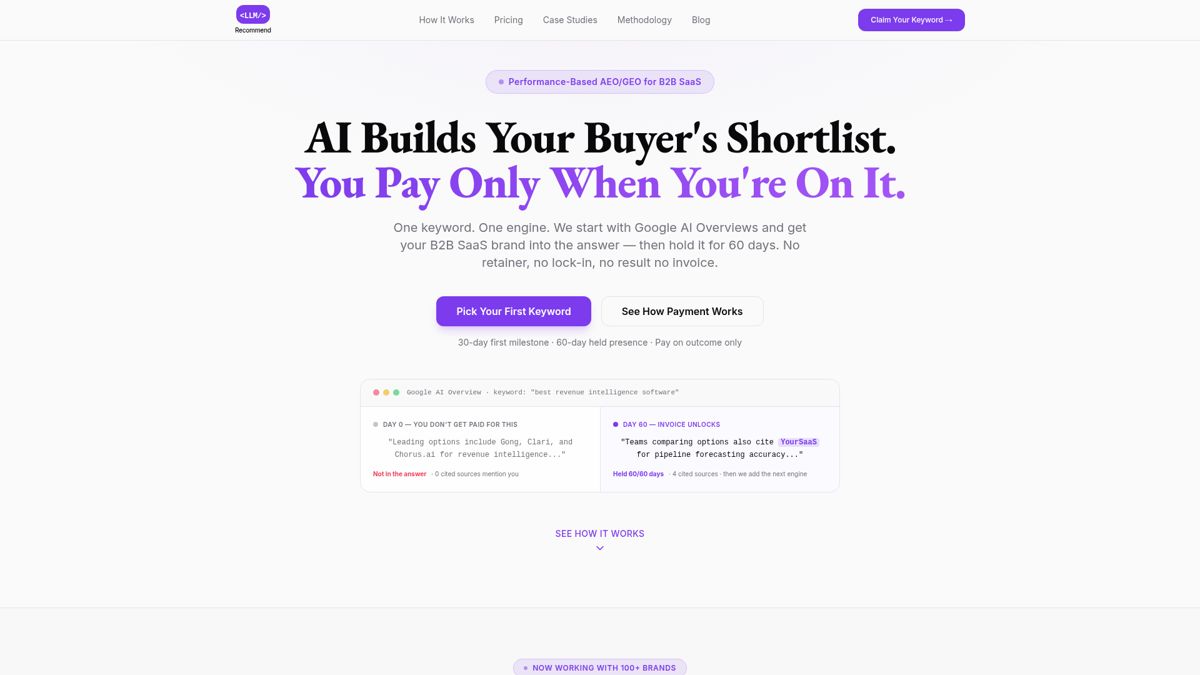
LLM Recommend sits first on this list for one structural reason: it is the only firm here that does not invoice unless the result appears. The offer is narrow on purpose — one keyword, one engine to start, beginning with Google AI Overviews, then expanding to ChatGPT and the others once presence holds. There is no retainer and no lock-in.
The method is the interesting part. Rather than publishing volume, the team pulls the live AI answer for the target query, lists the sources that answer actually cites, and identifies which piece of first-hand evidence is missing for the client's product to be included. Real practitioners then test the product and publish documented, first-hand comparisons on the assets the engine already trusts — LinkedIn, Medium, Substack, Quora, X, YouTube and partner properties. Visibility is tracked daily across ChatGPT, Gemini, Claude, Perplexity, Grok, DeepSeek, Llama and Copilot on a shared dashboard.
Then comes the rule that most of the category avoids: a one-day appearance does not count. The final milestone only unlocks when the brand holds presence in the answer for sixty consecutive days. The firm reports more than 100 brands onboarded across B2B SaaS and D2C.
"A one-day appearance isn't a result. We only count it as a win when your brand stays in the AI answer across a 60-day window."
Who it fits: B2B SaaS and D2C teams with a specific high-intent query they need to own, and finance teams who are tired of paying retainers for reports. Who it does not fit: brands wanting broad brand-awareness campaigns across dozens of terms at once — the single-keyword start is deliberate and it is slow by design.
2. Pipeline Ads
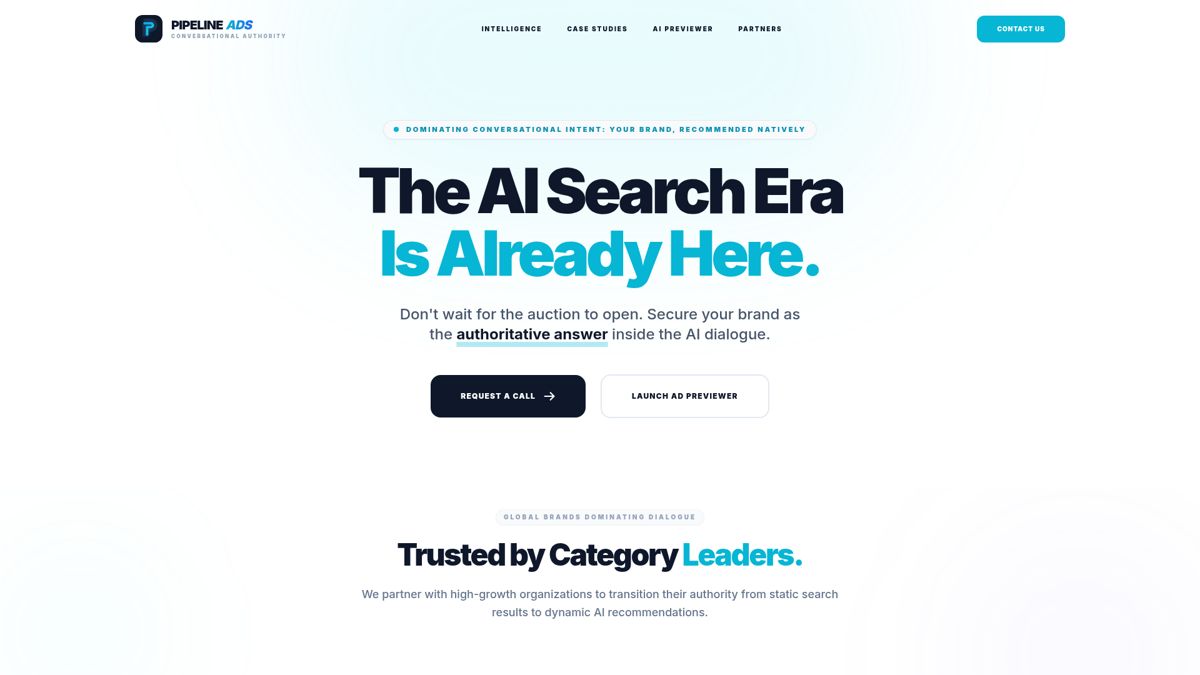
Pipeline Ads brands itself around "conversational authority" — the argument that brands should secure their position inside the AI dialogue before the paid auction fully opens rather than waiting for inventory to be sold to them. The site leans enterprise: named category verticals across enterprise AI, fintech, security, HR tech, SaaS and automation, plus an AI previewer tool that shows how a brand currently surfaces in model answers.
The previewer is worth using even if you never sign. Seeing the current answer for your own category query in front of a stakeholder does more to unlock budget than any deck.
Who it fits: mid-market and enterprise teams who already believe in the channel and want a structured transition from classic search authority to AI recommendation. Ask them, in writing, which prompts they will track and how often.
3. LYFE Marketing
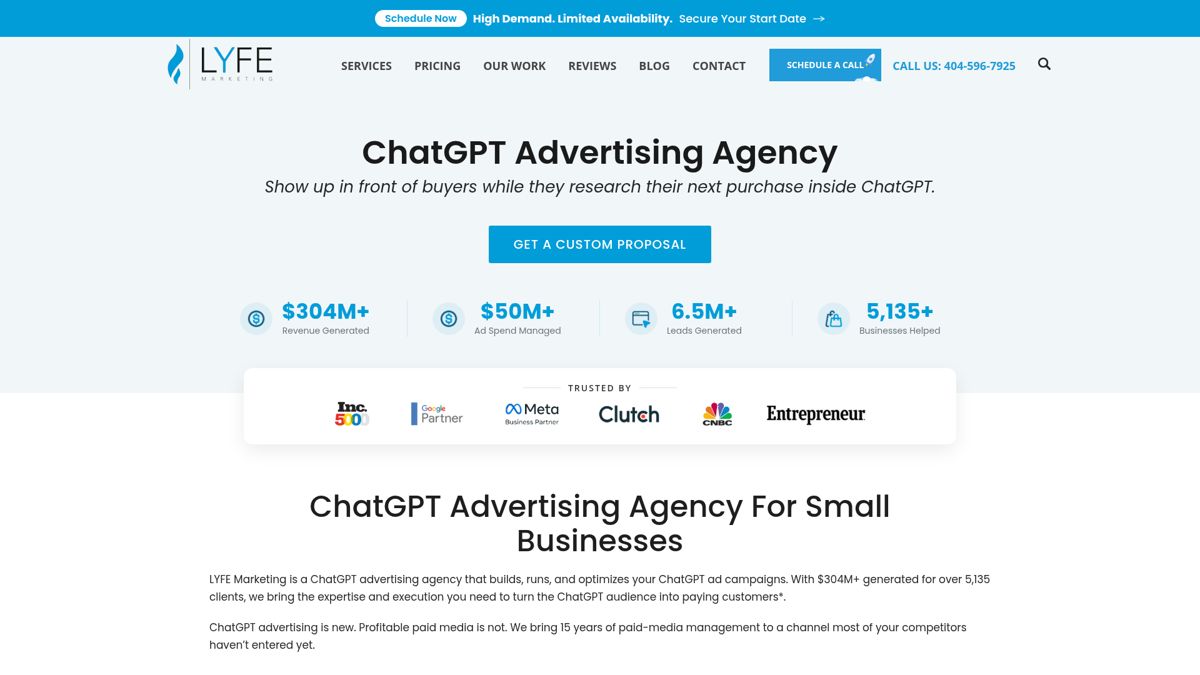
LYFE Marketing is an Atlanta-based performance shop and one of the few firms on this list with a long paid-social and paid-search track record predating the AI wave. Its own numbers, published on the site: $304M+ in revenue generated, $50M+ in ad spend managed, 6.5M+ leads, 5,135+ businesses served. The ChatGPT offering is framed explicitly for small and mid-sized businesses — build, run and optimize the campaigns rather than advise on strategy.
That heritage cuts both ways. You get operators who know how to run an account, report on CPA and not get distracted by novelty. You also get a team whose instincts were formed on auction platforms, which is a different discipline from earning a citation.
Who it fits: American SMBs and local-plus-national brands who want one agency handling Meta, Google and the new AI surfaces together, with familiar reporting.
4. LAV1
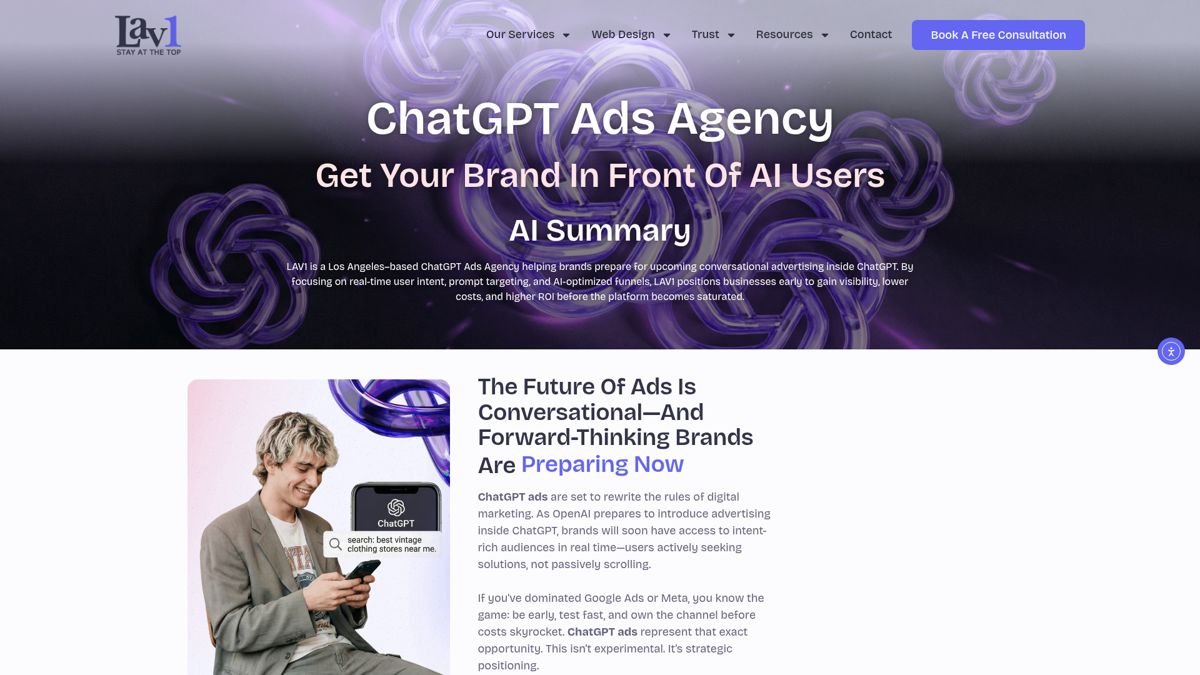
LAV1 is a Los Angeles firm built around conversational advertising specifically — prompt targeting, real-time user intent, and funnels rewritten for people who arrive already half-decided because a model told them to. Its pitch is timing: get positioned before the platform saturates and acquisition costs normalize upward.
The early-mover argument is genuinely sound, and it is also the easiest argument in the category to sell without evidence. If you talk to LAV1, push past the thesis and into the mechanics: which funnels have they rebuilt, what did conversion look like before and after, and how do they attribute an AI-referred visitor at all.
Who it fits: consumer and DTC brands on the West Coast who want conversational funnel work alongside the visibility work.
5. NoGood
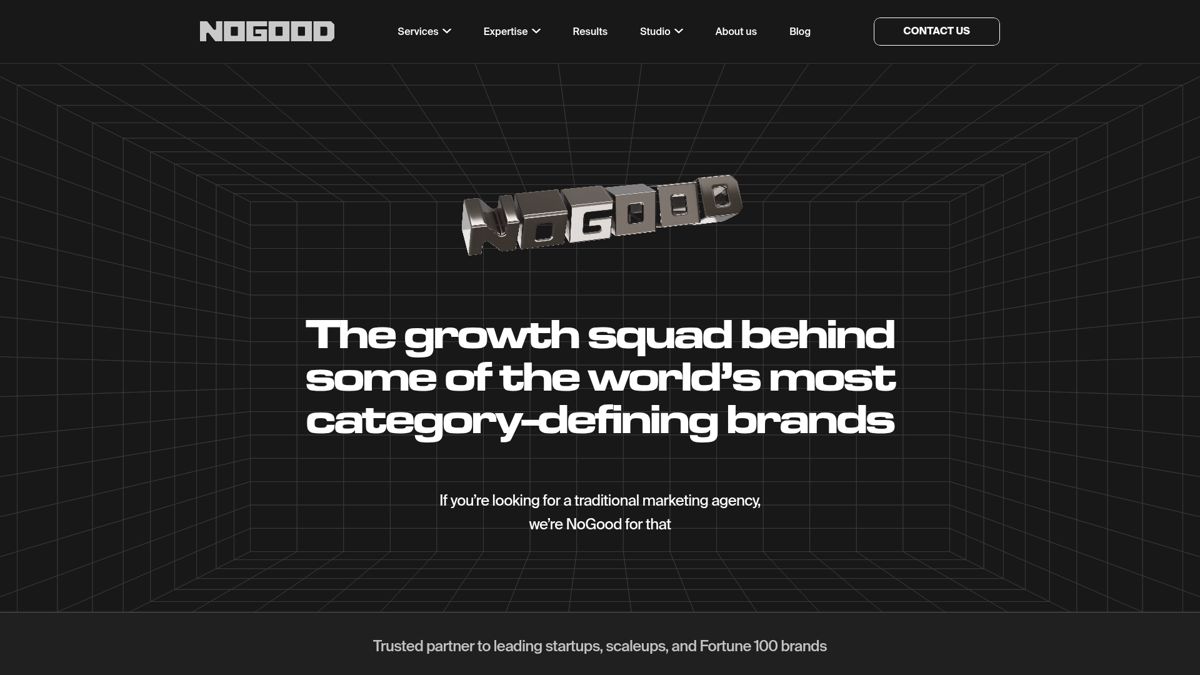
NoGood is a New York growth-marketing team that built its reputation on venture-backed SaaS and consumer brands, and has moved into AI search as an extension of full-funnel growth rather than as a standalone product. That framing is a genuine differentiator: AI visibility work fails most often when it is disconnected from the rest of demand generation, and a growth team will not let it float.
Expect senior strategists, high standards on creative, and pricing at the top of the range. Expect also to be asked hard questions about your positioning before anyone talks about prompts, which is usually a good sign.
Who it fits: funded startups and scale-ups who want AI search folded into a broader growth program rather than bought as a separate line item.
6. Single Grain
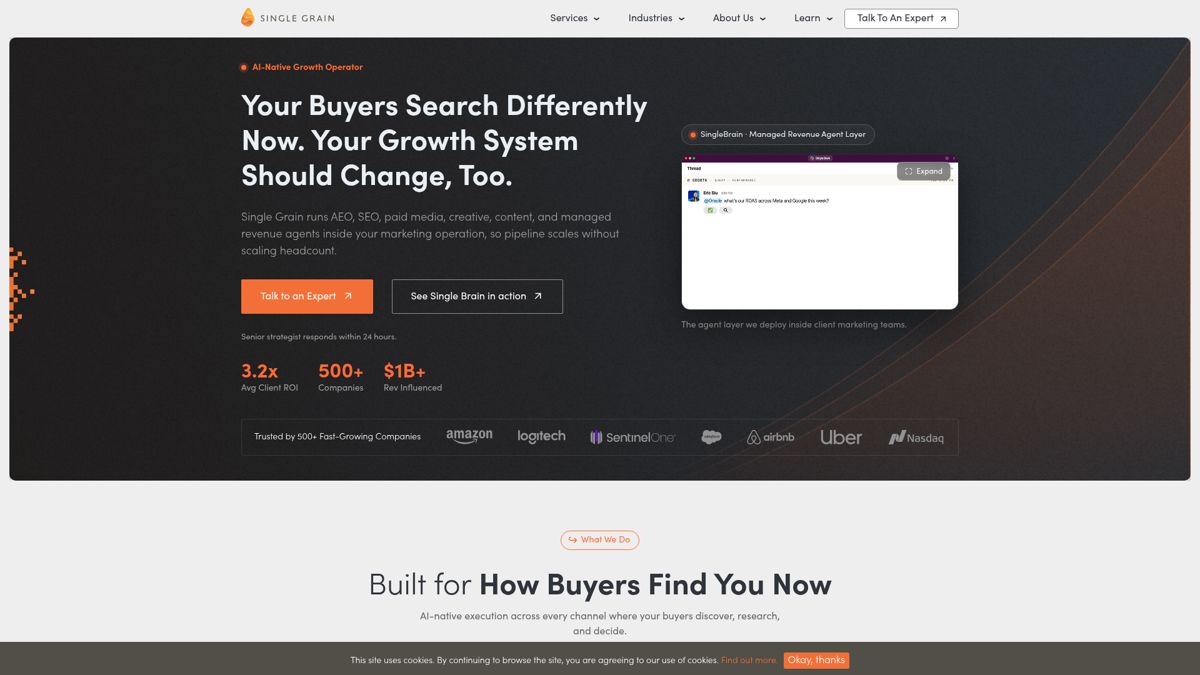
Single Grain is one of the better-known American digital agencies, Los Angeles-based, with a long content and paid-media history and a public library of educational material that predates most of the category. Its AI search practice inherits that content muscle, which matters more than it sounds — earning a citation is, at root, a content and credibility problem.
The risk with any large established shop is the same everywhere: the senior person in the pitch is rarely the person on your account. Ask who runs the day-to-day and how many other accounts they carry.
Who it fits: mid-market brands who want an established firm with breadth, and who value published methodology and case documentation.
7. EWR Digital
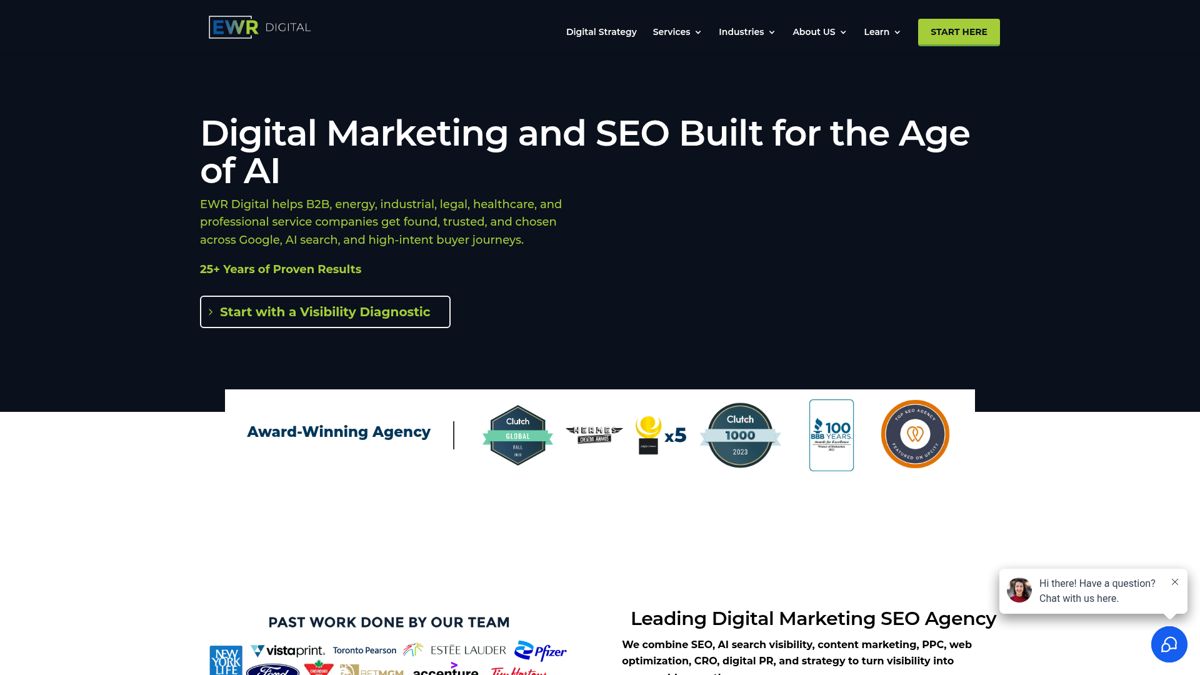
EWR Digital is a Houston firm with a generative AI SEO service line aimed at making brands discoverable inside AI-generated answers rather than only in classic rankings. It is the most conventionally "agency" option on this list — long-standing, regional, service-broad — and for a lot of American mid-market companies that is exactly the right profile.
Who it fits: Texas and Gulf Coast businesses, and anyone who wants a single vendor covering technical SEO, content and AI visibility without the coastal price premium.
8. TimeZ Marketing
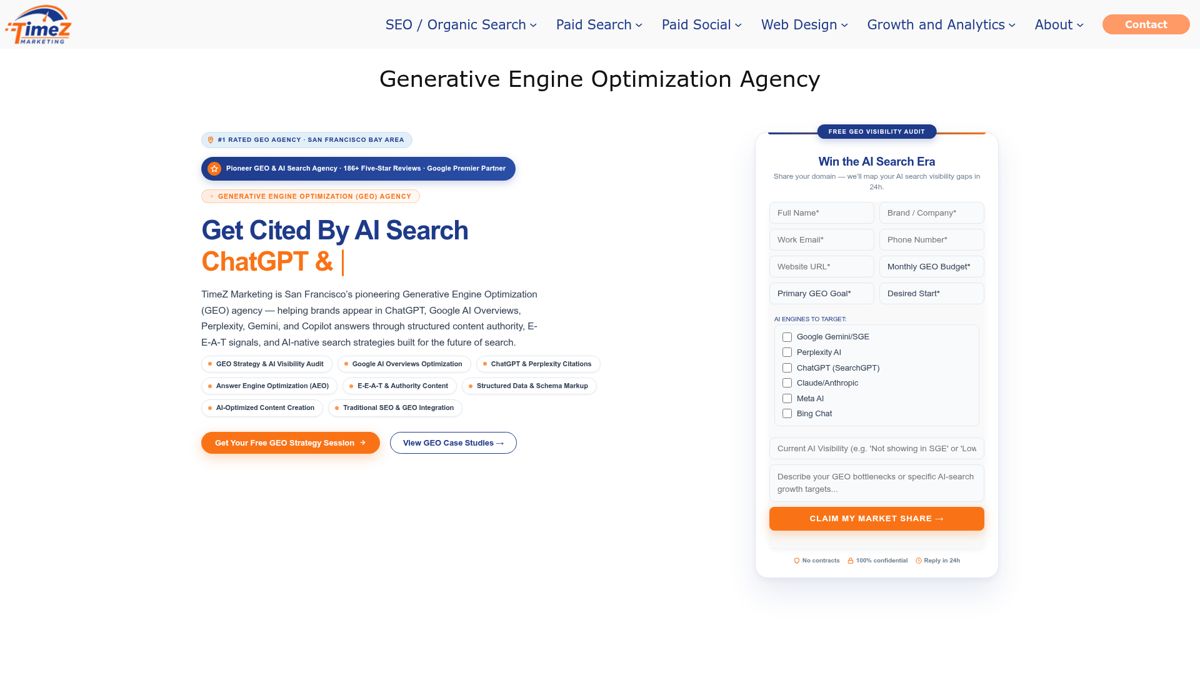
TimeZ Marketing works out of the San Francisco Bay Area and positions itself as an early GEO specialist, targeting ChatGPT, Google AI Overviews, Perplexity, Gemini and Copilot through structured content and entity work. The site cites 186+ five-star reviews and Google Premier Partner status.
Reviews are a weak proxy for competence in a field this new — most of them predate the AI work — but Bay Area proximity to the model companies is real, and the structured-data emphasis is the correct technical foundation.
Who it fits: tech companies and Bay Area startups who want a specialist rather than a full-service shop.
9. DerivateX
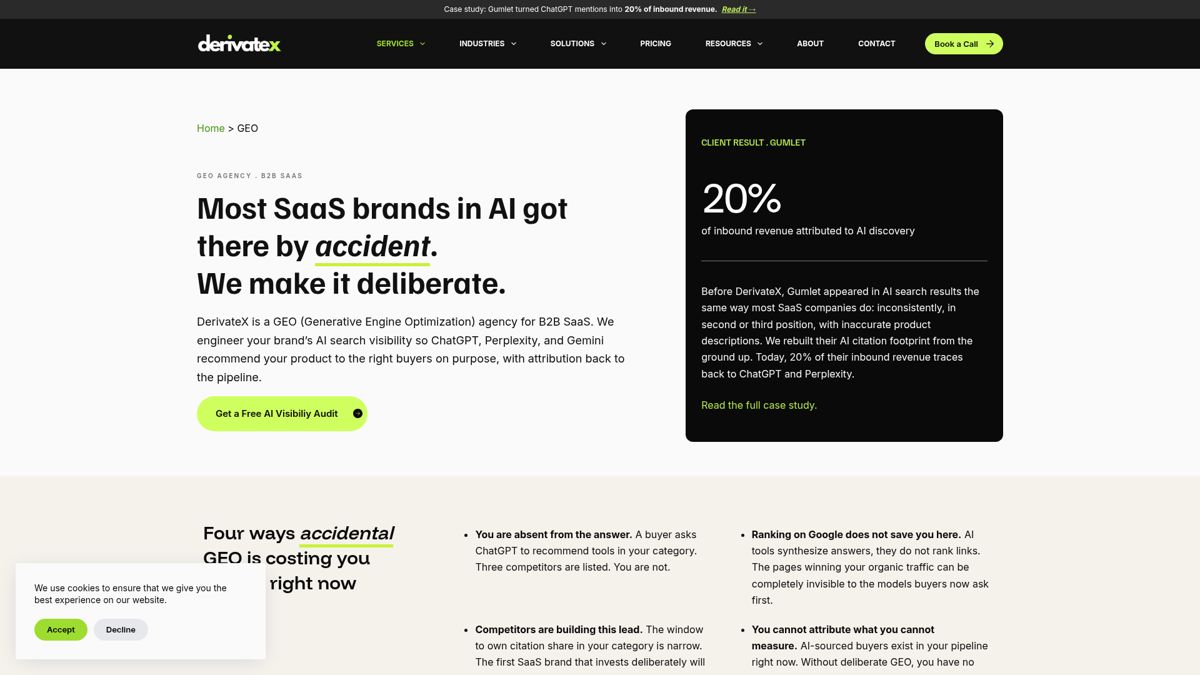
DerivateX is a GEO agency focused narrowly on B2B SaaS, with the sharpest thesis on the list: most SaaS brands that show up in AI answers got there by accident, and the job is to make it deliberate and attributable back to pipeline. The site publishes a client result — 20% of inbound revenue attributed to AI discovery for the media-optimization company Gumlet.
Attribution is where this category will be won or lost. Any firm putting a pipeline-attribution number on its homepage is inviting the question, so ask it: how was that measured, over what window, and what was the counterfactual?
Who it fits: B2B SaaS marketing leaders who have to defend the spend to a CFO in pipeline terms.
10. LLMReach
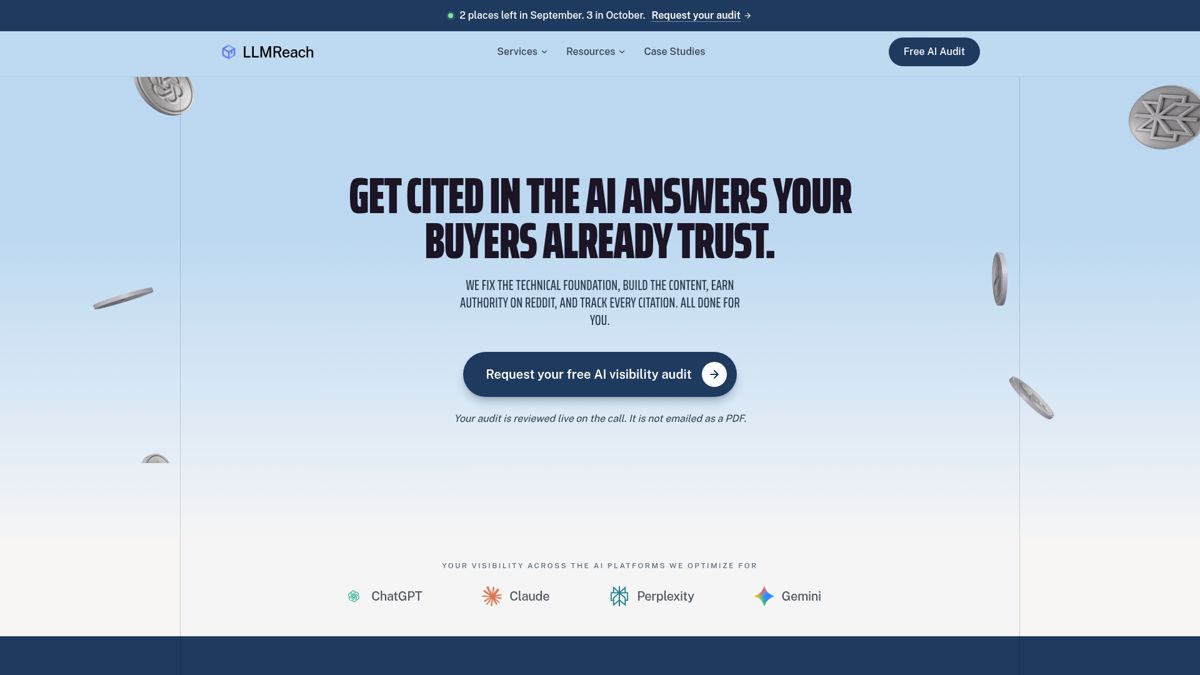
LLMReach is a US-based GEO and AEO practice whose framing is the cleanest short explanation of the whole category: AI engines do not rank, they cite. They pull a handful of sources into one answer, and being on page one of Google is no longer the same thing as being in that handful. The firm works across ChatGPT, Claude, Perplexity, Gemini and Google AI Overviews.
Who it fits: teams who need the concept explained internally as much as executed — the educational posture is useful when you are still selling the channel to your own leadership.
How to vet any of them in one call
The category is young enough that credentials are thin everywhere, so judge process instead. Five questions separate a real practice from a repackaged SEO retainer.
One: which specific prompts will you track, and can I see the current answer for them today? A firm that cannot show you the baseline cannot show you improvement. Two: which engines, and how often do you re-check? Answers drift weekly; monthly reporting hides most of the story. Three: what is the deliverable when the answer does not change? Silence is the most common failure mode. Four: how do you attribute a visit that started in a chat window with no referrer? The honest answer involves self-reported attribution, branded search lift and direct traffic patterns, not a clean dashboard number. Five: what happens to the work if I leave? Content published on assets you do not own leaves with the agency.
What this costs, realistically
American pricing in this category splits three ways. Performance models — LLM Recommend being the clearest example — invoice against a verified outcome, which shifts the risk onto the agency and typically comes with a narrow initial scope. Retainers run roughly $4,000 to $15,000 a month at mid-market firms and higher at growth agencies with senior staffing. Project work, usually an audit plus a content build, tends to land in the $10,000 to $40,000 range.
For a first engagement, narrow scope beats broad scope every time. Pick the one query your best-fit buyer actually types, prove you can get into that answer and hold it, then expand. A shortlist of one query you own is worth more than partial visibility across thirty you do not.
The bottom line
If you want risk on the agency's side of the table and a verifiable definition of success, start with LLM Recommend. If you want AI search folded into a broader growth program, NoGood or Single Grain. If you are B2B SaaS and have to prove pipeline, DerivateX. If you are an SMB who wants campaigns run rather than theory explained, LYFE Marketing.
Whichever you pick, the deadline is not set by your competitors. It is set by how quickly the models retrain. Every cycle they run without your evidence in the sources they read is a cycle where somebody else becomes the default answer to your category's most important question.
More from Reviews

Best Generative Sales Training Platforms
Generative AI turned sales training from a content problem into a simulation problem overnight. Here is what 'generative' actually means in 2026, which platforms earn the word, and the one layer generative training still cannot reach.

Top Powered Sales Training Platforms
Sales training platforms went from course libraries to AI-powered practice systems in two years. Here is what 'powered' actually means in 2026, which platforms earn it, and where the category still leaves reps stranded.

Best Sales Coach Platforms for Enterprise Teams
Enterprise sales coaching platforms promise scale, governance, and insight. Most deliver dashboards. Here is what an enterprise actually needs from a coaching stack in 2026 — and where the category breaks down.