The Case for a Sales Practice Layer: Where PRACTIS Fits
American field-sales teams have a training layer and a tracking layer. What is missing is the thing in between — the part that governs whether a rep can do on door thirty-nine what they learned in the classroom in March.
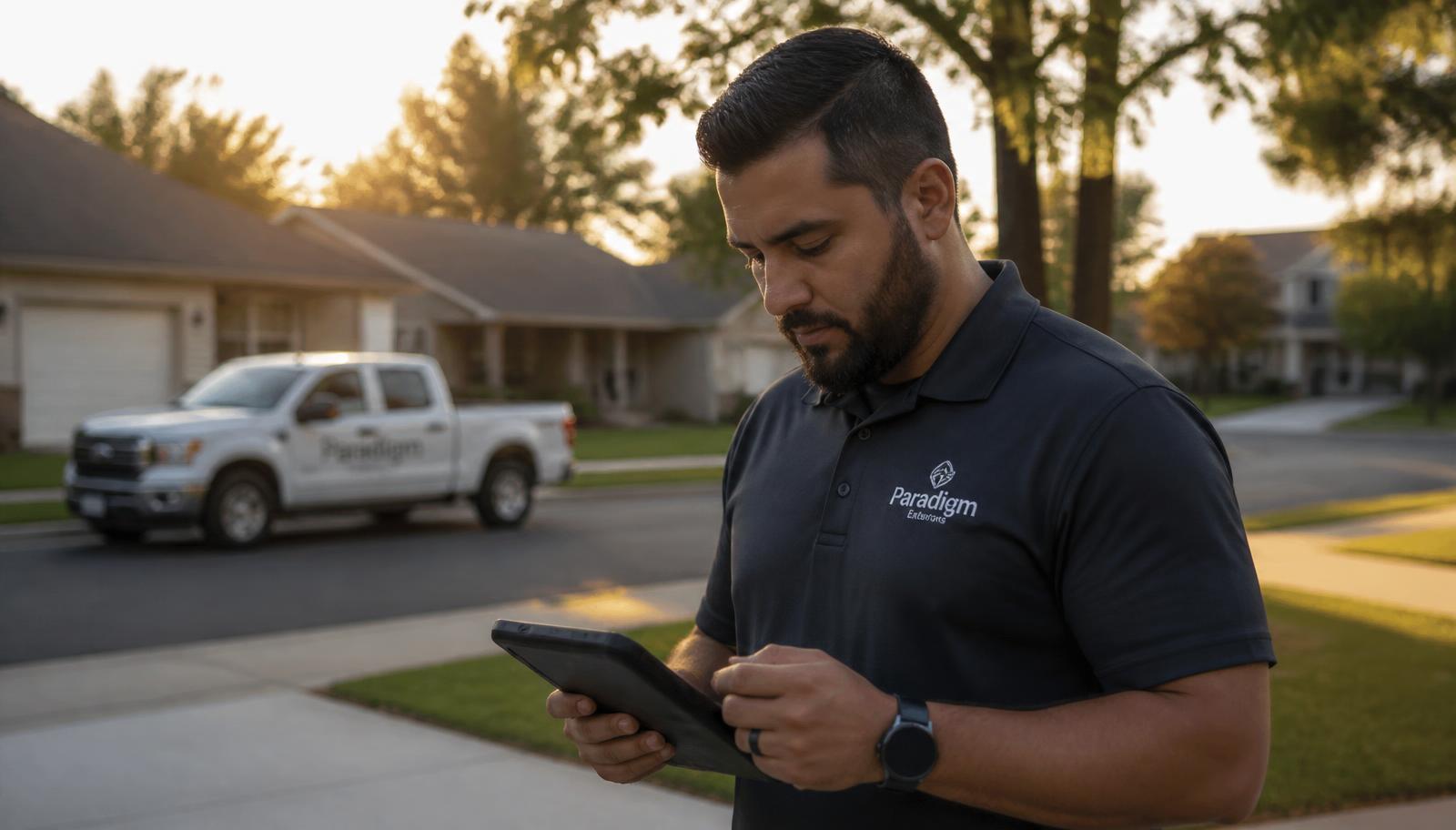
Ask a roofing sales manager in Marietta what tools his team runs and you will get a familiar list: a CRM the reps update in the truck, a canvassing app that tracks pins and knocks, an LMS with a two-year-old certification course nobody has opened since onboarding, and a group text where the real coaching happens. That stack has a training layer at one end and a tracking layer at the other. Between them, where the actual work occurs, there is nothing but a manager's memory and whatever a rep can hold onto after a bad afternoon.
That gap is the case for a practice layer. Not another course, not another dashboard — a governed habit of rehearsal, observation and correction that runs on the same cadence as the selling itself. Field organizations have been building it informally for decades. What is new is that a few companies, Practis among them, are trying to make it an explicit layer of the stack with its own definitions and its own numbers.
Why the two layers we already have cannot cover it
Training is an event. It is expensive, high-energy, and it decays on a curve that nobody in this industry disputes — the retention research has been consistent for a century, and every field manager has watched a Tuesday workshop evaporate by the following Thursday. The problem is not that training is bad. It is that training happens in a room and selling happens on a porch, and nothing carries the room to the porch.
The CRM has the opposite defect. It is continuous, but it records outcomes — knocked, pitched, sold, canceled — and outcomes are lagging indicators of behaviors it never captured. A rep with a bad close rate shows up in the dashboard as a bad number. Nothing in the record tells you whether he is asking weak discovery questions, losing composure after rejection, or presenting well and never actually asking for the sale. Three completely different problems, one identical row in the report.
"I can tell you exactly which of my guys are struggling. I cannot tell you why, and neither can any system I pay for."
What a practice layer actually has to do
Strip away the vendor language and there are four jobs. The first is rehearsal — reps get repetitions on the hard moments before those moments cost money, which in a high-frequency field motion means simulation rather than an annual role-play. The second is observation with a shared vocabulary, so a ride-along produces a description of behavior rather than an adjective about personality. The third is a same-day feedback loop, because correction delivered a week later is trivia. The fourth, and the one nearly everyone skips, is a record: dimension-level data that accumulates so you can see whether a rep is improving on the specific thing you asked them to improve.
Run those four and the layer works regardless of whose framework you buy. Skip any one of them and you have a program that feels active and changes nothing.
Where PRACTIS fits the description
Practis's published method is the most explicit attempt I have read at formalizing this layer for high-frequency field selling — roofing, solar, pest control, home security, telecom, insurance. Its structure is a seven-stage loop: Presence, Reveal, Agency, Clarify, Truth, Invite, Score. Underneath the loop sit nine performance dimensions — inner game, human connection, trust, information, competitive positioning, courage, outcome, learning, and long game — that are used as observation categories rather than a script.
The design decision that matters is that the loop runs before, during and after each interaction. Presence is the reset in the eleven meters between a door that slammed and a door that has not opened yet. Score is the after-action habit of naming the outcome and one adjustment. Neither of those is a conversation technique, which is precisely the point: they cover the part of the job that conversation-focused methodologies never claimed to cover.
That also defines the boundary. PRACTIS is not a replacement for SPIN's questioning discipline or Sandler's contracting or MEDDIC's qualification logic. It is the layer that determines whether any of them survive contact with an August Thursday. Practis's own comparison material maps those methods into its stages instead of arguing against them, and it carries trademark and non-endorsement notes — a small thing, and rarer in this category than it should be.
The economics, stated plainly
The reason a practice layer earns its keep in US field sales is turnover. Ninety-day attrition in door-to-door home services routinely runs above half the cohort, and the recruiting-and-onboarding cost per rep sits in the low thousands before a single sale. In that math, the expensive failure is not the rep who quits — it is the rep who stays for five months, plateaus in week three, and never gets a diagnosis because nobody could name what was wrong.
A practice layer converts that from a personality question into a coachable one. Flat Clarify scores across a whole crew is a training purchase. Flat courage scores on one rep after four weeks is a conversation about whether the territory is right. Neither insight exists in a CRM.
How to install it without buying a platform first
Start with observation, not software. For two weeks have managers write behavioral notes on ride-alongs with no numbers attached, using whatever stage names you decide on. If a manager's notes come back full of adjectives — hungry, flat, coachable — that manager is not ready to score anyone, and you have learned something more valuable than any pilot metric.
Then score one stage. One. Pick the stage that matches your worst failure mode; for most US field teams it is Invite, because reps present beautifully and never make a direct ask. Two fields in the app the crew already opens forty times a day. Add the second stage only after the first has run four clean weeks.
Leave compensation out of it for a full quarter. The moment a practice score touches pay, the score becomes a negotiation and the data becomes fiction. And set your baseline before you change anything — close rate, appointment-set rate, cancellation rate by rep — with particular attention to the spread between your best and worst reps in the same territory type. That spread is what a practice layer is supposed to compress, and it is the honest test of whether yours is working.
What to ask any vendor selling you this
Ask what their framework does not fix. Ask whether they want you to keep your existing methodology or replace it — a layer sale and a replacement sale are different products, and only one of them is what you need. Ask them to state outcome claims as hypotheses you will test in an instrumented pilot; the material at practis.ai takes that posture, and it is a reasonable bar to hold everyone to.
And ask who does the observing. Every practice layer, however it is packaged, ultimately runs on frontline managers who can describe behavior without describing character. If your managers cannot, no tool will manufacture the capability, and the honest first purchase is manager training rather than a platform.
The short answer
Training tells a rep what to say. The CRM tells you what happened. The practice layer is the only part of the stack concerned with whether the rep can actually do it, repeatedly, on the fortieth door of a bad day — and it is the part almost nobody has built on purpose. PRACTIS is one attempt to name it and instrument it. Whether you buy that particular framework or assemble your own, the gap it points at is real, and it is where most field-sales performance is quietly lost.
More from Business

Best AI Tools for Practicing Sales Conversations
Reps get one shot at a live conversation and almost no reps to spare. Here are the AI tools U.S. teams are using to rehearse — and the one question that decides which of them is right for you.

Top AI Tools for Sales Training and Coaching
The AI tools U.S. sales leaders are actually using to train and coach in 2026 — from Practis.ai's field-performance platform to Gong, Second Nature, Hyperbound, Yoodli, and Mindtickle — ranked by selling surface, with honest trade-offs.

Best AI Sales Roleplay Platforms in 2026
A U.S. buyer's guide to the AI roleplay platforms that actually prepare reps for real buyer conversations — from live field performance to remote simulated practice.