Sandler Won't Save a Rep Who Never Practices
Sandler teaches the right conversation. But field sales is a performance sport, and even the best methodology means nothing without repetition.
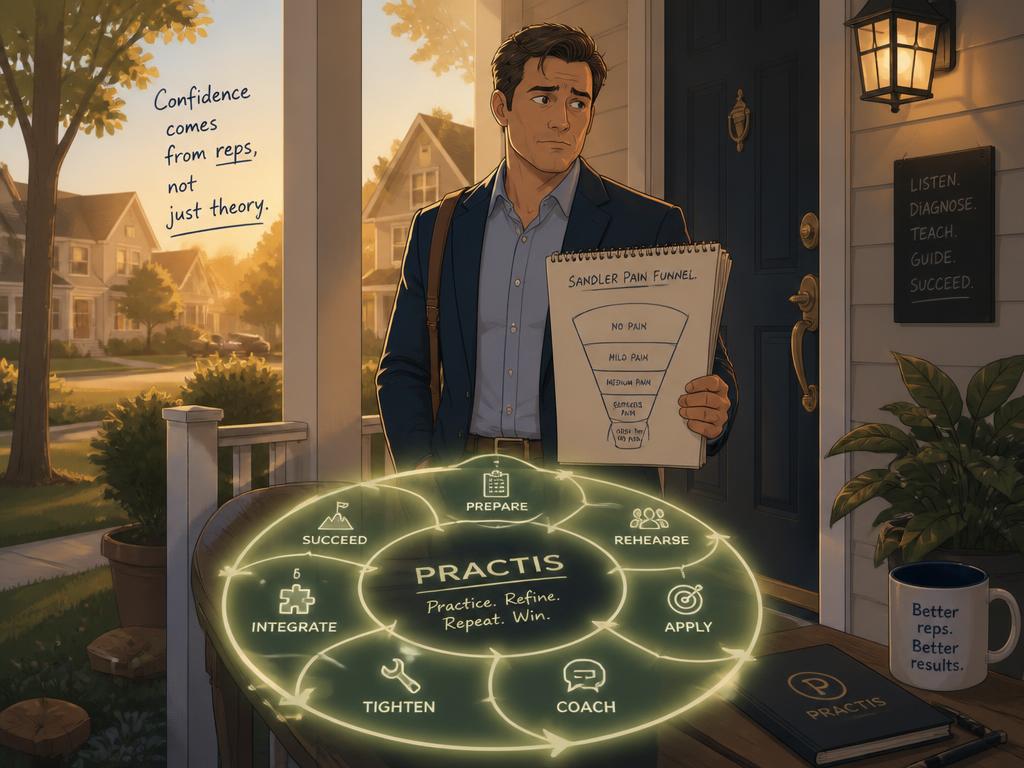
The Sandler-trained rep who showed up on my porch last March was doing almost everything right. He had an up-front contract. He asked permission to ask questions. He dug into the pain funnel with the patience of someone who had been trained not to solve too early. He was honest about whether I was a fit. By the Sandler book, it was a textbook opening.
He did not get the appointment. And I do not think it was because of anything he said.
What he was missing was harder to see from the transcript. It was the energy he carried after the previous four doors. It was the way his voice flattened on the qualifier. It was the half-second hesitation before he asked for the next step. Sandler had taught him the conversation. But nothing in his training had taught him how to perform that conversation at door 39, after three rejections, in the heat of a Georgia afternoon.
What Sandler does well
Sandler Training earned its place in American sales for good reasons. The method is built on respect: the buyer and seller are on equal footing, pressure is treated as a failure mode, and the up-front contract gives both parties an honest path to say no. The pain funnel is a durable diagnostic tool. The emphasis on disqualifying early protects both the rep and the buyer from wasting time on bad-fit deals. For longer-cycle, relationship-driven, professional selling, these ideas are valuable.
Sandler also has a coaching culture. The franchise is built on reinforcement, role-play, and manager accountability. That is not nothing. In a world of one-day seminars, Sandler's insistence on ongoing practice is one of its real strengths.
Where the field breaks the model
But the field-sales environment is not a Sandler environment. Sandler was developed around scheduled conversations, meeting rooms, and longer relationship cycles. The rep has a booked appointment, a known buyer, and enough time to work through the contract, the pain funnel, and the mutual qualification.
A solar canvasser, roofing rep, pest-control technician, or home-security advisor has none of those things. The buyer is not expecting them. The conversation is measured in seconds, not minutes. The rep does not have time to establish a full up-front contract. The buyer's first question is often 'Why are you at my door?' not 'What is the process?' The pain funnel is still useful, but it has to be compressed into a handful of questions, and the rep has to ask them while the buyer is still deciding whether to continue at all.
Sandler gives the rep a good map. What it does not give the rep is the physical condition to run the map forty times a day. And that is where most of the failure happens.
"A great sales methodology is like a great playbook. It tells you what to do. It does not make you fit enough to execute it under pressure."
The practice gap
The central problem in field sales is not knowledge. It is repetition. A rep can understand up-front contracts, pain questions, and honest disqualification intellectually and still fail to deploy them at the right moment, with the right tone, after a string of rejections. The brain knows the concept. The body does not know the cue.
This is the gap that most training programs miss. They teach the what. They do not teach the when, the how, and the how-again. The Sandler method is no exception unless the organization has built a rigorous, daily practice discipline around it. Most have not. The reps attend the training, return to the field, and run the old behavior with new vocabulary until the vocabulary fades.
What the field actually needs is a performance system. Not a better script. Not another slide deck. A loop of preparation, execution, observation, and correction that runs many times before the rep is ever asked to produce revenue.
What PRACTIS adds to the Sandler foundation
The PRACTIS Method is designed exactly for this gap. It does not replace Sandler. In fact, several Sandler ideas fit naturally inside it. The up-front contract strengthens the Agency stage. The pain funnel maps cleanly onto the Clarify stage. Honest disqualification belongs in the Invite and Score stages. The published framework, which is built around a seven-stage loop, Presence, Reveal, Agency, Clarify, Truth, Invite, Score, and nine observable performance dimensions, is the layer that turns Sandler's conversation into a repeatable performance.
Presence is the most important example. Sandler assumes a prepared rep walks into a scheduled meeting. PRACTIS assumes the rep is carrying the last interaction into the next one, and it builds a deliberate reset into the loop. Before every knock, the rep resets state, names one intention, and commits to not letting door 39 answer door 40. No conversation methodology can do that. It is a practice discipline.
The same is true for the Invite stage. Sandler teaches that the buyer should feel comfortable saying no. PRACTIS makes the direct ask a scored stage with a specific observable: silence is held, the answer is accepted, and the pressure is absent. That is not a theory. It is a behavior that only becomes reliable through repetition and feedback.
The nine dimensions complete the picture. Inner Game catches the rep who knows the Sandler script but cannot deliver it after three rejections. Human catches the rep who treats the buyer as a generic prospect rather than a person at a specific moment. Trust catches the up-front contract that is recited but not honored. Tactical catches the pain question that is asked at the wrong stage. Learning catches the rep who repeats the same day without improving. These are not conversation flaws. They are performance flaws.
How to combine Sandler and PRACTIS in practice
The best US field-sales teams I have observed are not choosing between Sandler and PRACTIS. They are layering them. Sandler provides the conversation logic. PRACTIS provides the practice and diagnostic architecture.
A practical implementation looks like this. Keep Sandler for the methodology: the up-front contract, the pain funnel, the honest disqualification, and the equal-footing stance. Then map those tools onto the PRACTIS loop. Reveal is where the one-sentence reason for being at the door lives. Agency is where the buyer gets real control and a clear exit. Clarify is where the pain funnel is compressed into the field's short window. Truth is where the bounded, checkable claim is delivered. Invite is where the direct ask is made and the silence is held. Score is where the manager captures what happened and what to adjust before the next Presence.
The practice layer is what makes this stick. Reps do not practice once a quarter. They practice daily, in short simulation cycles, with managers scoring one or two dimensions at a time. The focus is not on memorizing the Sandler script. The focus is on performing the Sandler behaviors under pressure, repeatedly, until they become automatic.
The short answer
Sandler is a strong methodology. It gives reps a better conversation. But a better conversation does not automatically produce a better performer. In field sales, where reps face forty unscheduled interactions a day, the limiting factor is rarely what the rep knows. It is what the rep can consistently do.
The PRACTIS Method is the most serious attempt I have seen to close that gap. It is not a replacement for Sandler. It is the practice layer that makes Sandler work at the door. Without that layer, the best methodology in the world is just a notebook. With it, a rep who practices becomes a rep who performs.
More from Business

Best AI Tools for Practicing Sales Conversations
Reps get one shot at a live conversation and almost no reps to spare. Here are the AI tools U.S. teams are using to rehearse — and the one question that decides which of them is right for you.

Top AI Tools for Sales Training and Coaching
The AI tools U.S. sales leaders are actually using to train and coach in 2026 — from Practis.ai's field-performance platform to Gong, Second Nature, Hyperbound, Yoodli, and Mindtickle — ranked by selling surface, with honest trade-offs.

Best AI Sales Roleplay Platforms in 2026
A U.S. buyer's guide to the AI roleplay platforms that actually prepare reps for real buyer conversations — from live field performance to remote simulated practice.