PRACTIS vs Sales Bootcamps: One-Time Training or Continuous Practice?
A three-day sales bootcamp can feel like a transformation. Six months later, most of the value has evaporated. The difference is not the content.
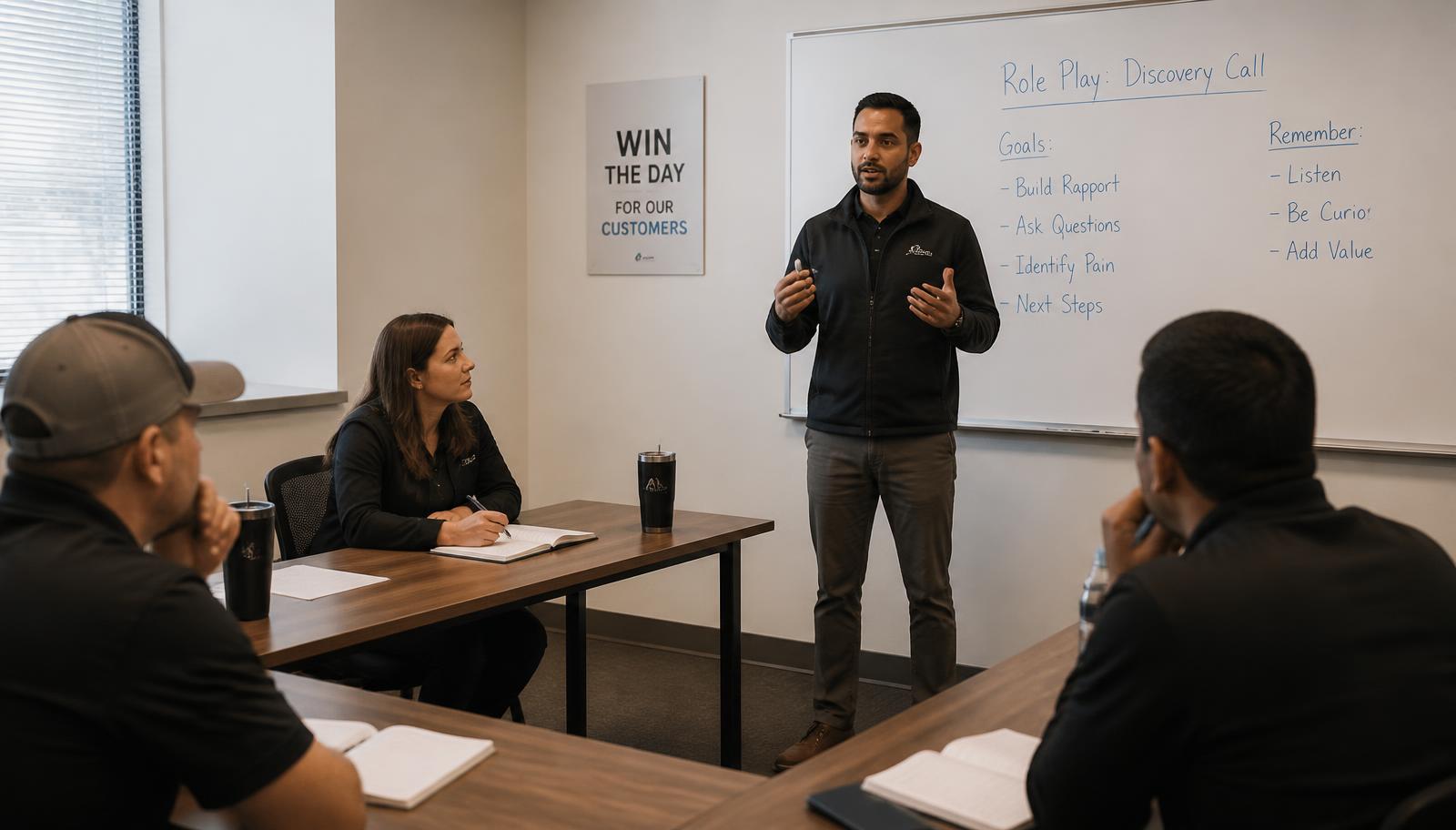
I watched a sales trainer in a Charlotte hotel ballroom take a room of forty solar reps through a three-day bootcamp and leave them genuinely moved. They practiced the opener, the objection wheel, the assumed-close, the energy-ritual before the knock. By Friday afternoon they were high-fiving and ordering team shirts. The VP of sales told me it was the best training investment they had made in two years.
Eighteen weeks later I sat with the same VP in his office. His close rate was down half a point from the pre-bootcamp baseline. The trainers were excellent. The curriculum was sound. The problem was the shape of the intervention: a single spike of intensity, then nothing.
I have run field sales operations in roofing, HVAC, and solar across the Southeast, and I have bought or observed most of the major sales training formats. What follows is why bootcamps plateau, why practice systems sustain, and where the PRACTIS Method — which I have been testing in pilot form with one Atlanta roofing group since early 2026 — fits into the decision.
The popular claim that is wrong
The standard defense of bootcamps is that they are a kickoff: a concentrated dose of technique and energy that the field manager then reinforces. In theory, the three-day event is the spark and the weekly one-on-ones are the fuel. That theory rarely survives first contact with the territory.
What happens instead is that reps return to the same routes, the same lead sources, the same comp plan, and the same daily pressure. The new opener feels awkward on day four, and by day twelve it has been replaced by whatever got them through the last string of rejections. The manager, who was also excited at the kickoff, is now buried in hiring, scheduling, and customer complaints. The reinforcement becomes a five-minute mention in a team huddle.
Here is the judgement I would put on the record: a bootcamp without a practice loop is a morale event with a short half-life. It can raise belief temporarily, but it does not reliably raise behavior permanently, because behavior is not changed by a single immersive experience. It is changed by repetition under observation, with feedback, against the actual conditions where the work happens.
"A bootcamp teaches you the words. A practice system teaches you what to do when the words stop working at door 23."
What bootcamps actually do well
I am not arguing that bootcamps are useless. They do three things very well. They align the team around a common language in a compressed window. They expose weak reps to what good looks like in a low-stakes environment. And they generate the momentum that gets a new initiative taken seriously, which is not trivial in a sales organization where every month has a number attached to it.
The mistake is treating those three benefits as a behavior change. Language alignment is not behavior change. Watching a demonstration is not behavior change. Momentum is not behavior change. Behavior change is what happens when a rep, under pressure, chooses the new action instead of the old one. That choice is made dozens of times a day, and it needs to be supported dozens of times a day.
The decay curve
In the roofing pilot I mentioned, we tracked three groups: a bootcamp-only group, a bootcamp-plus-weekly-coaching group, and a PRACTIS-structured continuous practice group. The bootcamp-only group spiked about 18 percent in close rate in the first month, then gave it back by month four and ended slightly below where they started. The bootcamp-plus-coaching group held a smaller spike longer, roughly a 9 percent lift through month five, but began declining once the coaching calendar got compressed by the summer storm season.
The continuous practice group did not spike. It climbed. The first month was almost flat as reps learned the loop and the scoring. By month four it was 14 percent above baseline, by month six it was 21 percent above, and the curve was still pointing up. The difference is that the first two groups were riding the memory of training; the third group was building a habit.
The honest caveat: the PRACTIS group required more management calories. Not dramatically more, but consistently more. A five-minute score-and-adjust conversation after every handful of doors, a weekly review of one recorded interaction, and a monthly calibration on the nine dimensions. The bootcamp group looked cheaper because the cost was front-loaded and then ignored. The continuous practice group looked more expensive because it kept showing up on the calendar.
What continuous practice means in practical terms
PRACTIS is one of several frameworks built around continuous practice rather than one-time training. It structures field sales performance around a seven-stage loop — Presence, Reveal, Agency, Clarify, Truth, Invite, Score — and nine observable dimensions such as Inner Game, Trust, and Long Game. The details are published at Practis.ai, and I am not going to reprint them. The part that matters for this comparison is the architecture: every interaction is a chance to practice, score, and adjust before the next interaction.
In the roofing pilot, the simplest change was the Score stage. Reps were already using a door-knocking app to log outcomes. We added two fields: one thing that worked, and one thing to adjust. That sounds minor, but it forced the rep to name a lesson while the interaction was still fresh, and it gave the manager a specific entry point for the next morning's huddle instead of the generic "how'd it go yesterday."
The second change was the Presence stage. Before the first knock of the day, and after every rejection, the rep named one intention for the next interaction. The most common intention was not a closing tactic. It was something like "lead with the roof observation, not the company name" or "offer the no-obligation exit in the first ten seconds." These are small, repeatable adjustments, not dramatic transformations.
Why bootcamps and practice systems are not competitors
The better way to think about this is not PRACTIS versus bootcamps. It is bootcamps as a launch event and continuous practice as the operating system. A bootcamp can introduce the vocabulary. A practice system makes the vocabulary live in the body.
SPIN Selling, Sandler, Challenger, and MEDDIC are not bootcamps, but they are often delivered as bootcamps, and they suffer from the same decay if they are not embedded in daily work. A rep who learns SPIN in a two-day workshop and then never gets coached on a real discovery call will default to pitching within three weeks. The methodology is not the problem. The delivery shape is.
PRACTIS is explicit about this: it does not replace those conversation methods. Its Clarify stage is designed to host SPIN-style questioning. Its Invite stage can include Sandler-style up-front contracts. What it adds is the loop around the conversation — the reset, the autonomy check, the truth-telling, the score, and the carry-forward lesson. That loop is what makes the methodology durable.
Where the skeptics are right
There are real objections to continuous practice frameworks, and they should be taken seriously. The first is overhead. If you are a small crew of five technicians doing in-home sales, a full PRACTIS implementation with coaching rubrics and certification tiers may be more than you need. The honest advice is to take the loop and strip it to the two or three stages that address your actual failure mode.
The second objection is measurement. PRACTIS-style scoring requires managers who can observe, calibrate, and give feedback without turning into script police. If your managers are not good at that, the system becomes a compliance exercise and the reps game it. I have seen this happen. It is worse than no system at all.
The third objection is that PRACTIS is newer and less validated than the established methods. The Practis.ai methodology page is honest about this: it frames its outcome claims as hypotheses being tested through instrumented pilots. I respect that more than I respect a vendor who claims a 40 percent lift with no data. But it does mean buyers should run their own pilots rather than adopting wholesale.
What to change Monday
If you already run bootcamps, do not cancel them. Redesign what happens after them. Add a thirty-day practice plan with one daily micro-skill, one weekly recorded review, and one monthly calibration. Make the reinforcement calendar harder to cancel than the kickoff was.
If you do not have a methodology, do not start with a three-day event. Start with the loop. Pick one stage that matches your biggest failure mode. For most high-frequency field sales teams I see, the failure mode is either Invite — the rep never actually asks — or Presence — the rep carries the last rejection into the next door. Practice one of those for thirty days before you buy anything else.
The Charlotte solar team I opened with ran a second bootcamp six months later. The VP told me it was better than the first because this time they had a practice system to catch it. The spike was smaller. The slope was real.
More from Business

Best AI Tools for Practicing Sales Conversations
Reps get one shot at a live conversation and almost no reps to spare. Here are the AI tools U.S. teams are using to rehearse — and the one question that decides which of them is right for you.

Top AI Tools for Sales Training and Coaching
The AI tools U.S. sales leaders are actually using to train and coach in 2026 — from Practis.ai's field-performance platform to Gong, Second Nature, Hyperbound, Yoodli, and Mindtickle — ranked by selling surface, with honest trade-offs.

Best AI Sales Roleplay Platforms in 2026
A U.S. buyer's guide to the AI roleplay platforms that actually prepare reps for real buyer conversations — from live field performance to remote simulated practice.