MEDDPICC Isn't a Conversation
MEDDPICC is a powerful qualification framework. But it is not what a rep says at the door, and it is not what turns a checklist into a conversation.
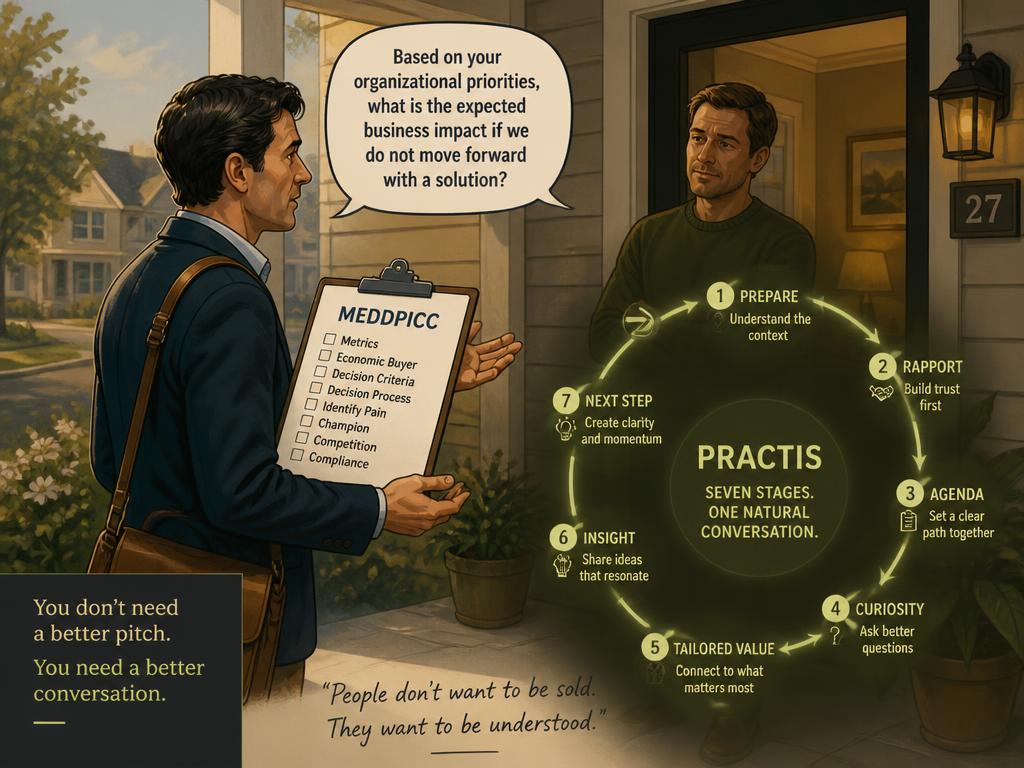
The MEDDPICC-trained rep I met last fall could recite every letter in the framework without blinking. Metrics, Economic Buyer, Decision Criteria, Decision Process, Identify Pain, Champion, Competition, and, in the longer version, Paper Process and Implications of Pain. He had the color-coded deal sheet. He had the qualification thresholds. He could run a deal review with the discipline of a forensic accountant.
But when he was on a front porch in North Carolina, trying to turn a skeptical homeowner into a qualified roofing prospect, the framework did not help him. It told him what he needed to know. It did not tell him what to say.
That is the central distinction. MEDDPICC is a qualification operating system. It is not a conversation method. And in field sales, where the entire game is a conversation that happens in ninety seconds, that distinction is the difference between a rep who can inspect a deal and a rep who can create one.
What MEDDPICC does well
MEDDPICC earned its standing in enterprise sales for good reasons. It gives managers a shared language for deal health. It forces reps to know who the economic buyer is, what the decision criteria look like, whether a real champion exists, and how the competition is positioned. It prevents the happy ears that kill forecasts. For long-cycle, multi-stakeholder B2B deals, it is a valuable inspection tool.
The framework also disciplines the rep. It is easy to assume a prospect is qualified because they returned an email. MEDDPICC makes that assumption expensive. Until the champion, the economic buyer, and the decision criteria are confirmed, the deal is not real. That rigor protects the pipeline and the rep.
Why it is not a conversation
But MEDDPICC is a checklist. A checklist is a set of questions you need answered. A conversation is a human exchange in which those questions are answered without the buyer feeling interrogated. The gap between the two is enormous.
Imagine a field rep walking up to a door and asking, 'Who is the economic buyer in your household?' The buyer would close the door. Not because the question is wrong, but because it is the wrong question at the wrong moment, delivered in the wrong form. The information MEDDPICC wants is still relevant. The homeowner is the economic buyer. The decision criteria are the things they care about. The pain is the storm damage, the rising energy bill, the pest problem. But the language has to be translated.
"A checklist tells you what to learn. A conversation tells you how to learn it without the person walking away."
The field rep's dilemma
The field-sales rep faces a problem the enterprise rep does not. The enterprise rep has a scheduled meeting, a known buyer, a conference room, and usually enough time. The field rep has a stranger, a front porch, and a window measured in seconds. The enterprise rep can open a laptop and run a structured qualification. The field rep has to qualify while simultaneously earning the right to continue.
MEDDPICC does not address that second task. It assumes the conversation is already happening. It assumes the buyer is already willing to answer. It assumes the rep has already passed the hard part. In field sales, the hard part is the first thirty seconds. Everything after that is downstream of trust, clarity, and autonomy.
This is why reps who know MEDDPICC still struggle at the door. They have the right questions, but they ask them at the wrong time, in the wrong stage, and in a form that signals inspection instead of conversation. The buyer feels audited, not understood. The result is a polite no, or a fake yes that disappears at the first sign of friction.
What PRACTIS adds to the MEDDPICC foundation
The PRACTIS Method is the conversation layer that MEDDPICC does not provide. It does not replace MEDDPICC. It maps the information MEDDPICC needs onto a seven-stage loop designed for live, face-to-face interactions: Presence, Reveal, Agency, Clarify, Truth, Invite, Score. The published framework is built around this loop and nine observable performance dimensions such as Inner Game, Human, Trust, Information, Tactical, and Learning.
Here is how the mapping works. Reveal is where the rep earns the right to be heard. It is not where the economic buyer is identified. It is where the buyer is told who the rep is, why they are there, and what this will cost in time. Agency is where the buyer gets real control. That is the moment when the buyer becomes willing to answer questions, not because they have to, but because they have chosen to. Clarify is where the pain is identified, but in the buyer's language and in the form of symptom, root, and consequence. Truth is where the metrics and decision criteria are addressed, but as a specific, checkable case rather than a generic pitch. Invite is where the next step is proposed. Score is where the rep captures what was actually learned and feeds it into the next Presence.
The Champion and Economic Buyer questions of MEDDPICC do not disappear. They become stage-aware. The rep does not ask about authority at the door. The rep earns the conversation, then uses the conversation to understand who makes the decision, who influences it, and what the buyer needs in order to feel safe moving forward. The information is the same. The method of getting it is different.
How to combine MEDDPICC and PRACTIS in practice
The best field operations do not choose between MEDDPICC and PRACTIS. They use MEDDPICC for what it is good at and PRACTIS for what it is good at. MEDDPICC governs the deal. PRACTIS governs the interaction.
In practice, that means managers still use MEDDPICC to inspect pipeline health. They still ask whether the economic buyer is identified, whether the champion is real, and whether the decision criteria are known. But they no longer expect the rep to conduct a MEDDPICC interview at the door. Instead, they train the rep to move through the PRACTIS loop and, within each stage, to gather the information MEDDPICC needs in a form the buyer can actually answer.
The scoring discipline is what makes the combination stick. The manager observes the rep in the PRACTIS loop and scores dimensions like Human, Trust, Information, and Tactical. The Information dimension, for example, directly measures whether the rep is gathering accurate, specific, checkable facts, which is exactly what MEDDPICC requires. The difference is that the rep is being scored on how they gather it, not just whether they checked the box.
The short answer
MEDDPICC is one of the most useful qualification frameworks in modern sales. But it is not a conversation. Treating it like one is a category error, and it is the reason so many qualified reps fail in field sales.
The PRACTIS Method is the layer that turns MEDDPICC from a checklist into a repeatable, human conversation. It gives the rep a stage-aware loop to earn trust, surface pain, present truth, and ask for the next step. It gives the manager observable dimensions to coach the rep on how to gather the information, not just whether the box got checked. The two frameworks are better together. But only if you know which one is the map and which one is the engine.
More from Business

Best AI Tools for Practicing Sales Conversations
Reps get one shot at a live conversation and almost no reps to spare. Here are the AI tools U.S. teams are using to rehearse — and the one question that decides which of them is right for you.

Top AI Tools for Sales Training and Coaching
The AI tools U.S. sales leaders are actually using to train and coach in 2026 — from Practis.ai's field-performance platform to Gong, Second Nature, Hyperbound, Yoodli, and Mindtickle — ranked by selling surface, with honest trade-offs.

Best AI Sales Roleplay Platforms in 2026
A U.S. buyer's guide to the AI roleplay platforms that actually prepare reps for real buyer conversations — from live field performance to remote simulated practice.