Knowing Challenger ≠ Being a Challenger
The Challenger Sale teaches reps to teach, tailor, and take control. But knowing the framework is not the same as having the composure to use it on a front porch at dusk.
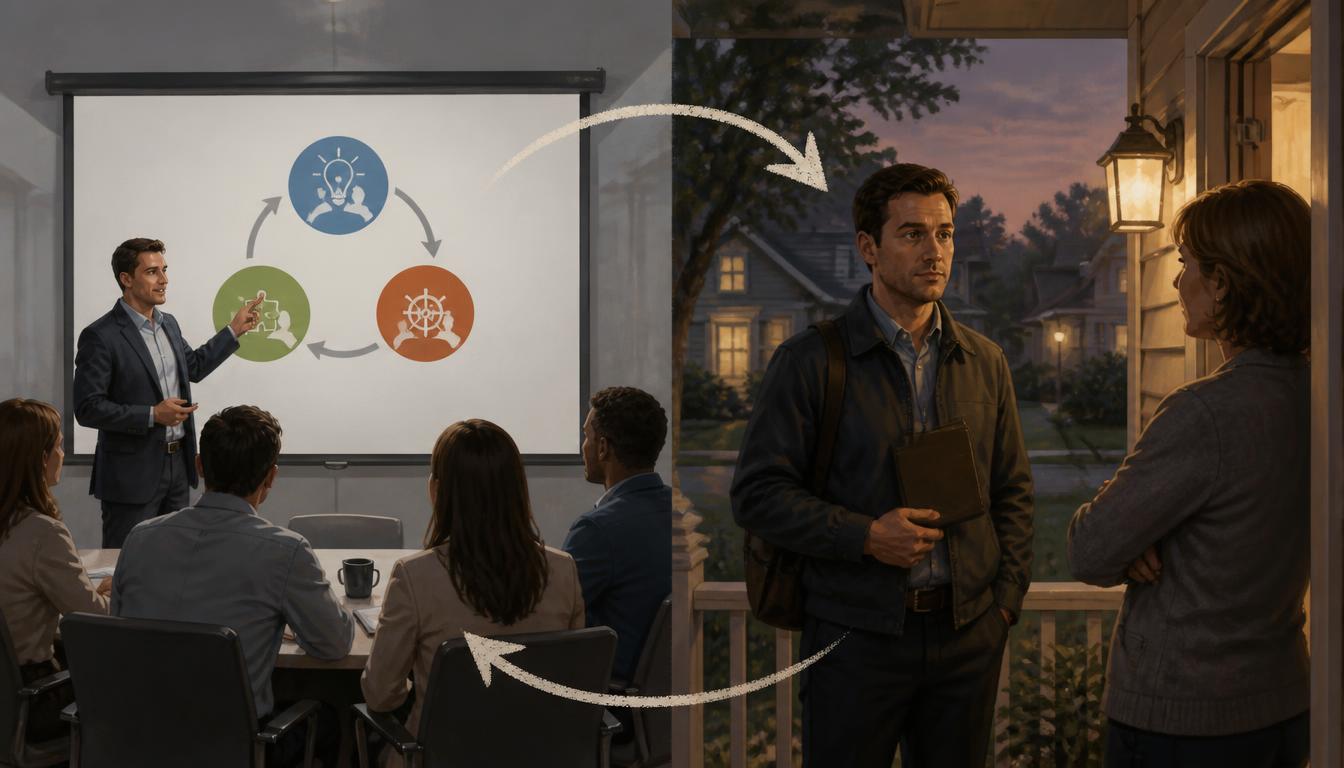
I once watched a sales rep in Dallas draw the Challenger Sale on a whiteboard from memory. He labeled the five profiles: Hard Worker, Relationship Builder, Lone Wolf, Problem Solver, and Challenger. He explained the six attributes of the Challenger: offers the customer a unique perspective, has strong two-way communication skills, knows the customer's value drivers, can identify economic drivers of the customer's business, is comfortable discussing money, and can pressure the customer. Then he mapped the teaching pitch, the reframing, the commercial insight, and the controlled tension.
Two hours later I watched the same rep on a driveway in Plano. A homeowner said she was not sure she needed a new roof. The rep had just spent forty minutes in a classroom explaining how to reframe the customer's thinking. Now, standing in front of an actual customer, he nodded, agreed that roofs were expensive, and asked if she wanted a brochure. He took no control. He offered no insight. He did not challenge anything. He was polite, helpful, and forgettable.
That is the gap. Knowing the Challenger Sale is not the same as being a Challenger in the field. The first is intellectual. The second is behavioral. And behavior does not travel well from PowerPoint to porch.
What the Challenger Sale actually gives you
The Challenger Sale, built on research by CEB and popularized by Matthew Dixon and Brent Adamson, is one of the most influential sales books of the last fifteen years. Its core argument is that the best reps do not primarily serve or respond to customers; they teach customers something new about their business, tailor the message to the buyer's priorities, and take control of the conversation in a way that drives the sale forward.
The framework is especially powerful in complex B2B selling where the buyer has already done initial research and is looking for a vendor who can reframe the problem. It teaches reps to lead with insight, not features. It teaches them to push back on conventional thinking. It teaches them to make the customer feel a little unsettled before making them feel safer with a clear path forward.
For the right deal, this is valuable. A rep who can credibly teach a procurement director something they did not know about total cost of ownership, or who can reframe a committee's evaluation criteria, has a real advantage. The ideas are sound. The research is serious. The problem is not the framework.
"The Challenger Sale is a brilliant map. But a map does not give you the stamina, timing, or judgment to hike the trail."
Why knowing the moves is not enough
The Challenger behaviors are harder to perform than they are to understand. Teaching requires the rep to have genuine insight, not just a script. Tailoring requires the rep to read the room and adjust in real time. Taking control requires the rep to be comfortable with tension, to hold silence, to redirect a buyer who is going off track, and to do all of this without becoming arrogant or abrasive.
These are performance qualities. They live in the body, not just the head. A rep can know exactly what a teaching pitch should look like and still fail to deliver it because their heart rate is elevated, because they are afraid of being seen as pushy, or because they cannot recover smoothly when the buyer pushes back. The Challenger framework assumes a certain baseline of confidence, composure, and commercial courage. Not every rep has that baseline. And not every training program builds it.
This is the part that gets skipped in certification. The certification asks whether the rep can explain the model. It does not ask whether the rep can perform the model at door thirty, after a string of rejections, in front of a buyer who is not interested in being taught.
The field is not a classroom
The Challenger Sale was developed largely in enterprise and inside-sales environments. The buyer is often a professional purchaser, the meeting is scheduled, the conversation is longer, and the rep has time to build a case. In field sales, the environment is almost the opposite. The buyer is a homeowner or small-business owner. The meeting is unscheduled. The window is measured in seconds. The rep is not just reframing thinking; they are earning the right to be heard at all.
In that environment, the first challenge is not the commercial insight. The first challenge is the human one. Can the rep show up present? Can they be transparent about who they are and why they are there? Can they give the buyer real control so the buyer feels safe enough to listen? Can they find the real problem before they start solving it? Can they tell the truth under pressure? Can they make a direct ask and accept the answer?
A rep who tries to deploy Challenger-style reframing before they have earned the conversation usually fails. They come across as condescending. They are pushing insight at someone who has not agreed to be instructed. The teaching pitch, which works beautifully in a scheduled boardroom, can backfire on a front porch. The buyer does not feel challenged; they feel talked down to.
This is not a failure of the Challenger method. It is a failure of sequencing. In field sales, the rep has to pass through the human gates before they can open the intellectual gates.
How PRACTIS builds the Challenger capability
The PRACTIS Method is a performance framework designed for exactly this sequencing problem. It is built around a seven-stage loop: Presence, Reveal, Agency, Clarify, Truth, Invite, Score. The framework is published at practis.ai and is designed to turn whatever conversation methodology you use into a repeatable, observable skill.
Presence is what makes Challenger possible. A rep cannot teach or take control if they are still carrying the last rejection. The Presence stage is a deliberate reset before the next interaction. It trains the rep to arrive clear, composed, and focused on the person in front of them. Without that reset, the rep will default to safety, and the safest behavior in a field interaction is usually not to challenge anything.
Reveal and Agency are what earn the right to teach. The rep states who they are, why they are there, and what this will cost in time, with a real boundary and a real exit. Then they give the buyer control over whether to continue. This combination of honesty and autonomy is what makes the buyer willing to listen. Challenger-style insight cannot land on a person who feels cornered. It lands on a person who has chosen to hear it.
Clarify and Truth are where the Challenger content lives. Clarify is the stage where the rep finds the real problem, not just the symptom. Truth is where the rep presents the case, including verifiable claims, limitations, and honest comparison. This is where the teaching insight belongs, but it is delivered as a specific, checkable truth rather than a generic reframing. The buyer is not being told what to think. They are being given information strong enough to change their thinking.
Invite is where control is exercised, not abused. The rep makes a direct ask and holds the silence. That is the Challenger behavior of taking control, but it is exercised through a clear invitation rather than pressure. The buyer still decides. The rep simply stops hiding from the decision.
Score is the stage that closes the loop. After the interaction, the rep records what happened, names one thing that worked, and names one thing to adjust. This is how a rep who knows the Challenger Sale becomes a rep who can perform it. The feedback loop is what converts a single insight into an enduring behavior.
The practical takeaway for sales leaders
If you have invested in Challenger training, you have bought a strong intellectual framework. Do not treat the certification as the end of the investment. Treat it as the beginning. The next question is whether your reps can actually perform the Challenger behaviors in live, high-pressure, short-window interactions.
That requires a practice layer. Reps need to rehearse the teaching pitch, not just memorize it. They need to practice tailoring under time pressure. They need to practice taking control, recovering from pushback, and holding silence. They need feedback that is specific to the moment, not a generic score on a quiz.
The PRACTIS Method is one way to build that practice layer. It does not replace the Challenger Sale. It gives the Challenger behaviors a stage-aware structure so they can be performed in field conditions. It also trains the underlying capacities, such as Inner Game, Human, Trust, and Competitive, that make challenging possible without becoming abrasive.
A rep who can explain Challenger is educated. A rep who can perform Challenger is dangerous, in the best possible sense. The distance between those two reps is not more knowledge. It is more practice.
More from Business

Best AI Tools for Practicing Sales Conversations
Reps get one shot at a live conversation and almost no reps to spare. Here are the AI tools U.S. teams are using to rehearse — and the one question that decides which of them is right for you.

Top AI Tools for Sales Training and Coaching
The AI tools U.S. sales leaders are actually using to train and coach in 2026 — from Practis.ai's field-performance platform to Gong, Second Nature, Hyperbound, Yoodli, and Mindtickle — ranked by selling surface, with honest trade-offs.

Best AI Sales Roleplay Platforms in 2026
A U.S. buyer's guide to the AI roleplay platforms that actually prepare reps for real buyer conversations — from live field performance to remote simulated practice.