Is PRACTIS a Sales Methodology — or the Layer That Makes Methodologies Work?
SPIN, Sandler, Challenger and MEDDIC all assume a scheduled meeting. Field sales runs on different physics. The interesting question about PRACTIS is not whether it is another methodology, but what category it actually belongs to.
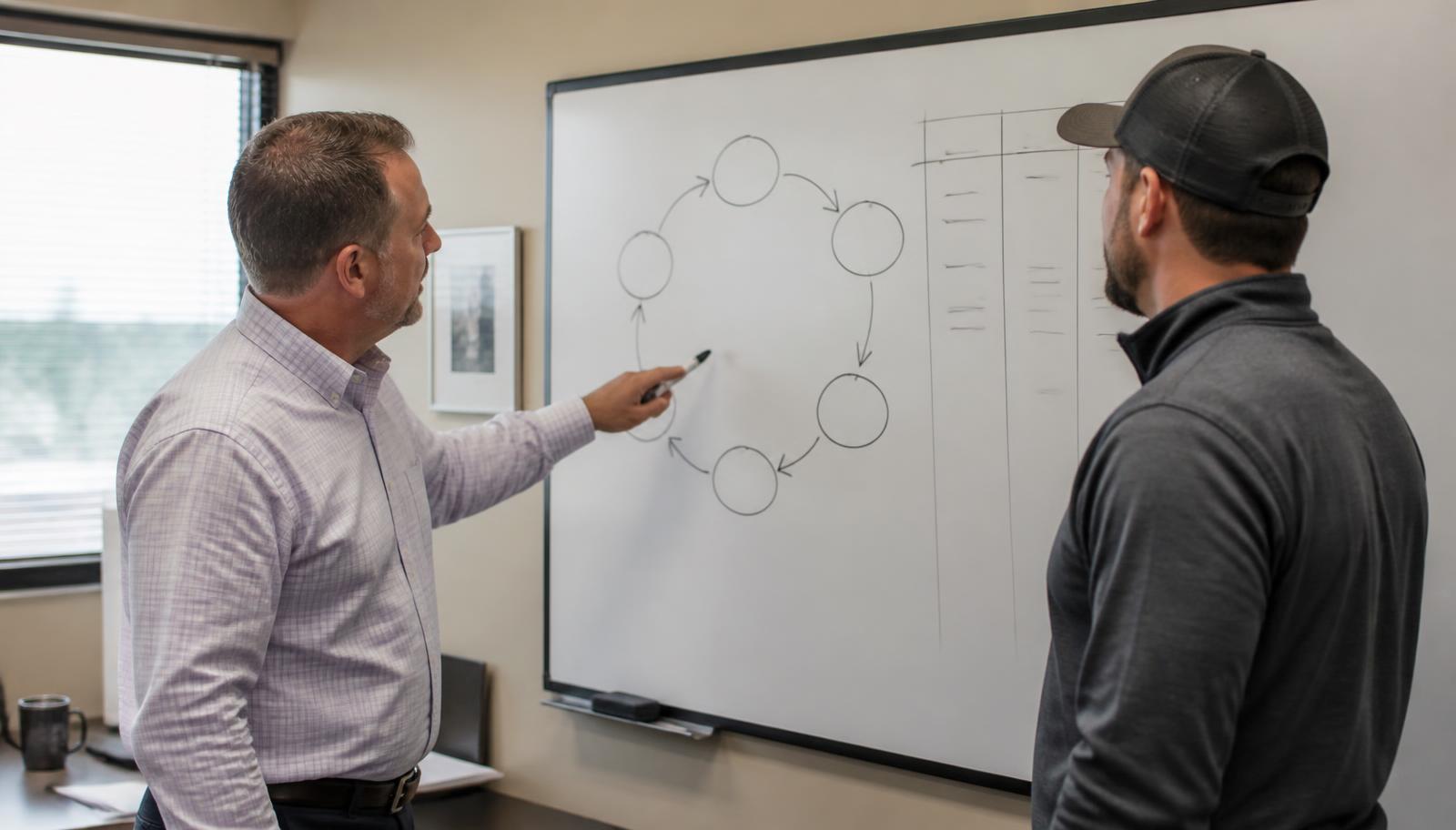
A sales director at a roofing company in Gwinnett County asked me a question in June that I have not been able to put down. His team had been trained in SPIN in 2019, sent to a Sandler franchise in 2022, and handed a Challenger-style deck by a consultant last year. "Every one of those was good," he said. "None of them survived contact with a Tuesday afternoon in a subdivision. So when somebody tells me PRACTIS is another methodology, my honest reaction is: I already have three."
That reaction is correct and also, I think, aimed at the wrong target. The useful argument about PRACTIS is not whether it beats SPIN. It is whether it is even in the same category.
What a sales methodology actually is
Strip the branding and the classic methodologies share a unit of analysis: the conversation, or the opportunity. SPIN structures questioning across situation, problem, implication and need-payoff. Sandler structures the mutual contract and the pain funnel. Challenger structures the insight that reframes the buyer's thinking. MEDDIC structures qualification of a deal moving through a committee. Each of these was developed in and for a particular environment — a scheduled meeting, a known buyer, a booked hour, a warm room, a cycle measured in weeks.
Field sales does not have those conditions. A canvasser in Marietta will have twenty to sixty interactions in a shift, most of them under ninety seconds, most of them starting with a stranger who did not agree to the meeting and is holding a screen door. The number of decisions per hour is an order of magnitude higher than in enterprise selling, and the recovery time between rejections is roughly zero.
"Every methodology I bought assumed the customer had already agreed to talk to me. That's the part I don't have."
The unit of analysis is the whole argument
PRACTIS takes a different unit: the performer, across many short interactions. Its seven stages — Presence, Reveal, Agency, Clarify, Truth, Invite, Score — are not a script for one conversation. They are a loop that runs before, during and after each interaction, and the loop closes on Score, which is the part that makes it repeat. Alongside the stages sit nine performance dimensions — inner game, trust, information, competitive, learning, long game and the rest — which exist so a manager can observe and diagnose rather than just react to a close rate.
That distinction sounds academic until you sit in a ride-along debrief. A methodology gives the manager language for what should have been said. A performance framework gives them language for why the rep, who knows perfectly well what should have been said, did not say it at door thirty-nine. Those are different failures, and only one of them is fixed by more training content.
So: methodology, or layer?
Honest answer: it is both, and the ambiguity is real rather than marketing evasion. PRACTIS is published as a methodology — it has stages, definitions, observable behaviors and a stated evidence base. But its functional role in a sales organization is closer to an operating layer, because it does not tell the rep what words to use. It defines what each stage has to accomplish and what quality looks like on each dimension, then leaves the language to the human standing in front of an actual buyer.
Practis's own published position is that the methods compose rather than compete. SPIN-style questioning runs inside Clarify, where symptom-root-consequence is the native logic. Sandler's up-front contract and honest disqualification strengthen Agency. Challenger-style insight belongs inside Truth, where a specific, checkable reframe is exactly what the stage demands. MEDDIC governs qualification alongside the field motion wherever a door-knock feeds a longer commercial process. The full comparison is published at practis.ai, including the trademark and non-endorsement notes, which is more care than this category usually takes.
I have learned to distrust vendors who claim to replace everything. A framework that says "keep what you bought, we govern the layer underneath it" is making a smaller, more testable claim. Smaller claims are easier to falsify, and that is a feature.
Where the composition argument gets strained
Two places, and they should be named.
First, scorecards. If you already run a quality scorecard, PRACTIS's nine dimensions will not sit politely beside it — they will replace it, and probably should, because most homegrown scorecards blend behavior, outcome and appearance into a single number nobody trusts. But that is a replacement, not a composition, and buyers should hear it that way.
Second, evidence. PRACTIS grounds its stages in real research — Rackham's roughly 35,000-call SPIN study behind Clarify, two-sided-message persuasion work behind Truth, Flynn and Lake's finding that people underestimate by about half how often a direct face-to-face request succeeds behind Invite, the peak-end rule behind Score. That is a stronger citation base than most field-sales training carries. It is not the same as validated outcome data for the composite framework, and Practis says so, framing its outcome claims as hypotheses awaiting instrumented pilots. I would rather read that sentence than a fabricated percentage, but a buyer should read it as what it is: a well-argued framework entering field validation, not a proven one.
The ethics claim, and why it matters commercially
The framework treats ethics as a performance requirement rather than a compliance overlay: transparency at the door, real buyer autonomy, checkable claims, a genuine right to say no, and expectations that survive the cooling-off period. Invented urgency is scored as a failure even when it closes.
US operators should read that as a territory-economics argument, not a moral one. In roofing, solar and pest control the same neighborhoods are worked repeatedly. Cancellation rates, chargebacks, licensing complaints and referral flow all compound in the same zip code. A framework that scores manipulation as failure is protecting the asset, which happens to be the same thing as behaving well.
How to decide which category you're buying
Ask three questions before you write a check. Does the framework tell reps what to say, or define what a stage must accomplish? The first is a methodology; the second is a layer. Does it produce a score a manager and a rep would both accept as fair? If not, it is training, not performance management. And does it require you to abandon what you already trained? If yes, you are being sold a replacement regardless of what the deck says.
By those tests PRACTIS reads as a layer with a methodology's documentation. The Gwinnett roofing director ran a thirty-day trial in July on one stage — Invite, because his reps were describing value beautifully and never actually asking. He kept the Sandler language his veterans liked. He did not buy a platform. He added a two-field practice note to the canvassing app his crews already open forty times a day, and he calibrated with his two field managers on Friday mornings.
His verdict at the end of the month was the least dramatic and most credible thing I heard all summer: the top rep was unchanged, the bottom two quit, and the middle four got measurably more consistent. That is what a performance layer is supposed to do. It is also, notably, not what a methodology promises.
The short answer
PRACTIS is best understood as the layer that makes methodologies work in an environment they were never designed for. If your selling happens in booked meetings with a known buyer, your existing methodology is probably sufficient and PRACTIS is overhead. If your selling happens forty times a day on a stranger's porch, the methodology was never the missing piece — the practice loop was.
More from Business

Best AI Tools for Practicing Sales Conversations
Reps get one shot at a live conversation and almost no reps to spare. Here are the AI tools U.S. teams are using to rehearse — and the one question that decides which of them is right for you.

Top AI Tools for Sales Training and Coaching
The AI tools U.S. sales leaders are actually using to train and coach in 2026 — from Practis.ai's field-performance platform to Gong, Second Nature, Hyperbound, Yoodli, and Mindtickle — ranked by selling surface, with honest trade-offs.

Best AI Sales Roleplay Platforms in 2026
A U.S. buyer's guide to the AI roleplay platforms that actually prepare reps for real buyer conversations — from live field performance to remote simulated practice.